The Grail That Time Forgot
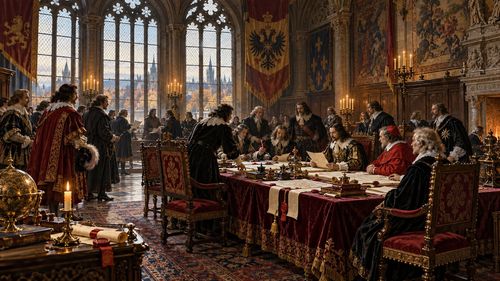
Sometime around the year 1300 — when Edward I sat on the English throne, when Dante Alighieri was beginning work on the Divine Comedy, when the city of Paris was the largest in Europe and the Black Death was still half a century away — an unknown scribe in the French city of Metz sat down with a quill, a stack of vellum, and a pot of gold leaf, and began to copy out the greatest stories of his age. The result was the Clermont-Tonnerre Grail: 126 illuminated miniatures and hundreds of pages of Old French prose telling the story of King Arthur, Merlin the shape-shifting magician, the Knights of the Round Table, and the Quest for the Holy Grail. For the next 700 years, it passed through private hands — a 15th-century knight, a Victorian collector, a French industrialist who won honors in two world wars — and was never exhibited publicly, never fully studied by scholars, never seen by the wider world. This morning, Christie's announced it will go to auction in London on July 8, with an estimated price of up to $2.7 million. For the first time in seven centuries, the world will have a chance to know where the Clermont-Tonnerre Grail ends up next.
The Text That Built a Legend
The stories contained in the Clermont-Tonnerre Grail belong to what scholars call the Lancelot-Grail Cycle — also known as the Vulgate Cycle — a vast, anonymous prose epic written in Old French between approximately 1210 and 1235 that synthesized and expanded the Arthurian legends into the most complete and influential version the Middle Ages produced. It is the text from which Thomas Malory drew most heavily when he composed Le Morte d'Arthur in the 1460s — the book that gave the English-speaking world its definitive King Arthur, the one from which every subsequent film, novel, musical, and retelling ultimately descends. The Lancelot-Grail Cycle invented or codified nearly everything readers recognize as Arthurian: the love affair between Lancelot and Guinevere as the fatal flaw at the heart of Camelot, the spiritual dimension of the Grail quest, Merlin as a figure of half-devilish and half-divine origin, the chivalric code of the Round Table as a governing ideal. The Clermont-Tonnerre Grail is one of the earliest surviving manuscripts of this cycle — written within living memory of the cycle's composition, in the very dialect and tradition that produced it — and it is, by the assessment of Christie's medieval manuscripts specialist Dr. Eugenio Donadoni, both the oldest and the most heavily illustrated of the only three comparable manuscripts known to remain in private hands anywhere in the world.
Its 126 miniature illustrations — painted on vellum with gold leaf in the style of Gothic illumination — include images that scholars have had almost no opportunity to study. Among them: Merlin transformed into a talking stag, one of the rarest visual depictions of the shape-shifting enchanter in any surviving medieval manuscript. The three texts it contains cover the History of the Holy Grail, the Origins of Merlin, and some of Merlin's early adventures with Arthur — the foundation stories on which everything that followed in the legend was built. Some 200 copies of various parts of the Lancelot-Grail Cycle survive in institutions around the world. Of those, only seven are complete. Very few belong to private collectors — and of those, this manuscript is the oldest. The Rochefoucauld Grail, a comparable manuscript, sold at Sotheby's in 2010 for $3.2 million. Scholars are hoping whoever buys the Clermont-Tonnerre Grail in July will be a public institution. "It should interest institutions," Donadoni told Artnet, "because it's a virtually unknown manuscript of one of the greatest medieval romances." The manuscript has never been fully accessible to researchers. Every page of it is, in a meaningful sense, new.
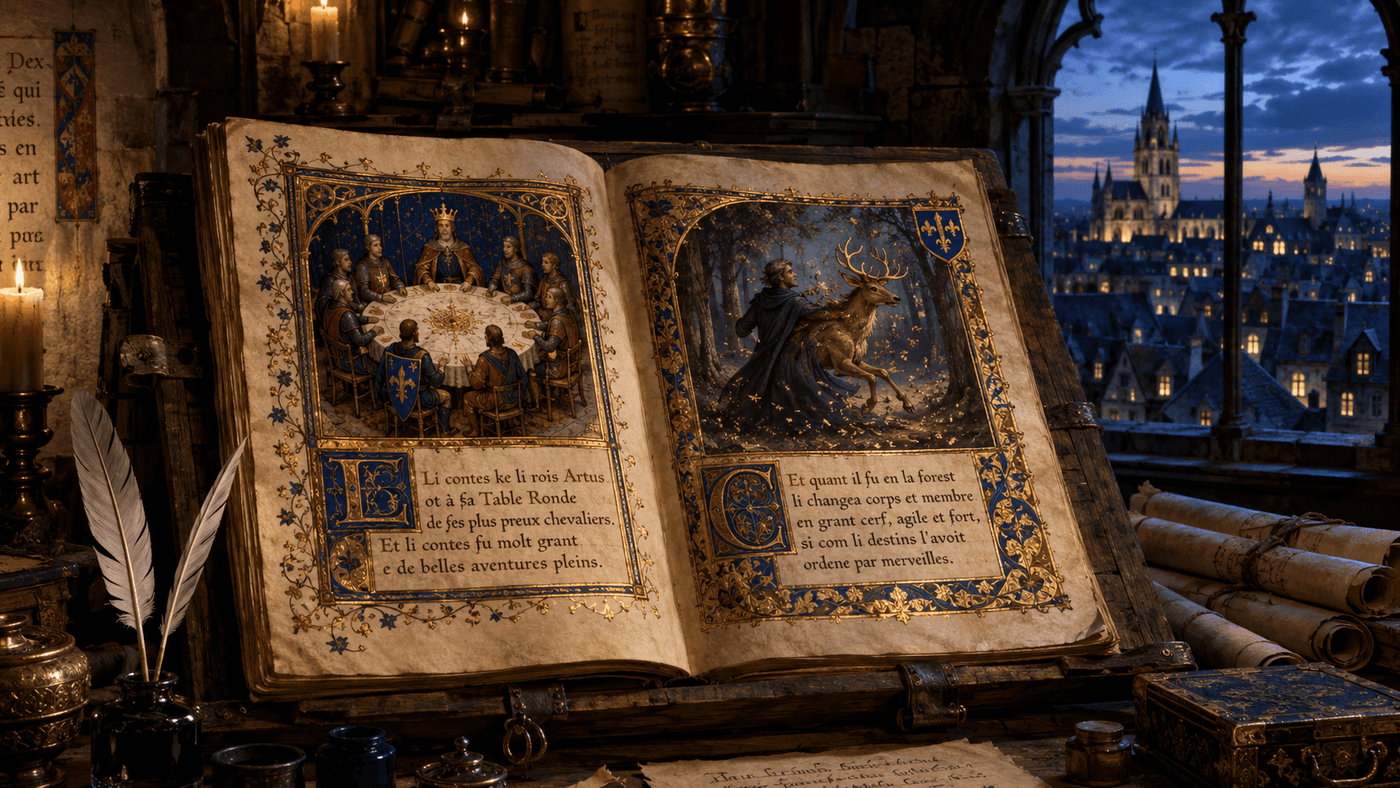
The King Arthur that most of the world knows — the sword in the stone, the Round Table, the love triangle, the Grail, the island of Avalon — is not a historical figure but a literary one, assembled across centuries by writers who added, elaborated, and transformed the legend to reflect the values and anxieties of their own ages. The unknown scribe who copied the Clermont-Tonnerre Grail in Metz around 1300 was doing the same thing the Lancelot-Grail's original anonymous authors had done: transmitting and preserving stories that seemed to matter, that captured something about honor and failure and the gap between the ideals a civilization holds and the human weakness that undoes them. Seven hundred years later, those stories are still being told — in films, in novels, in games, in every culture on earth that has absorbed the Arthurian myth. On July 8 at Christie's in London, the manuscript that carried some of those stories across the medieval world goes under the hammer. Somewhere in its 126 gold-leaf illuminations is Merlin, mid-transformation, becoming a stag — caught in the moment of becoming something else, as the legend has always been, as it will continue to be for whoever reads it next.