June 22: Benefits, Bills, and a Quarter Mile at a Time
June 22 is a day for bold wagers. In 1944, a president signed a piece of legislation that would reshape American society more profoundly than almost any law of the twentieth century — sending millions of veterans to college, into homes, and into the middle class in a single generation. One hundred and sixty-nine years earlier, a Continental Congress with no treasury, no bank, and no guarantee of victory printed its first money and dared to call it currency. And in 2001, a modest action film about street racing opened in theaters and quietly launched one of the most improbable franchises in Hollywood history. Three bets on what was possible. Three payoffs nobody fully predicted.
The Bill That Built the Middle Class
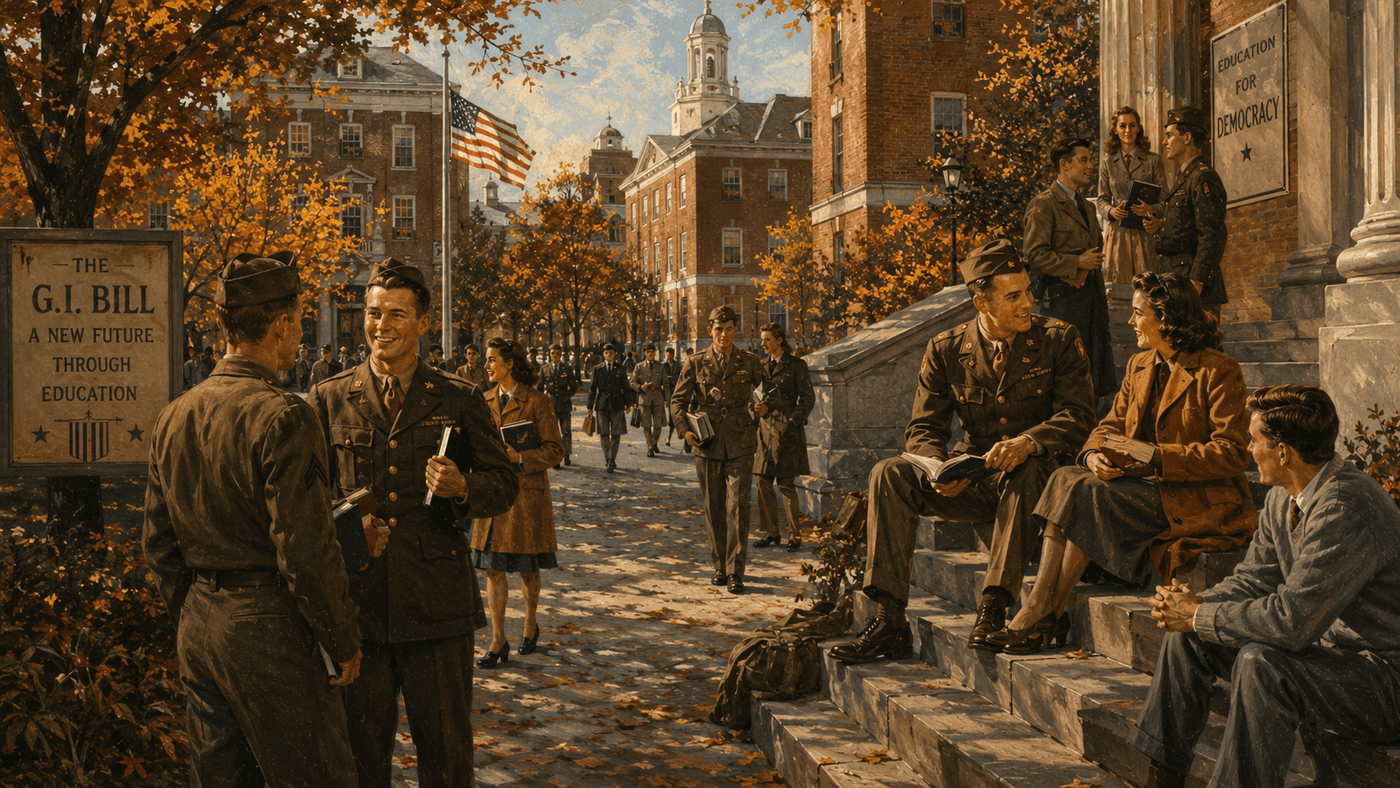
On June 22, 1944, President Franklin D. Roosevelt signed the Servicemen's Readjustment Act — the G.I. Bill — into law, setting in motion one of the most ambitious and consequential pieces of social legislation in American history. The war in Europe was not yet over; D-Day had taken place just sixteen days earlier. But Congress and the Roosevelt administration were already planning for what would come after: the return of some sixteen million servicemen and women to civilian life, and the very real possibility that without support, they would come home to the same economic devastation their parents had faced after the First World War. The G.I. Bill was the answer — a suite of benefits that included college tuition, low-interest home loans, unemployment insurance, and job training, offered to any honorably discharged veteran.
The scale of what followed was staggering. By 1956, nearly eight million veterans had used G.I. Bill benefits to attend college or vocational school — more than double the number who had enrolled in higher education in the entire previous decade. The Federal Housing Administration, working in tandem with G.I. Bill home loan guarantees, financed the construction of the postwar suburbs that reshaped the American landscape. A generation of Americans who might never have attended college, owned a home, or started a business were given the tools to do all three. The law was not without its failures: many Black veterans were systematically denied access to its benefits through discriminatory implementation at the local level, deepening the racial wealth gap the law might have helped close. But for those who could access it, the G.I. Bill did something no legislation before it had quite managed: it made the middle class not just possible but probable, for millions of Americans at once.
Not Worth a Continental
On June 22, 1775, the Second Continental Congress authorized the issuance of two million dollars in Continental Currency — paper money backed by nothing more than the collective promise of thirteen colonies that had just picked a fight with the most powerful empire on earth. The decision was born of necessity: the Continental Army needed to be paid, supplied, and equipped, and the Congress had no power to levy taxes and no gold or silver to draw upon. Paper money was the only tool available. The bills were printed and distributed, bearing the Latin motto Fugio — "I fly," a reference to the passage of time — and the optimistic instruction: "Mind Your Business." They were accepted, initially, because the revolution required it.
The experiment did not go well. As the war dragged on and Congress printed more and more currency to meet its obligations, inflation ran rampant. By the end of the Revolutionary War, Continental Currency had lost nearly all of its value — giving rise to the phrase "not worth a Continental," which entered the American vernacular as a synonym for worthlessness. The lesson was painful and direct: a currency is only as strong as the government behind it, and a government without taxing power or hard reserves is not much of a government at all. The failures of Continental Currency were a primary motivation for the Constitutional Convention of 1787, which gave the federal government the power to coin money and regulate its value. The bills that Congress authorized on June 22, 1775, were among the most important failures in American financial history — teaching the founders, at considerable cost, exactly what they would need to get right.

Quarter Mile at a Time
On June 22, 2001, The Fast and the Furious opened in theaters across the United States with a production budget of $38 million and expectations that were, by Hollywood standards, modest. Directed by Rob Cohen and starring Vin Diesel and Paul Walker, the film followed an undercover cop who infiltrates the world of Los Angeles street racing and finds himself drawn into the loyalty and kinship of the crew he was sent to bring down. Critics were mixed. Audiences were not. The film grossed $207 million worldwide, far exceeding its budget, and introduced a set of themes — family, loyalty, the brotherhood of the road — that would prove remarkably elastic across sequels, spinoffs, and a franchise that studios would spend the next two decades expanding in every possible direction.
What no one in 2001 could have predicted was just how far that quarter mile would go. The Fast and the Furious franchise has since grown into one of the highest-grossing film series in history, generating more than $7 billion at the global box office across ten mainline films, multiple spinoffs, and an animated series. The movies evolved from street-racing crime thrillers into globe-spanning action spectacles — a tonal journey so extreme it became its own kind of cultural commentary on American excess and appetite. The franchise also became notable for its unusually diverse ensemble cast at a time when Hollywood was still resistant to such choices, a fact that helps explain its extraordinary international reach. The first film's most enduring legacy may be personal rather than cinematic: Paul Walker, who died in a car accident in 2013, is remembered with genuine grief by the franchise's fans in a way that few movie characters inspire. The Fast and the Furious was always, at its core, a story about family. It turned out that was the part audiences believed most.