The Sun Stands Still
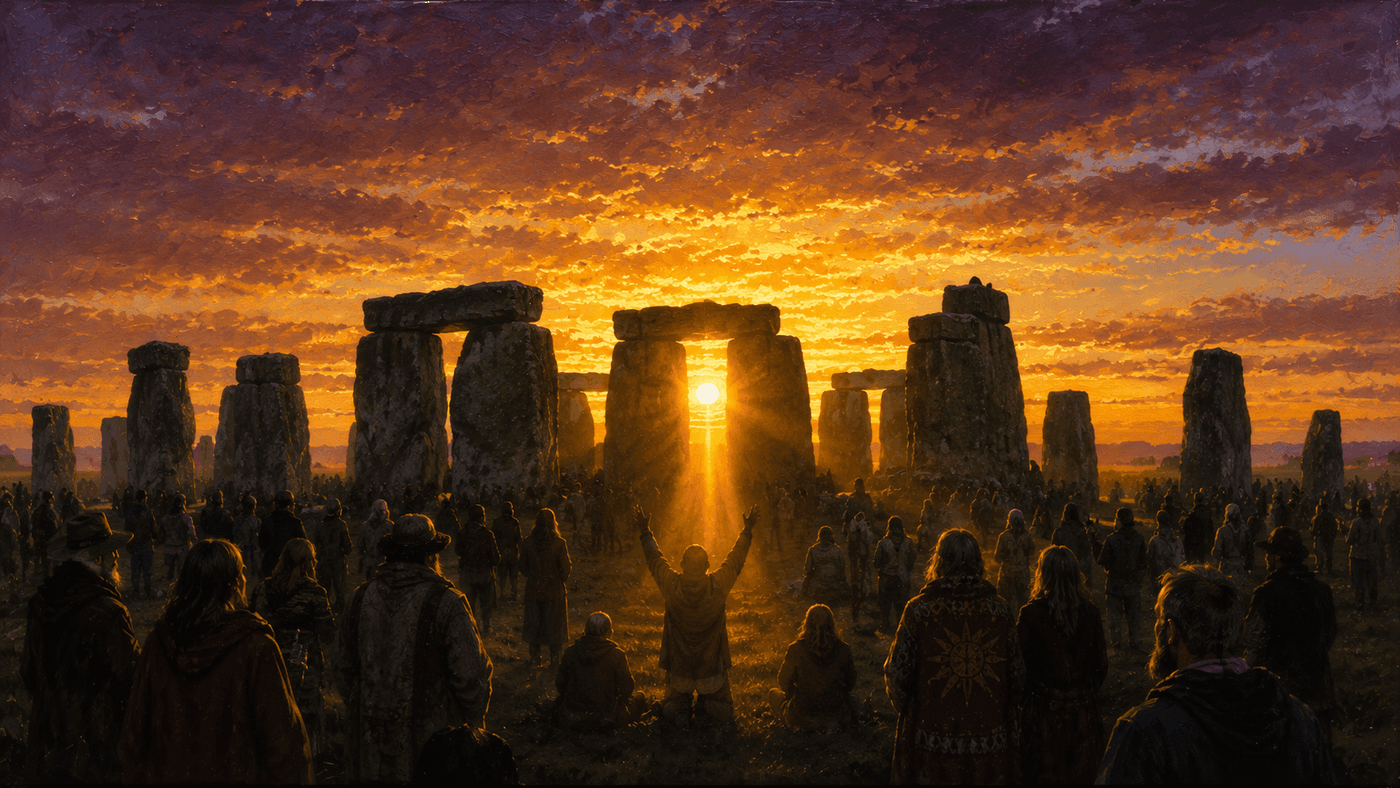
This morning at 4:24 a.m. Eastern time — 3:24 a.m. in the Central time zone — the summer solstice arrived: the precise instant when the Earth's Northern Hemisphere reaches its maximum tilt toward the Sun, producing the longest stretch of daylight in the entire year. It is not an event that lasts a day. It is a single moment, calculated to the second by astronomers, that has been anticipated by humans across every culture on Earth for thousands of years. At Stonehenge, in Wiltshire, England, thousands of visitors stood among the ancient stones at dawn as the rising Sun cleared the Heel Stone and sent its first rays through the monument's central axis — an alignment the monument's builders engineered more than 4,000 years ago, when midwinter and midsummer tracking was the most important technology a civilization could possess. Today, on the same longest day, the U.S. Open Championship concludes at Shinnecock Hills and World Cup matches continue across three countries. The world has never found a more complicated way to spend its longest day.
Sol + Sistere: The Sun That Stopped
The word "solstice" comes from the Latin sol — sun — and sistere — to stand still. It captures something ancient observers genuinely noticed: in the days surrounding the solstice, the Sun's rising and setting positions along the horizon appear to stop their northward drift, pause, and then slowly reverse toward the south. The Sun seems to hesitate. To ancient civilizations without clocks or calendars, tracking this moment was not a curiosity but a survival skill. Knowing when the days would start growing shorter meant knowing when to plant, when to harvest, when to prepare for winter. The monuments built around this knowledge — Stonehenge in England, Newgrange in Ireland, Chichén Itzá in Mexico, the Goseck Circle in Germany — are among the oldest intentional structures on Earth. The Great Pyramids of Egypt are oriented so that on the solstice, the Sun sets precisely between the two largest pyramids when viewed from the Sphinx. These were not accidents. They were the scientific instruments of their age.
The celebrations that grew around the solstice are as varied as humanity itself. Scandinavian midsummer festivals — Midsommar — involve bonfires, flower crowns, maypoles, and feasting that continues through the short Nordic night, which at high latitudes barely darkens at all. The ancient Romans celebrated Vestalia in honor of the goddess of the hearth. The Inca marked the winter solstice in the Southern Hemisphere with Inti Raymi, the Festival of the Sun, which is still celebrated in Peru each June 24. Indigenous peoples across North America have marked the solstice with ceremony for millennia. In China, the summer solstice has traditionally been associated with the feminine principle yin, and festivals honoring the Earth and femininity have been observed for centuries. The specifics differ. The impulse — to stop, look up, and mark the moment the Sun reaches its highest point — is universal.
Today is also Father's Day — and Scottie Scheffler's 30th birthday, as he plays the final round of the U.S. Open at Shinnecock Hills in pursuit of the career Grand Slam. It is the day the FIFA World Cup plays its first full slate of matches on American soil. It is the longest day of the year, which means it is also the first day the days begin to shorten again — a bittersweet astronomical truth that ancient peoples understood intuitively. The solstice is simultaneously a peak and a turning. From this morning forward, each day will be slightly shorter than the last until December's winter solstice brings the cycle back around. The Sun stood still at 4:24 a.m. this morning. Then it began its long, slow walk back toward winter. For now, though: it is June 21, the sky is bright at 8 p.m., and the longest day of 2026 stretches beautifully ahead.