July 8: The Bell, the Base, the Great Leader
History has a way of announcing itself — with the toll of a bell, with gunfire in the dark, with a state broadcast read in a voice trained to betray nothing. July 8 has heard all three. In 1776, a bronze bell called colonists to hear words that would define a republic. In 1959, two soldiers died in a country most Americans couldn't yet find on a map, and a long war began to announce itself in blood. In 1994, a Korean state broadcaster told the world that its founding father was gone — and the world held its breath to see what would come next. Three moments of announcement, across three centuries, each one reshaping what came after.
Proclaim Liberty
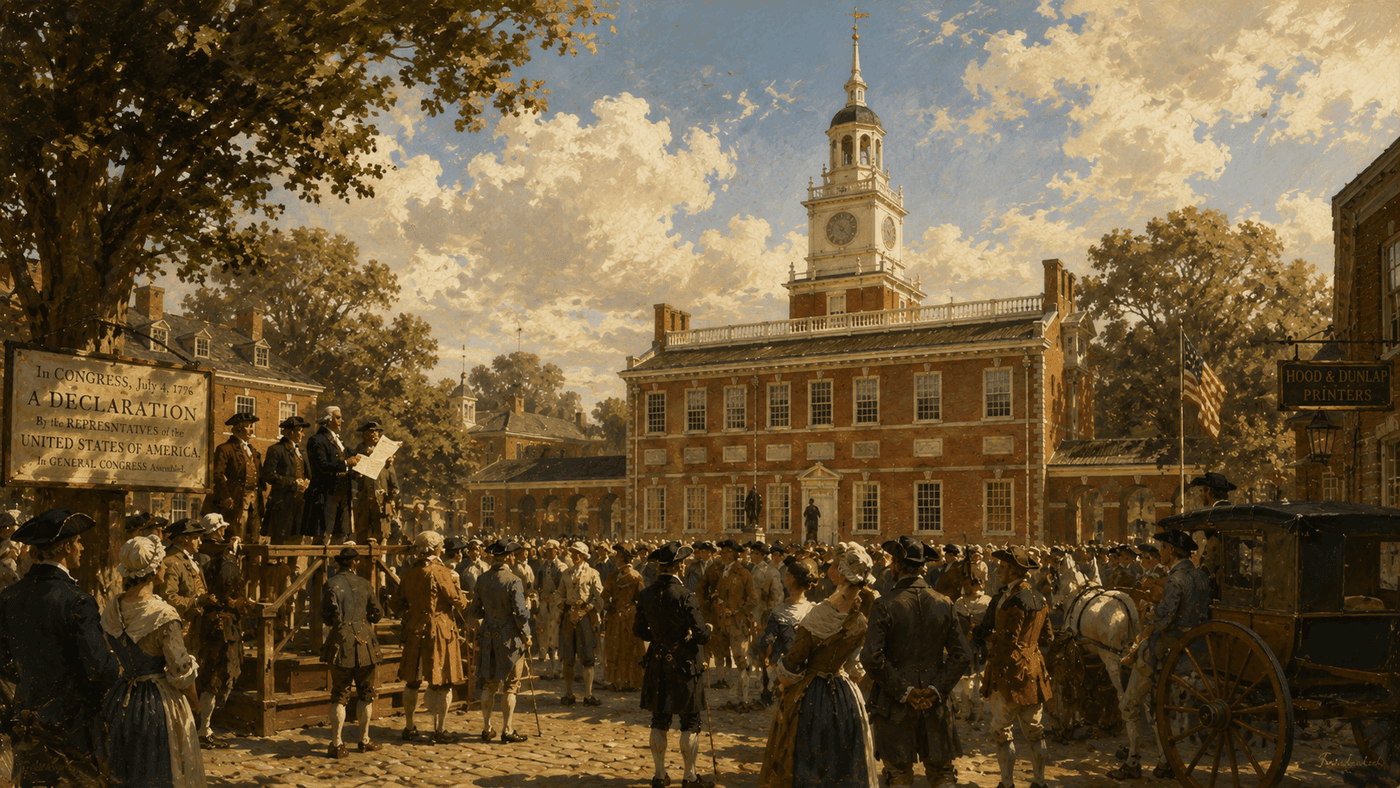
On July 8, 1776, four days after the Continental Congress formally adopted the Declaration of Independence, a bell rang from the tower of the Pennsylvania State House in Philadelphia and called the city's residents into the street. What followed was the first public reading of the Declaration — the moment when the document ceased to be a political resolution passed in a closed chamber and became, instead, a proclamation made to the people in whose name it had been written. The crowd that gathered in the cobblestone courtyard below heard, for the first time aloud, that their ties to the British Crown had been dissolved, and that the government those ties had sustained derived its just powers from the consent of the governed. The bell that called them was already old — cast in London in 1752, recast twice after cracking — and bore an inscription from Leviticus: Proclaim Liberty Throughout All the Land Unto All the Inhabitants thereof.
The bell would not acquire its now-famous name until the 1830s, when abolitionist societies adopted it as a symbol of their cause — drawn, pointedly, to that Leviticus inscription and to the crack that had rendered the bell silent. By then it had already rung for decades of civic occasions: the deaths of Washington and Franklin, the visit of Lafayette, the anniversaries of independence. The crack that silenced it permanently is thought to have widened during a ringing for George Washington's birthday in 1846. It has not rung since, but it has not needed to. The Liberty Bell has become one of the most recognized objects in American history — a 2,000-pound piece of bronze whose meaning has been argued over, claimed, and reclaimed by nearly every movement that has ever insisted America live up to its founding words.
Bien Hoa
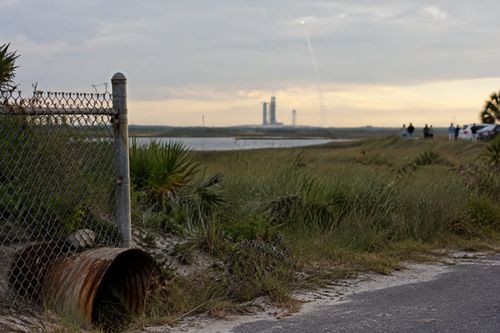
On the evening of July 8, 1959, Major Dale R. Buis and Master Sergeant Chester M. Ovnand were watching a movie at their quarters at Bien Hoa Air Base in South Vietnam when Viet Cong guerrillas infiltrated the compound and opened fire. Both men were killed — the first Americans to die in what would become the longest and most divisive war in the nation's history. They were serving with the Military Assistance Advisory Group, part of the Eisenhower administration's effort to bolster the South Vietnamese government against communist insurgency without committing American combat troops. Their deaths drew little attention at the time. The United States was not at war, officially. These were advisors. The casualty count that would eventually reach more than 58,000 names had begun.
The names of Buis and Ovnand appear at the very top of Panel 1E of the Vietnam Veterans Memorial in Washington, D.C. — the first names on a wall that stretches for nearly 500 feet and lists the dead in the chronological order in which they fell. Maya Lin's design places the first casualties at the center of the wall, so that visitors must walk its entire length to reach the beginning. Buis and Ovnand are at the end of that walk, or the start of it, depending on which direction you choose. Either way you arrive at them: two men in a darkened room, a movie interrupted, and the quiet opening of something enormous.

The Succession
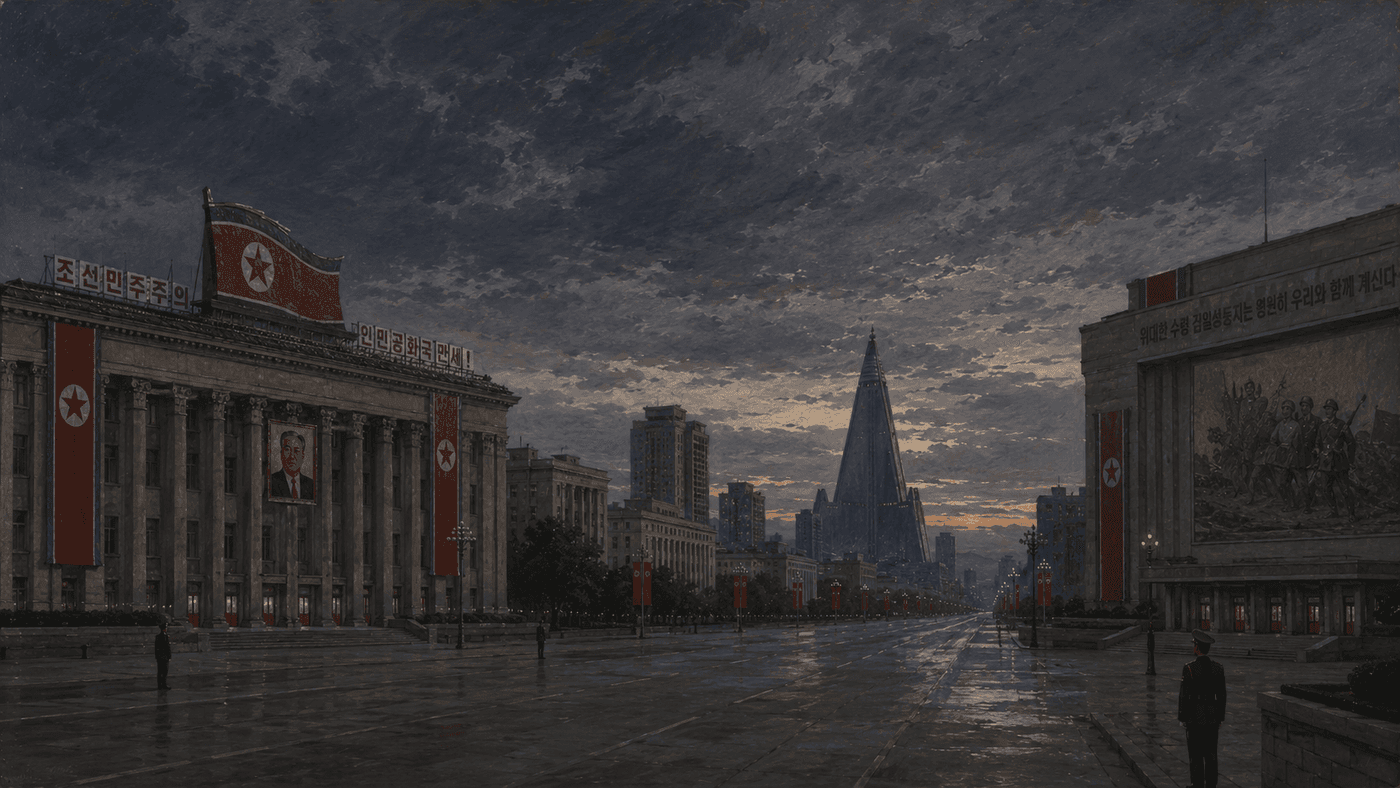
On July 8, 1994, North Korean state radio interrupted its regular programming to announce that Kim Il-sung — the nation's founder, its "Great Leader," the man whose portrait hung in every home in the country by law — had died of a heart attack at the age of eighty-two. He had ruled North Korea since its founding in 1948, constructing one of the most isolated and total authoritarian systems in modern history: a state apparatus built around a personality cult so comprehensive that Kim's ideology, his image, and his family line had become indistinguishable from the nation itself. His death came at a fraught moment — North Korea's nuclear ambitions had brought it into direct confrontation with the United States, and a summit with South Korean President Kim Young-sam, which might have eased decades of division, had been scheduled for just weeks later. It was canceled.
What followed Kim Il-sung's death was something the world had not seen before: the orderly hereditary transfer of power within a communist state. His son, Kim Jong-il, assumed control — beginning a succession that would pass, upon Jong-il's death in 2011, to his own son, Kim Jong-un, the current leader. The grief displayed by North Koreans in the days after the announcement was, by any external measure, extraordinary — mass public mourning of an intensity that observers attributed to both genuine feeling and the rational calculus of life in a surveillance state. Kim Il-sung himself was not buried but embalmed and placed on permanent display in Pyongyang's Kumsusan Palace of the Sun, where he remains today — the dead founder of a living dynasty, the Great Leader who never quite left.