July 6: A Court, a Secret, a Commission
History's most important moments are often acts of refusal — a refusal to accept the boundaries drawn by others, to disappear quietly, to concede that the world as it is must be the world as it stays. On July 6, across three different decades, three stories unfolded that share exactly that refusal. A young woman in Amsterdam chose concealment over surrender. A tennis player in London walked onto a grass court and dismantled a barrier that had stood for generations. And eighty-one women in Annapolis pinned on their ensigns and reported for duty in an institution that had spent 131 years insisting they had no place there.
Althea
On July 6, 1957, Althea Gibson walked onto Centre Court at the All England Club in Wimbledon and defeated Darlene Hard 6–3, 6–2 to become the first African American ever to win a Grand Slam singles title at the tournament. It was a performance of controlled dominance — Gibson, tall and athletic, dictating play from the baseline and net with a power and precision that left Hard few answers. The victory came a decade after Jackie Robinson had broken baseball's color barrier, and it carried the same historic weight: tennis, with its country club origins, its white linens and strawberries-and-cream decorum, had long been among the most exclusionary of major sports. Gibson had spent years fighting simply to compete.
Gibson had grown up in Harlem, the daughter of South Carolina sharecroppers, and learned tennis on the paddle tennis courts of 143rd Street before being taken under the wing of Black tennis clubs and mentors who recognized her extraordinary talent. She was barred from competing in major tournaments for years because of her race, admitted only after a campaign led by former champion Alice Marble, who wrote a forceful public letter demanding Gibson be allowed to compete. Once she was, she did not simply compete — she won. In 1957 and 1958 she claimed both Wimbledon and the U.S. National Championships, and she did it while navigating a sports world that offered Black athletes almost no commercial infrastructure or financial reward. She later became the first African American to compete on the women's professional golf tour, and she has never received the lasting recognition her achievements demand.

The Secret Annex
Fifteen years before Gibson's victory, on July 6, 1942, thirteen-year-old Anne Frank and her family slipped out of their Amsterdam apartment and into hiding. They had received a deportation notice for Anne's older sister Margot — and Otto Frank, who had been quietly preparing a concealed space behind his office at Prinsengracht 263 for months, made the decision to disappear immediately. The family moved through the city in layers of clothing — it was too dangerous to carry luggage — and entered a hidden annex reachable only through a bookcase-covered door. They would not leave it for two years. Four of Otto's trusted employees, at enormous personal risk, became their lifeline — smuggling in food, news, books, and the small human comforts that made survival bearable.
Anne had received a diary as a birthday gift the previous month and had already begun writing in it. In the annex, it became her primary companion — a place to record the fear, boredom, longing, and astonishing inner life of a young woman confined to a few small rooms while the world outside grew more dangerous by the day. The annex was discovered by the Gestapo on August 4, 1944, and all eight inhabitants were arrested and deported. Anne died of typhus in Bergen-Belsen concentration camp in February 1945, weeks before the camp's liberation. Otto Frank, the only survivor among the eight, returned to Amsterdam and arranged for his daughter's diary to be published. The Diary of a Young Girl has since been translated into more than seventy languages and remains one of the most widely read documents of the twentieth century — a testament to the interior life of a girl the world tried to make invisible.

First in Class
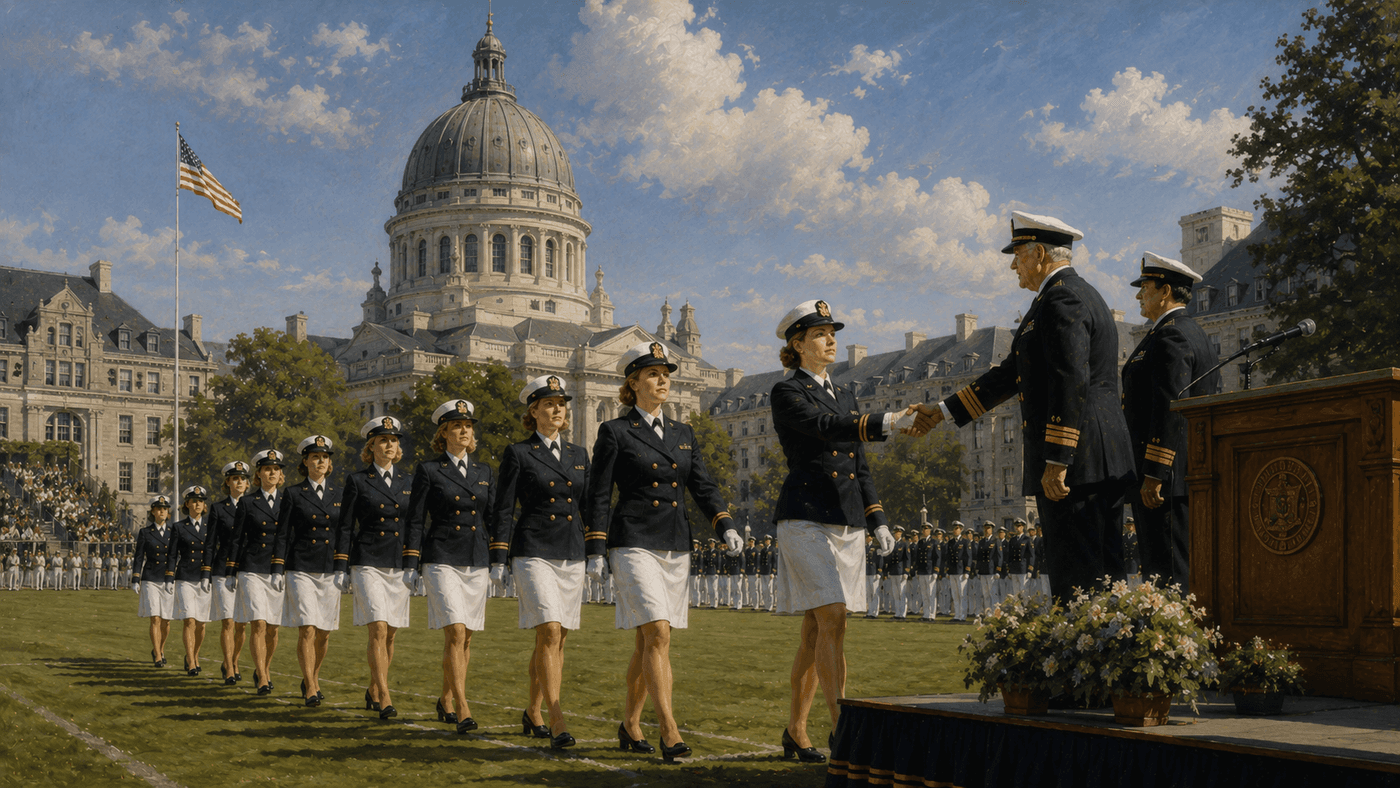
On July 6, 1976, eighty-one women graduated from the United States Naval Academy in Annapolis, Maryland, becoming the first female commissioned officers in the Academy's 131-year history. Congress had authorized the admission of women to the service academies the previous year, and the class of 1980 — which would graduate in 1980 — had entered Annapolis the previous summer as plebes. The 1976 graduates were transfer students, admitted under a separate provision, but their commissioning was no less historic for it: eighty-one women raised their right hands and were sworn in as ensigns in the Navy and second lieutenants in the Marine Corps, stepping into roles the institution had spent more than a century insisting were not for them.
The road they had traveled to that ceremony was not a smooth one, and the road ahead would be harder still. Female midshipmen faced resistance from classmates, from officers, and from an institutional culture that had no infrastructure — physical, social, or psychological — for their presence. They were assigned separate physical standards that were then used against them as evidence of unsuitability. They were excluded from combat roles that defined promotion pathways. And yet they graduated, commissioned, and served — and the women who followed them in the decades after pushed those barriers steadily back. Today women make up roughly twenty percent of the Naval Academy's brigade of midshipmen, command ships, lead squadrons, and have achieved flag rank across every branch of the armed forces. It began with eighty-one women on a parade ground in Annapolis.