July 5: A Sheep, a Swimsuit, and a Street Preacher
Some of history's most consequential inventions arrive without fanfare — a lamb born in a Scottish laboratory, a scrap of fabric unveiled at a Parisian pool, a Methodist minister standing on a street corner in London's East End. July 5 has a gift for quiet beginnings with enormous afterlives. The three events it holds span more than a century and three different countries, but they share a stubborn refusal to accept that things must stay as they are. Each one rewrote the rules — of biology, of fashion, of what a society owes its most vulnerable members.
Hello, Dolly
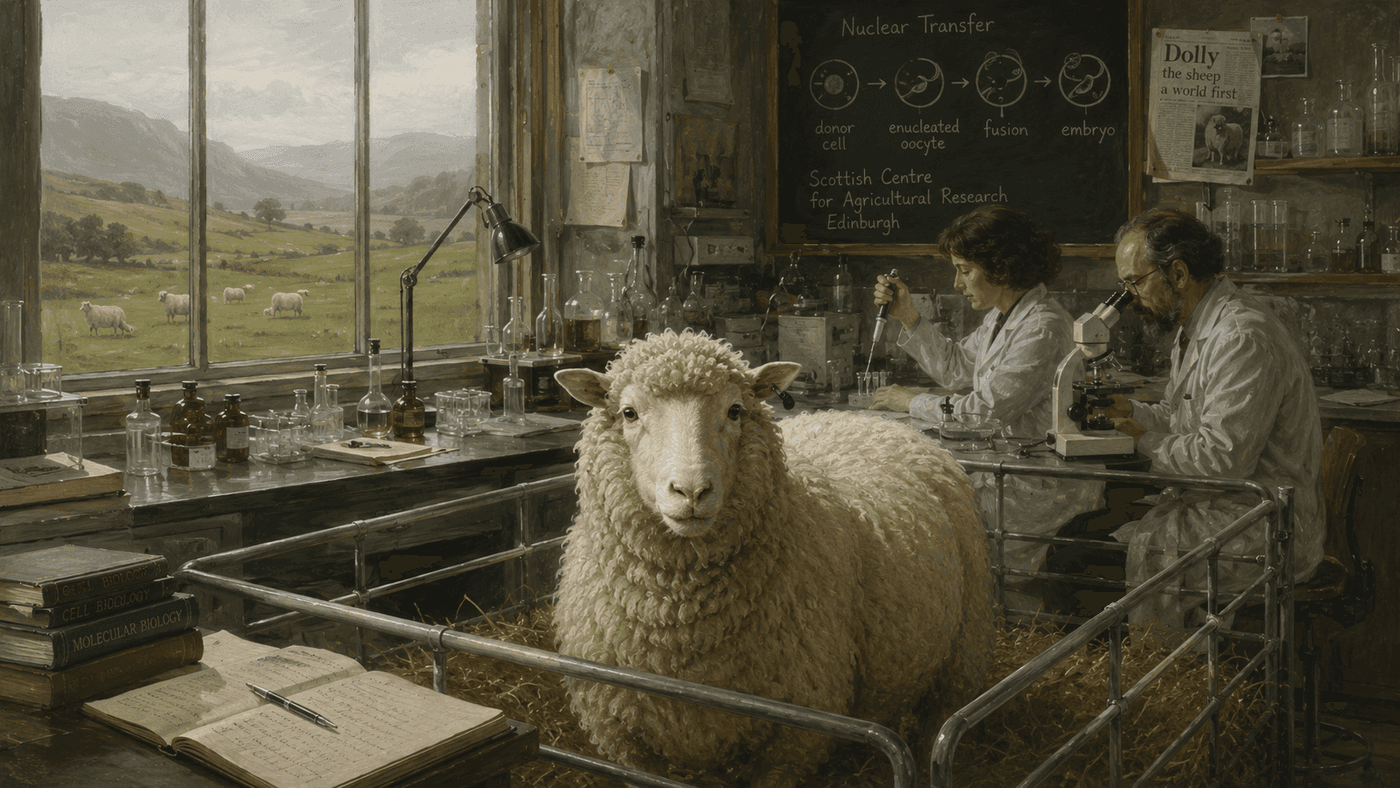
On July 5, 1996, a Finn Dorset sheep was born at the Roslin Institute outside Edinburgh, Scotland, and for seven months almost nobody knew. The lamb's name was Dolly, and she was unlike any animal that had ever lived: a genetic carbon copy of a six-year-old ewe, created not through reproduction but through a process called somatic cell nuclear transfer, in which scientists extracted the nucleus from an adult mammary gland cell and fused it with an egg whose own nucleus had been removed. The resulting embryo was implanted into a surrogate mother. It worked. When the Roslin Institute announced Dolly's existence in February 1997, the world received the news the way it receives very few scientific announcements — with genuine, widespread astonishment.
Dolly lived for six and a half years — a normal lifespan for her breed — and gave birth to six lambs of her own through conventional means. She was euthanized in February 2003 after developing a progressive lung disease. But her biological legacy proved far more durable than her body. Her creation demonstrated that adult cells retain the full genetic instructions needed to build an entire organism, overturning decades of scientific consensus. It opened research pathways into stem cell therapy, disease modeling, and genetic medicine that are still being explored today. Dolly herself now stands, preserved, in the National Museum of Scotland — a woolly monument to one of the most consequential moments in the history of biology.
Thirty Square Inches
Fifty years before Dolly's birth, on July 5, 1946, French engineer Louis Réard stood at the edge of the Piscine Molitor — an elegant public swimming pool in Paris — and unveiled a garment he had designed from thirty square inches of fabric. He called it the bikini, naming it after the Bikini Atoll in the Pacific, where the United States had detonated a nuclear test device just four days earlier. The naming was not accidental. Réard claimed his two-piece design would produce a reaction comparable to the atomic bomb, and he was not entirely wrong. The swimsuit exposed the navel — a breach of swimwear convention so radical that no professional model would agree to wear it. Réard hired a nude dancer from the Casino de Paris instead.
The immediate reaction was largely scandal. Several countries banned the bikini outright. The Vatican condemned it. Women's magazines refused to feature it. And yet within a decade it had begun its slow conquest of beaches from the French Riviera to California — propelled by cinema, by the countercultural currents of the 1960s, and by a gradual shift in attitudes toward the female body and its autonomy. Today the bikini is the best-selling swimwear style in the world, so ubiquitous as to seem inevitable — which makes it easy to forget that it was once a provocation radical enough to require a dancer willing to do what professional models would not.

East End
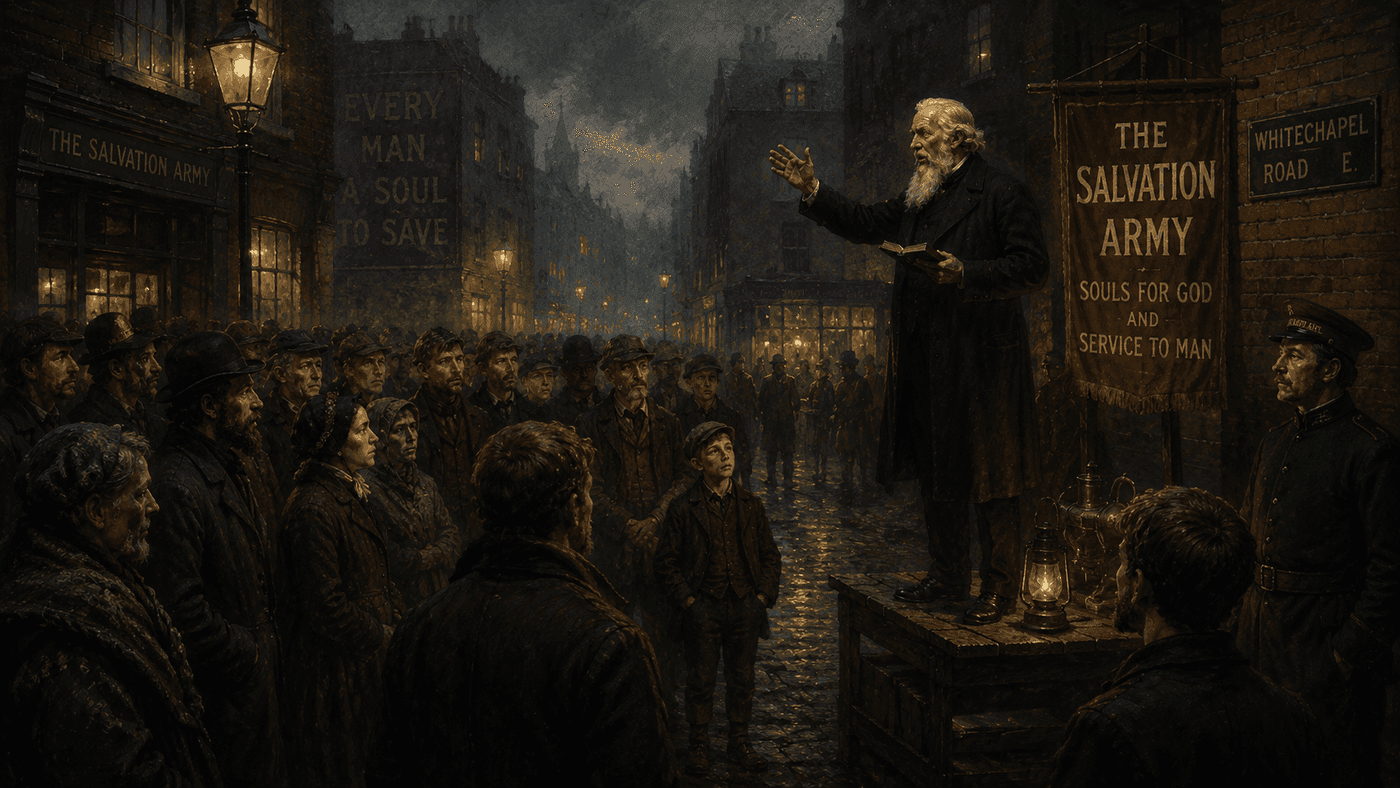
On July 5, 1865, a Methodist minister named William Booth held a series of open-air revival meetings in a tent pitched in a Quaker burial ground in Whitechapel, in London's East End. The neighborhood was one of the most destitute in the Victorian city — a landscape of overcrowded tenements, gin shops, and chronic unemployment, where disease moved freely and poverty was the permanent condition of the majority. Booth had grown frustrated with the institutional church's indifference to the suffering on its doorstep and had decided to take the gospel to the people who needed it most, on their own streets and in their own language. What he established that summer he called the Christian Mission.
Over the following decades, Booth's mission evolved into something far larger and more systematized than a tent revival. In 1878 he renamed it the Salvation Army, adopting a quasi-military structure — with officers, uniforms, and ranks — that gave the organization discipline and scale. The Army fed the hungry, housed the homeless, ran employment bureaus, visited prisoners, and campaigned against child labor and human trafficking at a time when the British government was doing almost none of those things. Today the Salvation Army operates in more than 130 countries and remains one of the largest providers of social services in the world — a global institution that traces its entire existence to a minister with a tent and a conviction that faith without action was no faith at all.