The City That Has Learned to Survive the Earth
At 4:27 p.m. on Tuesday, July 28, a magnitude 7.1 earthquake struck Kumamoto Prefecture on Japan's southern island of Kyushu, its epicenter 20 kilometers south of Kumamoto City, its rupture point just 10 kilometers below the surface — shallow enough to maximize the violence of the shaking above. The AEON Mall in Kashima City was packed with thousands of shoppers when the quake hit; a gas explosion in one section of the building killed and injured people who had not yet evacuated. Five workers died when a chimney collapsed at the Nippon Paper Industries factory in nearby Yatsushiro. Buildings fell across the prefecture. Kumamoto Castle — rebuilt painstakingly after the 2016 earthquake that had cracked its stone walls — sustained new damage. By this morning, at least 34 people are confirmed dead, more than 60 are injured, nearly 35,000 homes remain without power, and 15,000 without running water. More than 8,800 people are sheltering in over 400 evacuation centers across the region, where the summer temperature has reached 35 degrees Celsius and the government is rushing air conditioning units to the most crowded sites. The 72-hour window for finding survivors alive has closed. Recovery has begun.
A Prefecture That Has Been Here Before
Kumamoto Prefecture sits atop one of the world's most seismically active fault systems — the Futagawa and Hinagu fault zones, which run across Kyushu in interlocking segments capable of generating large, shallow earthquakes without warning. The people of Kumamoto understand this in the way that people who live with risk always understand it: practically, intimately, as a condition of ordinary life. On April 14 and 16, 2016, two powerful earthquakes — a 6.5 foreshock followed by a devastating 7.3 mainshock — struck the same prefecture, killing 273 people, injuring more than 2,500, destroying or damaging more than 100,000 buildings, and leaving 44,000 people displaced for months. The iconic Kumamoto Castle, a 400-year-old symbol of the city, lost towers, gates, and stone walls that had stood through previous earthquakes, wars, and fires. The recovery took years — the castle's full reconstruction was not completed until 2021 — and cost billions of dollars. The 2016 earthquakes prompted sweeping upgrades to building codes, evacuation procedures, and emergency supply stockpiling across Kyushu. The prefecture that endured Tuesday's earthquake had already rebuilt itself once in the preceding decade. It is, in the most literal sense, a community that knows what comes next.
Japan's earthquake preparedness system is the most sophisticated on Earth — the product of a country that sits on the Pacific Ring of Fire, experiences roughly 1,500 perceptible earthquakes every year, and has learned through repeated catastrophe that preparation is the only realistic response to a geological reality that will not change. The country's early warning system, operated by the Japan Meteorological Agency, detects the initial P-wave of an earthquake and transmits alerts to mobile phones, televisions, and public address systems in the seconds before the more destructive S-wave arrives — a window of perhaps 10 to 30 seconds that has saved countless lives since the system went fully public in 2007. Building codes enforced after the 1995 Great Hanshin earthquake, which killed 6,434 people in Kobe, require all new construction to withstand earthquakes of magnitude 7.0 and above. The Self-Defense Forces' disaster response capability — 4,600 personnel deployed to Kumamoto by Wednesday, with more staged and ready — has been refined through the 2011 Tōhoku earthquake and tsunami, the 2016 Kumamoto earthquakes, and several other major events into one of the most practiced disaster response operations in the world. None of this eliminates the deaths, the injuries, the lost homes, or the fear of the next aftershock. It does limit them — measurably, demonstrably, at a scale that is visible in the difference between the death tolls Japan produces from large earthquakes and the death tolls produced by comparable earthquakes in countries without the same infrastructure.
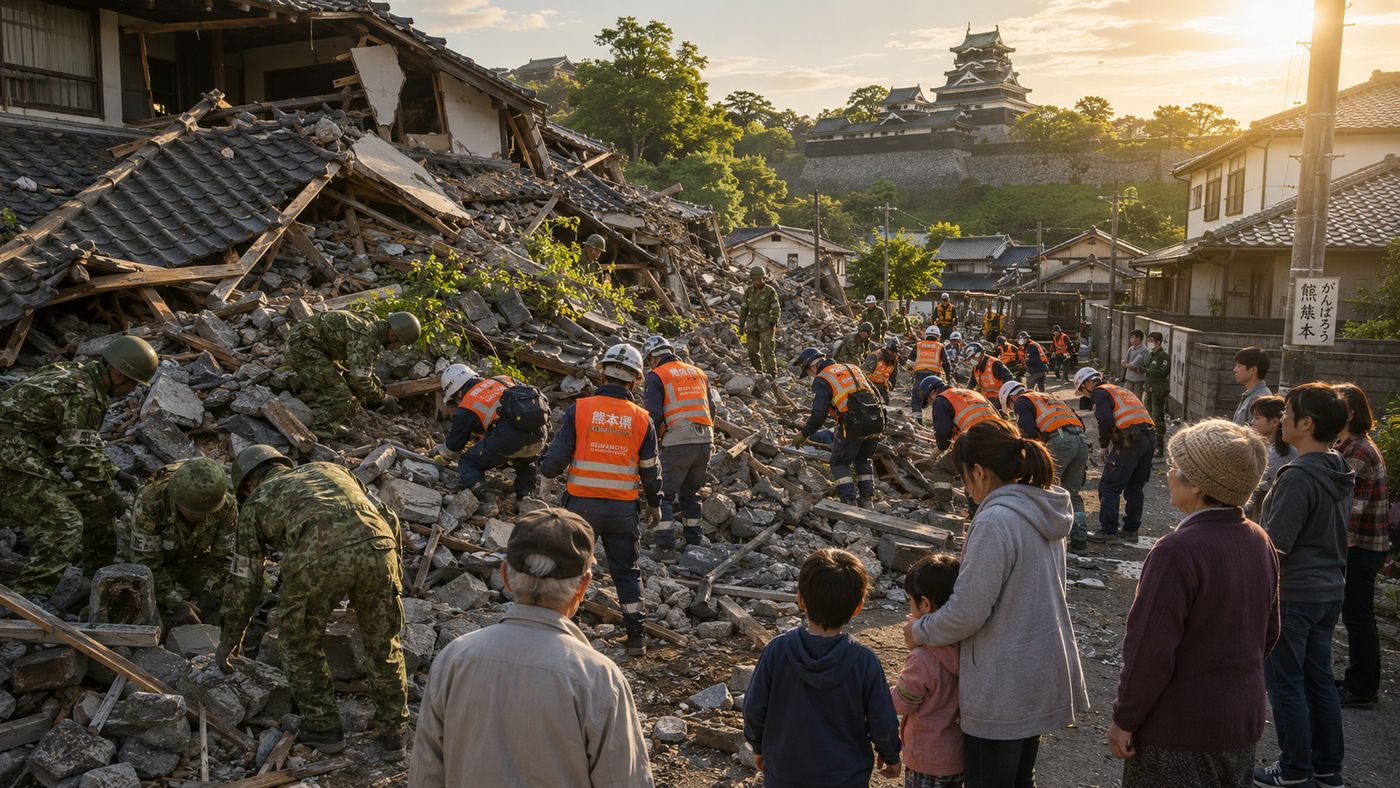
Prime Minister Sanae Takaichi, who held a press conference within hours of the quake, told the nation that "lifesaving and rescue operations are the top priority" and that the government was preparing food deliveries and other necessities for the hardest-hit areas. The Kyushu Shinkansen, suspended entirely in the immediate aftermath, resumed partial service Wednesday evening and is gradually restoring normal operations. Kyushu Electric Power has confirmed no abnormalities at the Sendai and Genkai nuclear power plants in adjacent prefectures. Taiwan's president sent condolences and offered assistance. The Ministry of Internal Affairs issued warnings about earthquake-related misinformation spreading on social media — a feature of modern disasters that Japan's disaster management apparatus now treats as seriously as the physical response. The aftershocks continue; authorities have warned that strong tremors could persist for days. In the evacuation centers, 8,800 people sleep on cots under emergency air conditioning in the July heat, waiting for the all-clear that will let them go home — or the assessment that will tell them their home is gone. Kumamoto has been here before. It knows, with the particular knowledge that only experience provides, that what comes after the shaking is not the end of the story. It is the beginning of the part that takes longer.