July 25: A Cry in Oldham, a Doctrine on Guam, and the First Crash
July 25 is a day for announcing the future, one moment at a time. In 1978, a baby's first cry in a hospital in northern England told the world that science had found a new way to bring life into being — a development that has since made parenthood possible for millions of people who would otherwise never have had children. Nine years earlier, on a Pacific island, a president announced that the United States would no longer fight other nations' wars for them, reordering the assumptions of American foreign policy that had held since the Second World War. And in 1832, in Massachusetts, a cable snapped on a new kind of transportation machine and a wagon careened into another, killing one man and inaugurating a long, complicated American relationship with the technology of the railroad. Three July twenty-fifths. Three firsts, each one setting something in motion that hasn't stopped yet.
Louise
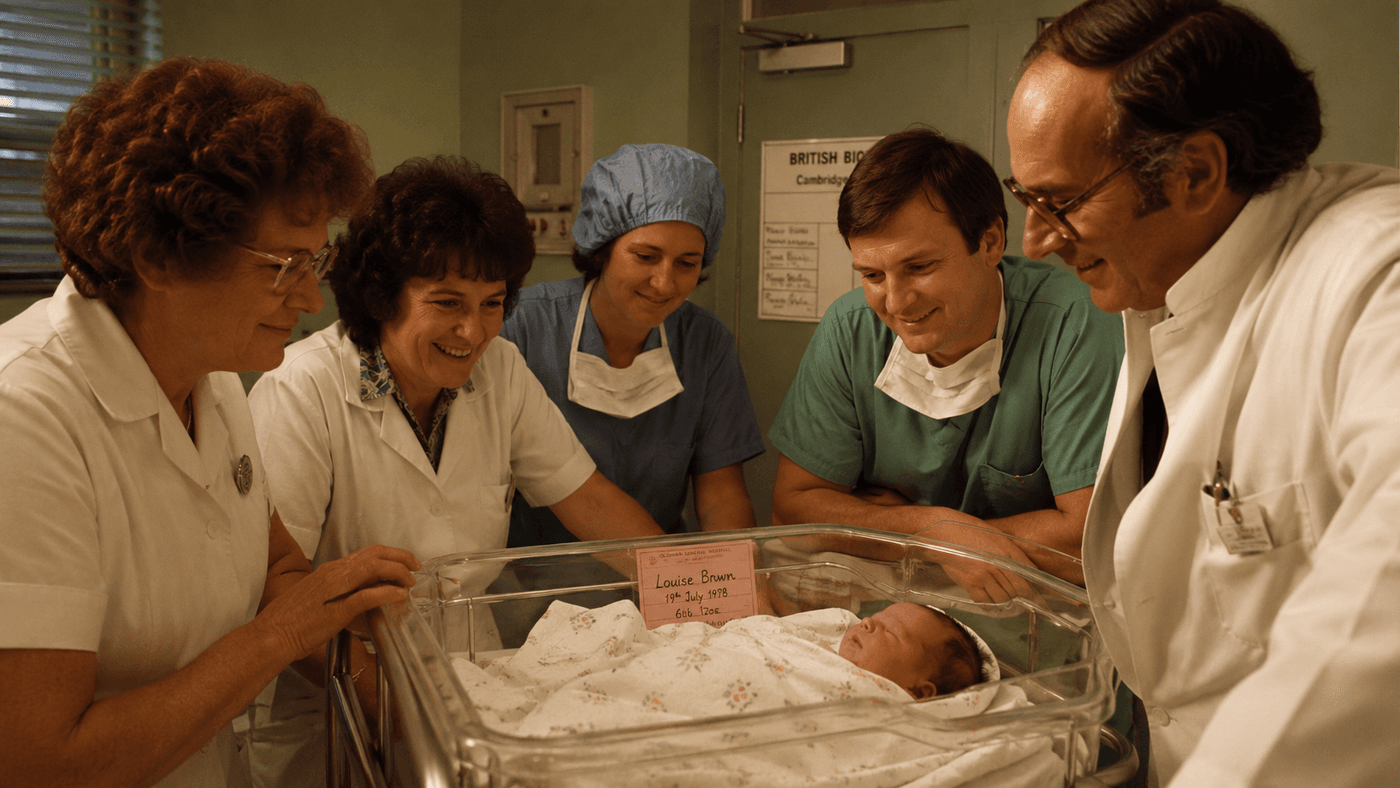
On July 25, 1978, at Oldham General Hospital in Lancashire, England, a baby girl was born who had been conceived not in the ordinary way but in a laboratory dish — the first human being ever brought into existence through in vitro fertilization. Her name was Louise Joy Brown. Her parents, Lesley and John Brown, had been trying to conceive for nine years, prevented by a blockage in Lesley's fallopian tubes. They had agreed to participate in the experimental program of physiologist Robert Edwards and gynecologist Patrick Steptoe, who had spent more than a decade developing the technique of removing an egg from a woman's ovaries, fertilizing it with sperm in controlled laboratory conditions, and implanting the resulting embryo back into the womb. The procedure had failed dozens of times before it succeeded. When Louise was born healthy, at 11:47 p.m. on July 25, the medical world understood immediately that something fundamental had changed.
The birth of Louise Brown opened a medical era whose scale has continued to expand for nearly five decades. By 2023, an estimated eight million babies had been born worldwide through IVF and related assisted reproductive technologies — a number that continues to grow by several hundred thousand each year. The technique has been refined and extended in ways that Edwards and Steptoe could not have fully anticipated: preimplantation genetic testing, egg freezing, gestational surrogacy, and embryo donation have all developed from the foundational science that produced Louise Brown. Robert Edwards was awarded the Nobel Prize in Physiology or Medicine in 2010, recognizing the full scope of what the work had accomplished; Patrick Steptoe had died in 1988 and was ineligible for the prize. Louise Brown herself grew up to live a thoroughly ordinary life — she works in a medical setting, has children of her own conceived naturally, and participates occasionally in public events marking IVF milestones. The baby whose birth announced a revolution turned out to be, in every other respect, simply a person — which is precisely the point.
The Guam Doctrine
On July 25, 1969, President Richard Nixon held an informal press briefing with reporters on Guam, stopping on the Pacific island during a tour that would take him to meet Apollo 11's returning crew and then to several Asian nations. What Nixon announced — in terms he initially described as off the record, then allowed to be reported — represented a significant reorientation of American foreign policy. The United States, Nixon declared, would honor its existing treaty commitments and continue to provide allies with military and economic support. But in future conflicts, the expectation that American ground forces would fight on behalf of threatened allies would no longer hold: nations facing military threats would have to provide their own troops to defend themselves. The announcement came as the United States was deeply mired in Vietnam, at a moment of intense domestic pressure to withdraw, and it reflected Nixon's recognition that the postwar framework of American military commitments had become unsustainable.
The Nixon Doctrine, formalized in subsequent speeches and policy documents, became one of the defining foreign policy frameworks of the early 1970s, with consequences that extended well beyond Vietnam. It accelerated the process of "Vietnamization" — the transfer of primary combat responsibility to South Vietnamese forces — and provided the theoretical rationale for the eventual American withdrawal. More broadly, it attempted to articulate a sustainable middle ground between isolationism and the maximalist military interventionism of the Johnson years: an America that remained globally engaged but expected its allies to carry more of the burden of their own defense. The doctrine was variously praised as realist and criticized as a retreat from American leadership, depending on the observer. Its core tension — between the United States' global commitments and its domestic capacity and appetite for sustaining them — has never been fully resolved, and versions of the same argument appear in American foreign policy debates to this day.

The First Crash
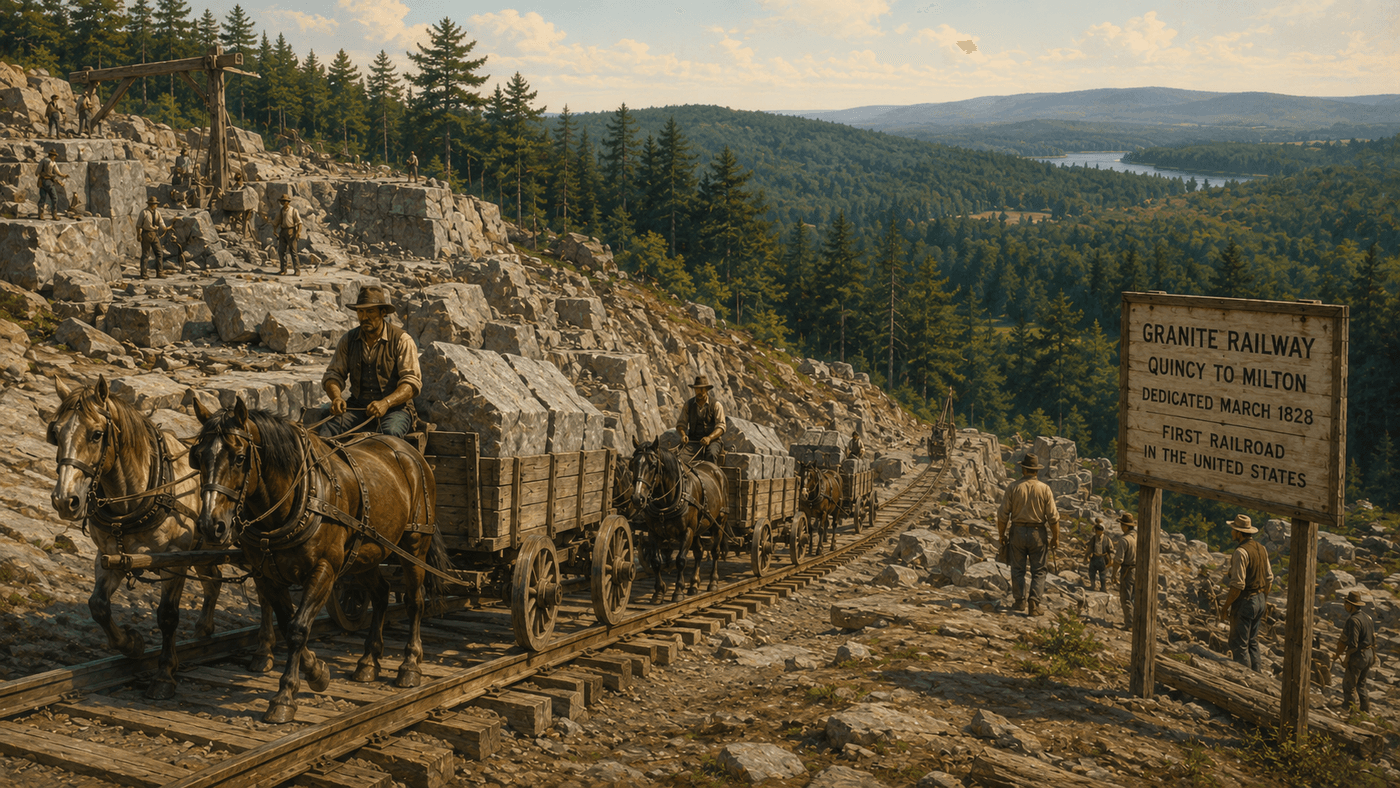
On July 25, 1832, on the Granite Railway near Quincy, Massachusetts — one of the earliest operational railroads in the United States, built to haul granite from a local quarry to the Neponset River for transport to Boston — a cable snapped while a heavily loaded stone wagon was being lowered down an inclined track. The wagon broke free and hurtled down the slope, colliding with another wagon waiting below. One worker was killed and several others were injured in the collision, making it the first recorded railroad fatality in American history. The Granite Railway had been in operation since 1826, a short industrial line designed to move building material rather than passengers, but the accident it suffered on July 25, 1832, established a grim precedent for a technology that was simultaneously transforming the country and demonstrating its capacity for catastrophic failure.
The railroad era that was just beginning in 1832 would go on to reshape the United States more thoroughly than almost any other technological development of the nineteenth century: connecting coasts, moving armies, enabling the settlement of the interior, and binding the national economy into a single coherent system. It would also kill and injure workers and passengers at a rate that made railroad travel, for much of the nineteenth century, among the most statistically dangerous activities an American could undertake. The first crash at Quincy in 1832 set a pattern that would repeat itself thousands of times over the following decades, driving the development of safety regulations, standardized equipment, and federal oversight of the railroad industry in a long, contested process that continued well into the twentieth century. The cable that snapped on July 25, 1832, was a small thing. What it inaugurated was anything but.