July 2: A Law, a Legend, and a Lost Horizon
July 2 is a date that has been asked to carry an enormous amount of history. A pen stroke that changed millions of lives. A radio signal that went unanswered. A gunshot that altered the course of a presidency. Three events, separated by decades, united by a single stubborn truth: that the most consequential moments in American life often arrive without warning, and that what happens next depends entirely on who has the courage to act.
The Long Arc Bends
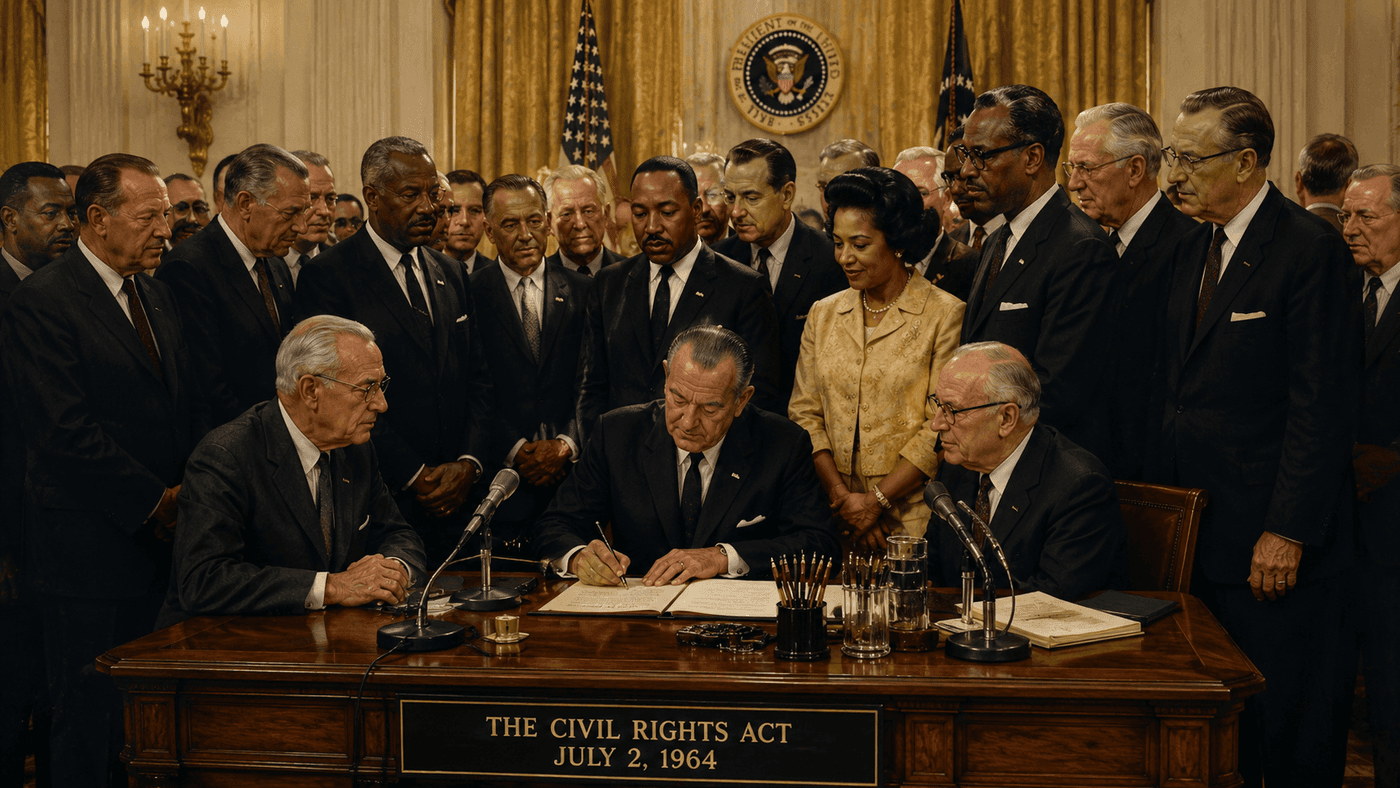
On July 2, 1964, President Lyndon B. Johnson signed the Civil Rights Act into law, setting his pen to one of the most consequential pieces of legislation in American history. The ceremony was brief; the implications were not. With a stroke, the law outlawed discrimination based on race, color, religion, sex, or national origin — dismantling the legal architecture of segregation that had governed American public life for generations. Johnson is said to have remarked privately that in signing the bill, he had delivered the South to the Republican Party for a generation. He signed it anyway.
The Civil Rights Act did not arrive easily. It was the product of decades of organizing, protest, sacrifice, and moral argument — from the courtrooms of Thurgood Marshall to the churches of Birmingham, from the lunch counters of Greensboro to the Edmund Pettus Bridge. The bill faced one of the longest filibusters in Senate history before finally passing by wide margins in both chambers. What Johnson signed that afternoon was not merely a law; it was a reckoning — an acknowledgment that the promises of the Declaration of Independence had gone unfulfilled for too long. The Act became the legal foundation for the equal society generations of Americans had fought and died to build.
Somewhere Over the Pacific
Twenty-seven years before Johnson's pen moved across that historic page, a different kind of American story was coming to its devastating close. On July 2, 1937, aviator Amelia Earhart and her navigator Fred Noonan vanished somewhere over the central Pacific Ocean, less than 7,000 miles from completing what would have been the first circumnavigation of the globe by a woman. They had departed Miami on June 1 and covered more than 20,000 miles across five continents — only the vast, featureless stretch of ocean between New Guinea and tiny Howland Island stood between Earhart and history. The U.S. Coast Guard cutter Itasca, stationed near Howland to guide her in, received fragmented transmissions in the final hours. Then silence.
The search that followed was the largest and most expensive in naval history to that point — sixteen ships and sixty-five aircraft combing 250,000 square miles of ocean for seventeen days. They found nothing. Earhart was declared legally dead in January 1939, but the mystery has never truly closed. Theories have proliferated for nearly nine decades: a crash at sea, a forced landing on a remote reef, even capture by Japanese forces. What remains undisputed is the magnitude of what Earhart represented — not merely a pilot, but a living argument that the boundaries drawn around women's ambitions were arbitrary and wrong. Her disappearance did not diminish that legacy. If anything, it enshrined it.

The Station
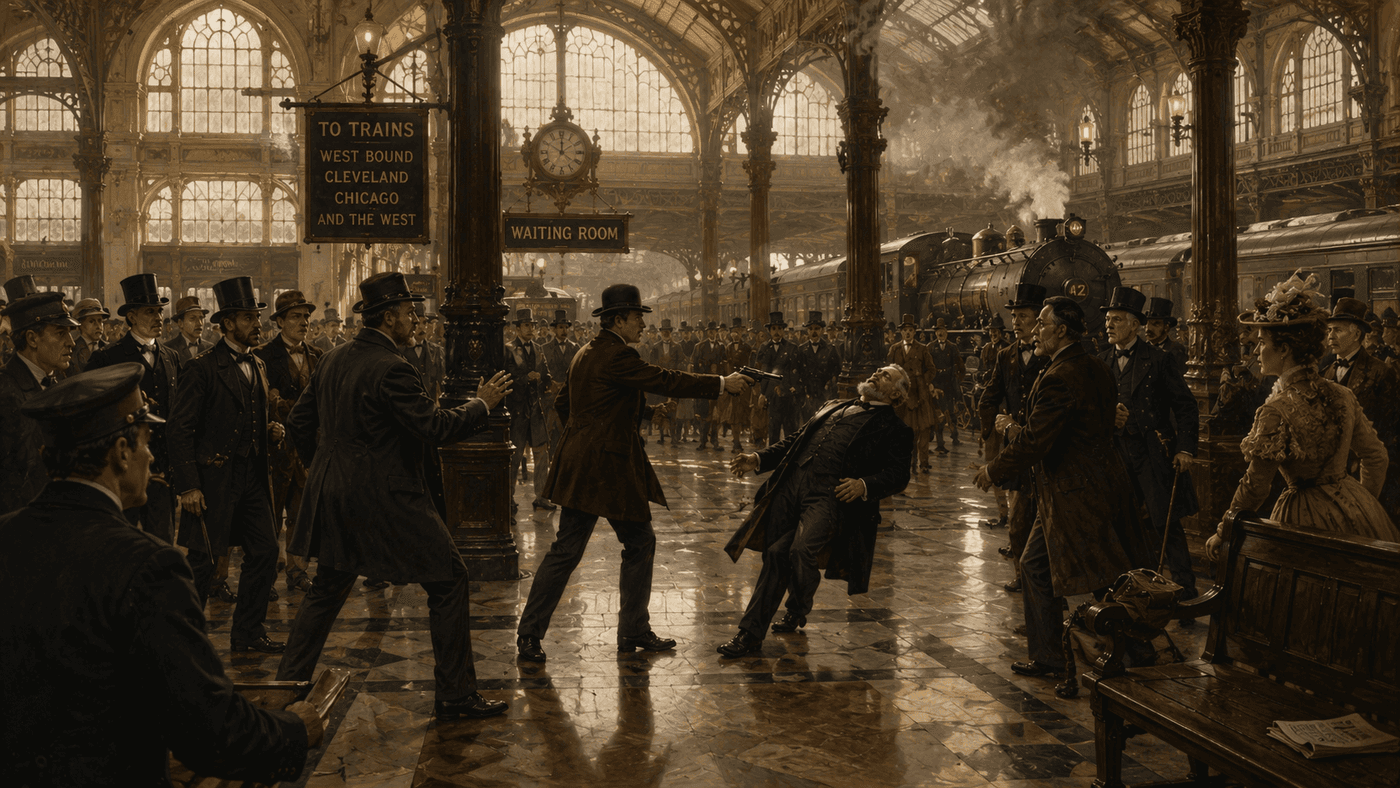
On July 2, 1881, President James A. Garfield arrived at the Baltimore and Potomac Railroad Station in Washington, D.C., bound for a summer vacation. He never made the train. Charles J. Guiteau, a delusional office-seeker who had convinced himself that Garfield owed him a diplomatic appointment, stepped forward in the waiting room and fired two shots. One grazed the president's arm. The other lodged near his spine. Garfield collapsed onto the marble floor of the station, conscious but gravely wounded — and what followed would be one of the most medically agonizing presidential tragedies in American history.
Garfield did not die that day. He lingered for seventy-nine days, enduring the relentless probing of physicians who searched for the bullet with unsterilized fingers and instruments, introducing catastrophic infection into what might otherwise have been a survivable wound. Alexander Graham Bell even brought an early metal detector to the bedside in an attempt to locate the slug — the device found nothing useful, confounded by the metal springs in Garfield's mattress. The president died on September 19, 1881, in Elberon, New Jersey, where he had been transported in hopes that sea air might restore him. His death was not simply a personal tragedy; it galvanized Congress to pass the Pendleton Civil Service Reform Act two years later, dismantling the patronage system that had driven Guiteau to his desperate, murderous act.