The Strait That Rules the World
At 4 p.m. ET today, U.S. Central Command begins enforcing a naval blockade of all Iranian ports and coastal waters in and around the Strait of Hormuz — a 21-mile passage through which roughly 20 percent of the world's oil and gas normally flows every single day. President Trump announced the blockade yesterday on Truth Social, declaring the United States would henceforth be "THE GUARDIAN OF THE HORMUZ STRAIT" and would seek reimbursement at a rate of 20 percent on all cargo shipped through the passage for protection. The June 15 memorandum of understanding that was supposed to end the Iran war — the peace deal that Trump celebrated with the words "ships of the world, start your engines" — is effectively dissolved. The U.S. and Iran exchanged strikes over the weekend for the third consecutive week, with Iran attacking commercial shipping and U.S. military sites across Bahrain, Kuwait, Oman, and Jordan. Brent crude climbed above $83 a barrel Monday. The average American gas price stands at $3.87 a gallon and rising. The war that was supposed to be over is not over.
Twenty-One Miles That No Nation Has Ever Owned
The Strait of Hormuz has been contested, threatened, and occasionally blockaded throughout its history — but never unilaterally claimed by a single outside power as its designated guardian and toll collector. At its narrowest point, the strait is 21 miles wide, with only a two-mile shipping lane in each direction separated by a two-mile buffer zone. Through those lanes, in normal times, flow approximately 20 million barrels of oil per day — about 20 percent of global petroleum supply — along with 30 percent of the world's seaborne liquefied natural gas. Every major oil exporter in the Persian Gulf — Saudi Arabia, Iraq, Kuwait, the UAE, Qatar — depends on free passage through the strait to reach world markets. There is no viable alternative route of comparable capacity. Portugal seized the island of Hormuz itself in 1507 to control the spice trade between the Persian Gulf and Europe, and held it for more than a century before being expelled by a joint Safavid-British force in 1622. The idea that any single power could control what passes through those waters has been a recurring imperial fantasy for five centuries. Today the United States is attempting to make it reality.
The legal and geopolitical reaction has been swift and sharp. International law, under the United Nations Convention on the Law of the Sea, guarantees the right of transit passage through international straits to all nations regardless of political relationships — a principle that the United States has itself invoked repeatedly to contest Iranian attempts to restrict navigation. Secretary of State Marco Rubio stated explicitly earlier this year, in response to Iranian fee proposals, that "no country is allowed to charge tolls or fees on an international waterway — that's existing international law." The Trump administration's 20 percent toll proposal directly contradicts that position. The European Union's top diplomat, Kaja Kallas, called Monday for the strait to remain open and for freedom of navigation to be respected. A senior Gulf source told Axios that the U.S. had not discussed the toll proposal with its regional allies before announcing it. Iran's Foreign Minister Abbas Araghchi responded with an almost satirical echo of Trump's own logic: "POTUS is absolutely right," he posted. "Iran has always been the GUARDIAN of the Strait and will remain so FOREVER. 20% is of course too much. We will be fair." On Sunday, before the blockade announcement, just 14 ships crossed the strait — compared to approximately 130 per day before the war began in February.
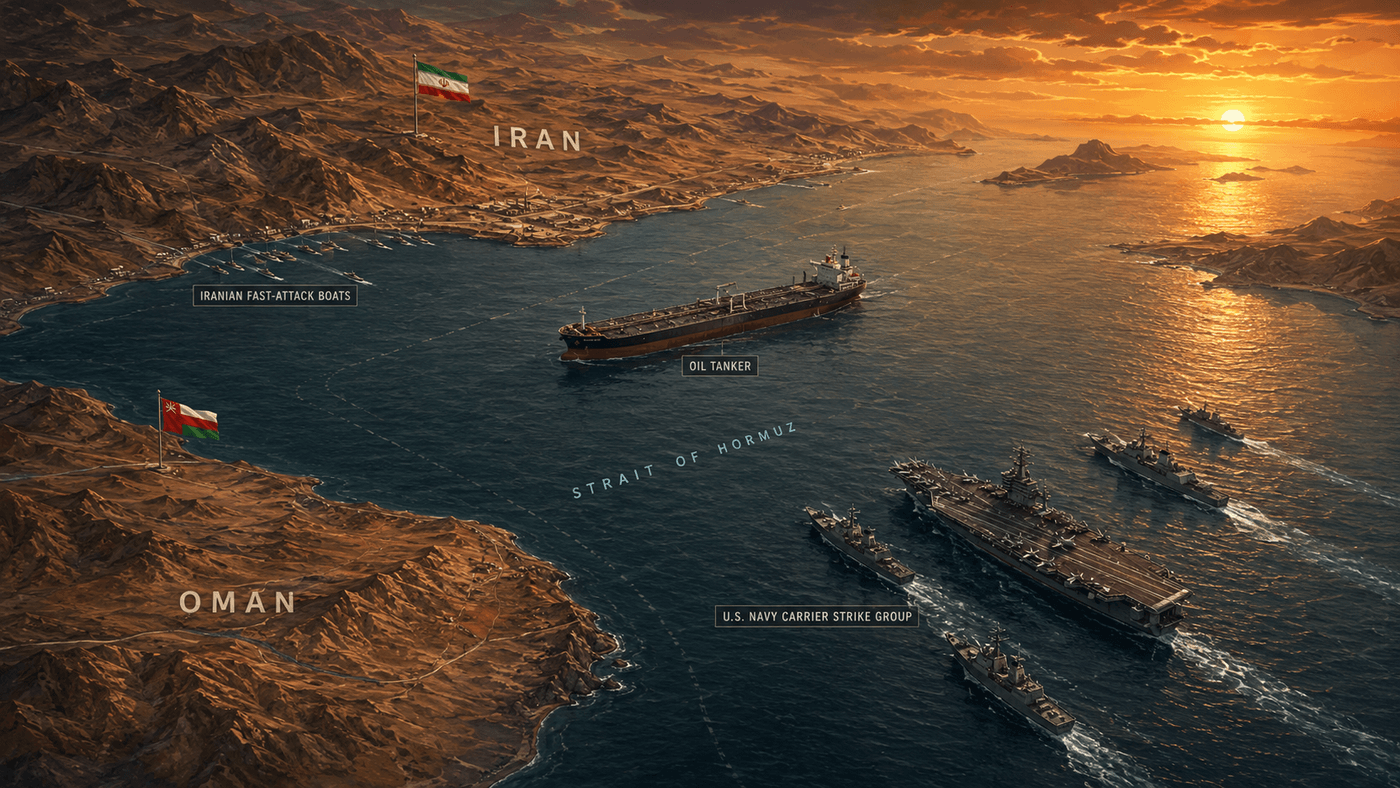
The 60-day negotiating window established by the June 15 MOU was supposed to produce a permanent settlement of Iran's nuclear program, the status of frozen Iranian assets, and the long-term administration of the strait itself. Instead, both sides are now exchanging military strikes for the third consecutive week, the ceasefire's key provisions have collapsed, and the United States has announced an assertion of control over international waters that has no precedent in the post-World War II international order. Iran's Revolutionary Guard has declared the strait "our territory" and warned that regional countries cooperating with the U.S. military will be considered to have committed an act of war against Iran. The blockade takes effect this afternoon. The global economy is watching. History is being made in 21 miles of water between Iran and Oman, and no one yet knows how it ends.