The Fire That Keeps Happening
At 11:57 p.m. local time on Sunday night, a fire broke out at the Na Ladprao pub in Bangkok's Chatuchak district. A musician performing nearby said he heard it began near a circuit breaker on the stage — smoke, then darkness, then an explosion. The venue rapidly filled with thick black smoke. The power went out. Patrons trying to flee to the rear of the building became trapped. By the time firefighters arrived and brought the blaze under control, 27 people were dead and 73 more were injured, 22 of them in critical condition. Thai Prime Minister Anutin Charnvirakul stood at the scene at dawn and told reporters the cause was still under investigation. Bangkok Governor Chadchart Sittipunt said investigators would examine whether emergency exits had been obstructed. It is the deadliest fire in the Thai capital in 17 years. And its details — the electrical spark, the blackout, the smoke, the blocked exits, the patrons who couldn't find a way out — are a precise echo of a disaster that happened 84 years ago and was supposed to have changed everything.
The Night That Was Meant to End Nights Like This
On November 28, 1942, the Cocoanut Grove nightclub in Boston was packed with more than 1,000 people — nearly twice its legal capacity — celebrating a Saturday night during wartime. The décor was elaborate and almost entirely flammable: artificial palm trees made of cloth and paper, fabric-covered ceilings, decorative draperies at every wall. At approximately 10:15 p.m., a small fire ignited in the basement Melody Lounge, likely from a match. Within minutes it had spread through the entire building. The exits — several of them locked or bolted to prevent patrons from leaving without paying — became death traps as panicked crowds surged toward them. When the fire was out, 492 people were dead. It remains the deadliest nightclub fire in American history, and the third-deadliest single-building fire in U.S. history. The response was swift and sweeping: Massachusetts immediately mandated clearly marked exits, outward-swinging doors, and fire-resistant building materials. The National Fire Protection Association accelerated adoption of its Building Exits Code, which had been written in 1927 but had not been widely enforced. Occupancy limits gained serious regulatory teeth for the first time. The Cocoanut Grove fire did not merely shock the country. It changed the physical design of every public building that followed.
And yet the fire keeps happening. In February 2003, 100 people died at The Station nightclub in West Warwick, Rhode Island, when pyrotechnics ignited foam soundproofing on the walls during a Great White concert — another electrical ignition source, another packed crowd, another blocked exit. In January 2013, 242 people died in a nightclub fire in Santa Maria, Brazil, when a flare used by a band ignited the ceiling. In Thailand itself, 14 people died in a music bar fire in the eastern part of the country in 2022. The pattern across eight decades is almost monotonous in its consistency: an electrical source or open flame near flammable materials, a venue operating beyond safe capacity, exits that are inadequate or obstructed, smoke that kills faster than the flames. The reforms that follow each disaster are real. They save lives. But they are local, they are imperfectly enforced, and they do not travel easily across borders or building types or decades. The codes written after Boston in 1942 did not prevent Rhode Island in 2003. The lessons of Rhode Island did not prevent Brazil in 2013. The lessons of all of them did not prevent Bangkok this morning.
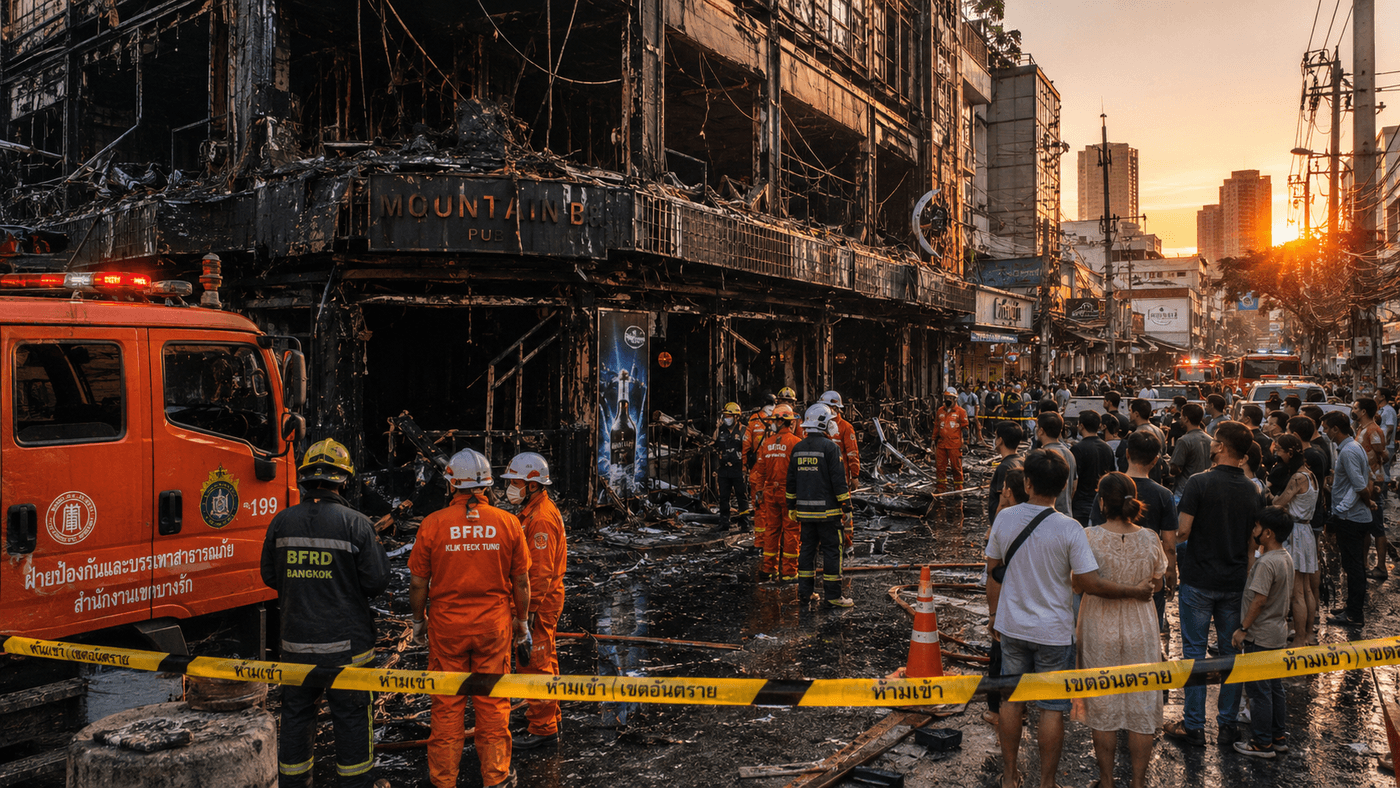
Twenty-two people remain in critical condition in Bangkok hospitals this morning, and the death toll may rise. Investigators are examining the ceiling materials, the venue's emergency exits, and the electrical systems on the stage. The families of the dead are gathering at registration points set up near the scene, submitting information about missing loved ones. A singer who was performing nearby that night rushed to the scene when she heard the news, because several of her bandmates had been performing at the Na Ladprao. One of them died. Three were hospitalized. One still has not been located. Somewhere in the gap between the fire codes written in Boston in 1942 and the pub that burned in Bangkok last night, 27 more people lost their lives to a disaster the world has had 84 years to prevent. The investigation will determine what failed here specifically. The broader answer is already known: the fire keeps happening because the urgency to prevent it diminishes, every time, until the next time it does not.