The Loudest Grand Slam on Earth Opens Tomorrow
Tomorrow morning, on the blue hardcourt of the USTA Billie Jean King National Tennis Center in Flushing, Queens, the 146th United States Open Tennis Championships begins its main draw. It is the last Grand Slam of the tennis calendar — the noisiest, the most electric, the one played in the city that treats every match like a neighborhood argument — and this year it arrives with a men's field that has been reshaped by injury in ways that make the outcome genuinely difficult to predict. World No. 1 Jannik Sinner has withdrawn with a knee injury, the same that cost him the Cincinnati Masters last week. Defending champion Carlos Alcaraz returns from a four-month wrist injury layoff that kept him out of both the French Open and Wimbledon — without having played a single competitive warm-up match before the biggest tournament of the American summer. The draw is wide open. The hardcourt is ready. The city is waiting.
From Newport's Grass to New York's Blue Hard
The U.S. Open began in 1881, not at Flushing Meadows, not in New York City, but on the grass courts of the Newport Casino in Newport, Rhode Island — a private club where 25 male players competed in the inaugural U.S. National Championship on August 31, 1881. Richard Sears won that first title and the six that followed it, a dominance matched in the tournament's early years only by the genteel exclusivity of who was allowed to enter: the tournament was, for decades, restricted by social class, race, and nationality in ways that bear little resemblance to the global democratic chaos of the modern Open era. Women were permitted to enter starting in 1887, with Ellen Hansell winning the first women's title. The tournament moved to the West Side Tennis Club in Forest Hills, Queens, in 1915, where it remained — transitioning from grass to clay to a peculiar indoor carpet called Har-Tru — until the current site at Flushing Meadows-Corona Park opened in 1978, the same year the tournament adopted the Open Era format and welcomed professional players. The blue hardcourt DecoTurf surface, installed in 2005, has since become one of the most recognizable playing surfaces in sport: fast, unforgiving, hard on the body, and uniquely suited to the baseline power game that has dominated the modern era. The Arthur Ashe Stadium — named for the first Black man to win the U.S. Open, the Wimbledon title, and the Australian Open — opened in 1997 with a retractable roof added in 2016. It holds 23,771 fans. At full throat, particularly on night sessions when New York's finest converge from the outer boroughs and beyond, it is the loudest tennis venue on Earth.
The 2026 men's draw has a quality of genuine uncertainty that recent editions have lacked. Alcaraz, the defending champion who beat Sinner in last year's final 6-2, 3-6, 6-1, 6-4, enters as the favorite at roughly 2-to-1 odds despite having not played a competitive match in four months. His talent is not the question — at 23 he has four Grand Slam titles across every surface and is, on his best day, the most complete player in the world. The question is whether four months off a racket, followed by two weeks of practice, followed directly by a Grand Slam, constitutes adequate preparation to beat the field from a draw that now includes Alexander Zverev — the French Open champion who won Cincinnati last week and arrives in New York in the form of his career — Novak Djokovic at 39, still capable of deep runs on hard courts, and an American contingent led by Ben Shelton and Tommy Paul whose own form this summer has been the best in years. On the women's side, defending champion Aryna Sabalenka — who has won back-to-back U.S. Open titles and reached the final five consecutive times — opens as the favorite on a surface that suits her power game as well as any on tour.
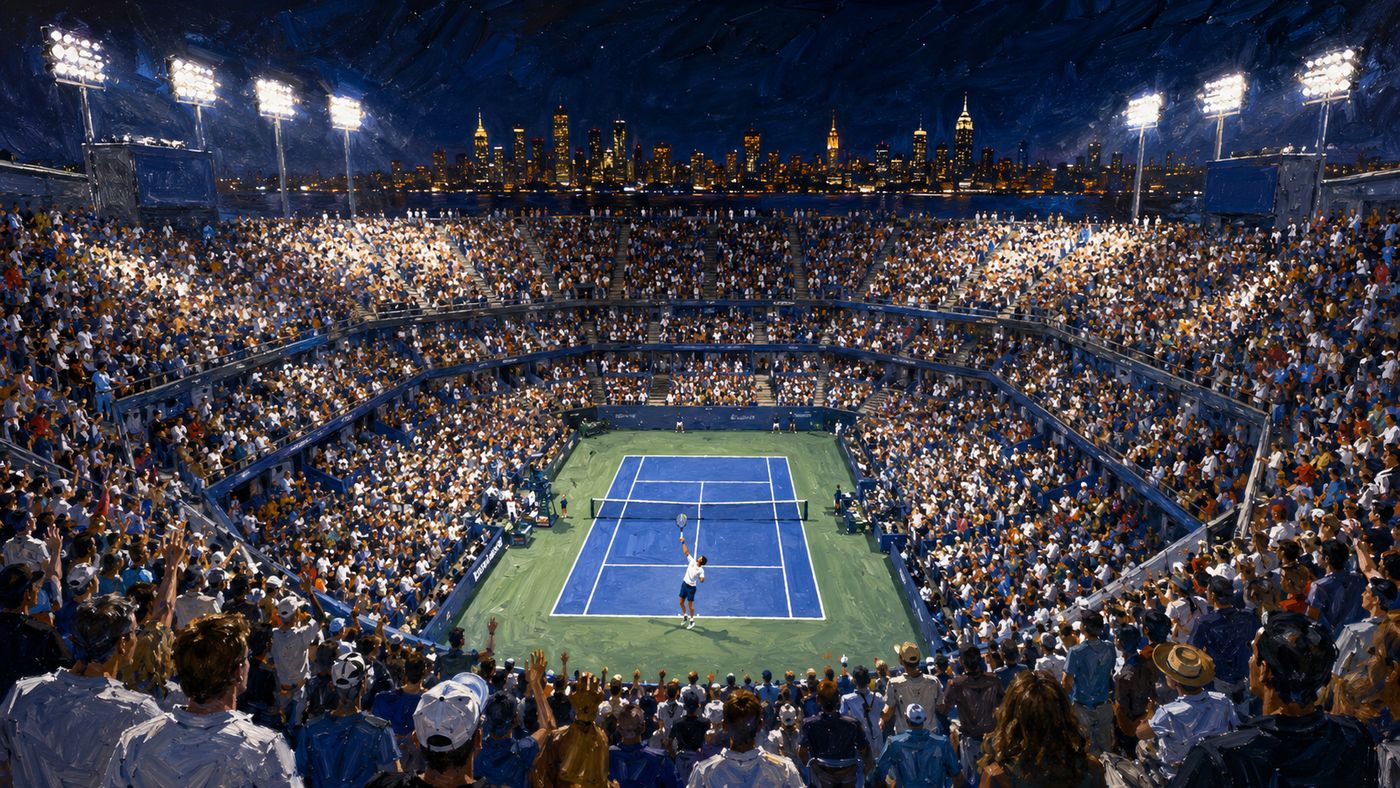
The U.S. Open's particular character among the four Grand Slams has always been its relationship with New York City — which is to say, its relationship with noise, electricity, and the specific democratic energy of a tournament that has always felt more like a borough block party than a gentlemen's club. The All England Club at Wimbledon asks for white clothing and serves strawberries and cream. Roland Garros is French. The Australian Open is friendly. The U.S. Open is New York — it is "You cannot be serious!" and John McEnroe arguing with line judges and Serena Williams winning 23 Grand Slams and Billie Jean King beating Bobby Riggs in the Battle of the Sexes in a stadium that wasn't even at Flushing Meadows yet. It is night sessions and flashbulbs and celebrities in the player boxes and a crowd that will cheer whoever it decides to cheer, which is not always the person the protocol says it should be. Tomorrow the main draw begins. The city will make itself heard. It always does.