D-Day, Economic Edition
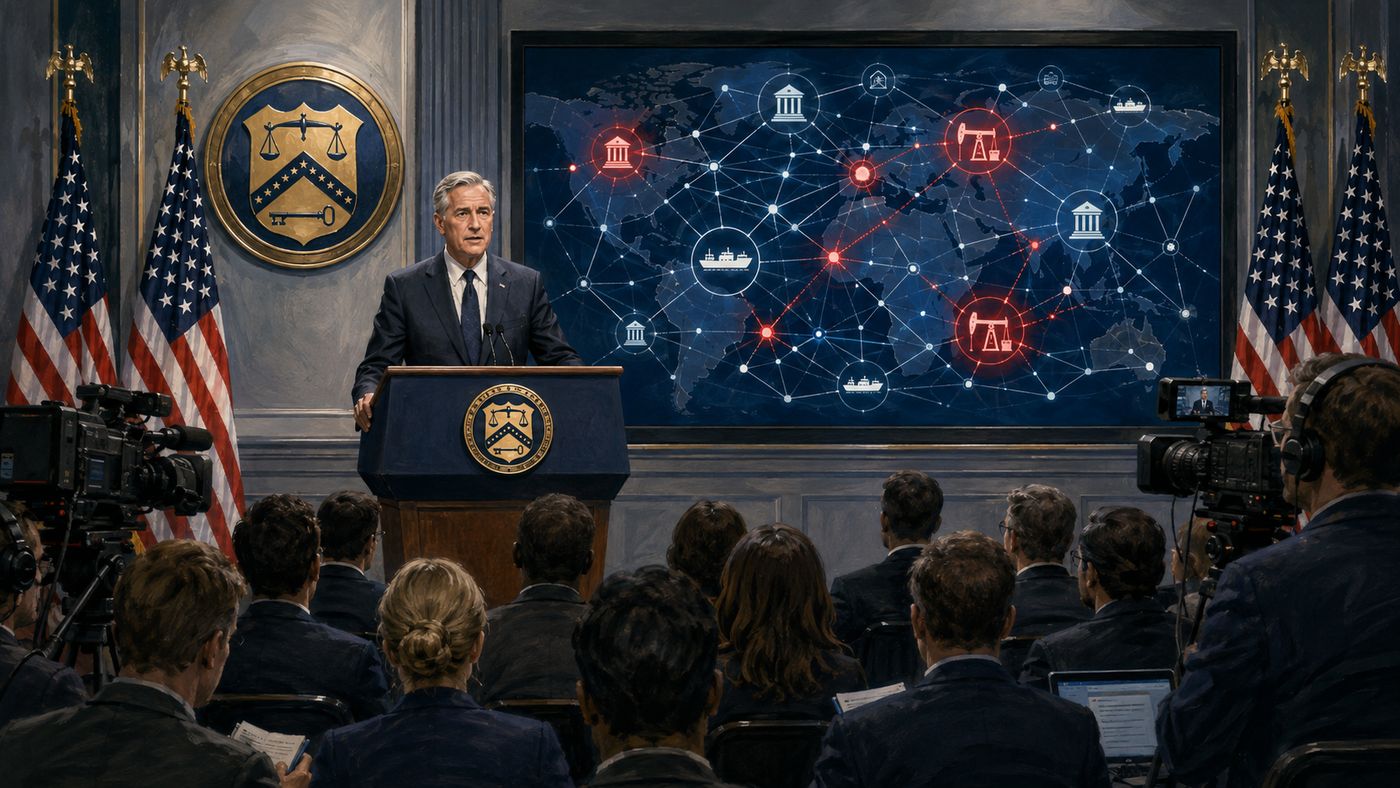
At 1 p.m. on Monday, Treasury Secretary Scott Bessent stood before reporters and invoked the Allied landings at Normandy. "Today, in that same spirit," he said, "we are launching an economic onslaught against Iran's financial connections around the globe." The operation is called Economic Outcast. Its ambitions are explicit and sweeping: to sever every pipeline — oil revenues, digital assets, gold trades, shipping networks, aviation services, technology transfers — through which the Islamic Republic of Iran connects to the global economy. More than 60 individuals, entities, and vessels were sanctioned Monday for enabling Iran's nuclear and missile procurement, cyber operations, and oil smuggling. Secondary sanctions — penalties against third-country entities that do business with Iran — were expanded to cover anyone operating in five critical Iranian sectors: aviation, digital assets, gold, shipping, and technology. An unnamed major financial institution is expected to face sanctions by the end of this week, in what officials described as the largest single financial enforcement action against Iran since sanctions were first imposed in 1979. "Iran now faces a very clear choice," Bessent said. "Complete global isolation and a subsistence economy, or a path back to normalcy with an opportunity to rejoin the global economy." Iran's currency hit a record low against the dollar yesterday. Trump posted that Iran is "completely collapsing." Iran's Economy Minister said Tehran has been "preparing for these sanctions for a long time."
The Long History of American Economic Warfare — and What It Has and Hasn't Achieved
The United States has maintained sanctions on Iran continuously since November 1979, when President Jimmy Carter froze approximately $12 billion in Iranian assets following the seizure of the American embassy in Tehran and the beginning of the 444-day hostage crisis. Those original sanctions — a response to one of the most humiliating foreign policy crises in American history — have been added to, modified, suspended, and tightened by every administration since, becoming the most comprehensive bilateral sanctions regime in U.S. history. The Obama administration's 2012 sanctions, which targeted Iran's central bank and cut off its access to the global SWIFT banking messaging system, reduced Iranian oil exports by more than half and contributed directly to the economic pressure that eventually produced the 2015 nuclear deal. That deal's suspension under the first Trump administration in 2018, and the subsequent "maximum pressure" campaign, drove Iran's oil exports to near-zero levels before the Biden administration partially eased pressure. What decades of American sanctions experience has consistently shown is that economic pressure on Iran is most effective when multilateral — when China, Europe, and regional partners participate — and least effective when unilateral, because Iran has repeatedly demonstrated an ability to find alternative trading partners, develop workaround financial systems, and build domestic resilience to sanctions pressure over time. Operation Economic Outcast is designed to address the multilateral problem through secondary sanctions: by threatening to cut any country or company that does business with Iran off from the U.S. dollar system, it attempts to force the choice on third parties rather than relying on their voluntary cooperation.
The operation's most significant immediate target is China, which has purchased the vast majority of Iranian oil throughout the conflict and whose banks and front companies have helped Iran navigate previous sanctions regimes. The Chinese Foreign Ministry, before Bessent's press conference, vowed to "do what is necessary to protect its interests" and urged restraint. This is the central tension in Operation Economic Outcast: secondary sanctions work when the threat of being cut off from the U.S. dollar system outweighs the economic benefit of doing business with the sanctioned country. For most of the world's smaller economies and mid-size banks, that calculation clearly favors U.S. compliance. For China — whose economy is the world's second largest, whose trade with Iran is both economically significant and strategically motivated, and whose broader confrontation with the United States over trade, technology, and Taiwan makes compliance with U.S. demands politically fraught — the calculation is more complicated. Bessent acknowledged that Trump is currently calling world leaders to communicate American expectations personally, though he declined to name which leaders or countries had been approached. By end of week, the unnamed major financial institution — widely assumed to be a Chinese bank — is expected to be designated. That announcement, more than yesterday's press conference, will determine whether Operation Economic Outcast has teeth or merely ambition.
The operation's strategic logic, as described by Axios, is revealing: it is intended as the main instrument of U.S. pressure on Iran "until at least after the midterm elections, when a new military campaign could again be on the table." That framing makes clear that Operation Economic Outcast is not a permanent shift away from military options but a tactical pause — a way to maintain pressure and demonstrate resolve while the political and diplomatic conditions for the next phase develop. Bessent said last week the aim was to create conditions for "regime collapse." Whether sanctions can achieve that outcome where military strikes could not is the central question the coming months will answer. The 1979 sanctions did not collapse the Iranian regime. The 1990s sanctions did not collapse it. The 2012 sanctions produced a nuclear deal — a negotiated outcome, not a collapse. What is different now is the simultaneous military degradation that has preceded the economic campaign: Iran's air force and navy have been severely degraded, its IRGC leadership significantly disrupted, its oil infrastructure damaged. Whether that degradation has fundamentally altered the regime's resilience to economic pressure, or whether Tehran has — as its Economy Minister suggested — simply had six months to prepare for exactly this — is what Operation Economic Outcast will spend the coming months attempting to determine.