August 22: A King Falls, a Red Cross Rises, and a Barrier Comes Down
August 22 is a day for the ending of one order and the beginning of another. In 1485, a king died in a field in Leicestershire and the Plantagenet dynasty — which had ruled England for more than three centuries — ended in an afternoon, replaced by the Tudors who would go on to produce Henry VIII, Elizabeth I, and one of the most consequential chapters in English history. Three hundred and seventy-nine years later, in Geneva, representatives of sixteen nations signed the first Geneva Convention and founded the International Red Cross, codifying for the first time the radical idea that the suffering of soldiers in wartime deserved a formal, organized, internationally recognized humanitarian response. And in 1950, an extraordinary tennis player walked onto the courts at Forest Hills, New York, and became the first African American to compete in the U.S. National Championships — not the last barrier she would break, but among the most significant. Three August twenty-seconds. Three moments when someone or something that had held the field for a very long time was finally asked to yield.
Bosworth
On August 22, 1485, Richard III of England rode into battle at Bosworth Field in Leicestershire against the forces of Henry Tudor — a Welsh-born claimant to the throne whose case rested on a somewhat attenuated line of descent from John of Gaunt — and died in the fighting, becoming the last English king to be killed in battle. Richard had seized the throne in 1483 following the death of his brother Edward IV, deposing Edward's young sons (the so-called Princes in the Tower, whose fate has been debated ever since) and ruling for two turbulent years while the exiled Henry Tudor assembled support in France and Wales. At Bosworth, Richard's army began the day with numerical advantage, but the defection of the powerful Stanley family — who had committed to neither side before the battle — proved decisive. Richard died fighting, reportedly in a cavalry charge toward Henry Tudor himself, a death that later generations would interpret as either desperate courage or strategic recklessness.
The battle of August 22, 1485, ended the Wars of the Roses — the three-decade dynastic conflict between the houses of York and Lancaster — and began the Tudor dynasty that would last until Elizabeth I died without an heir in 1603. Henry VII, the victor of Bosworth, proved a careful and effective king who consolidated the Tudor hold on power through fiscal prudence, diplomatic marriages, and the methodical elimination of rival claimants. His son Henry VIII and granddaughter Elizabeth I shaped English history in ways whose consequences still reverberate — the English Reformation, the defeat of the Spanish Armada, the foundations of what would become the British Empire. Richard III's reputation, the darkest in English royal history for centuries due largely to Shakespeare's portrayal, has been partially revised in recent decades: historians have questioned some of the Tudor-era accounts of his villainy, and the discovery of his skeleton under a Leicester parking lot in 2012 — confirming he had scoliosis but not the withered arm of legend — generated renewed interest in who he actually was. The field in Leicestershire where he fell is now a heritage site. The dynasty that ended there shaped the next century and a half of English history.

Geneva, 1864
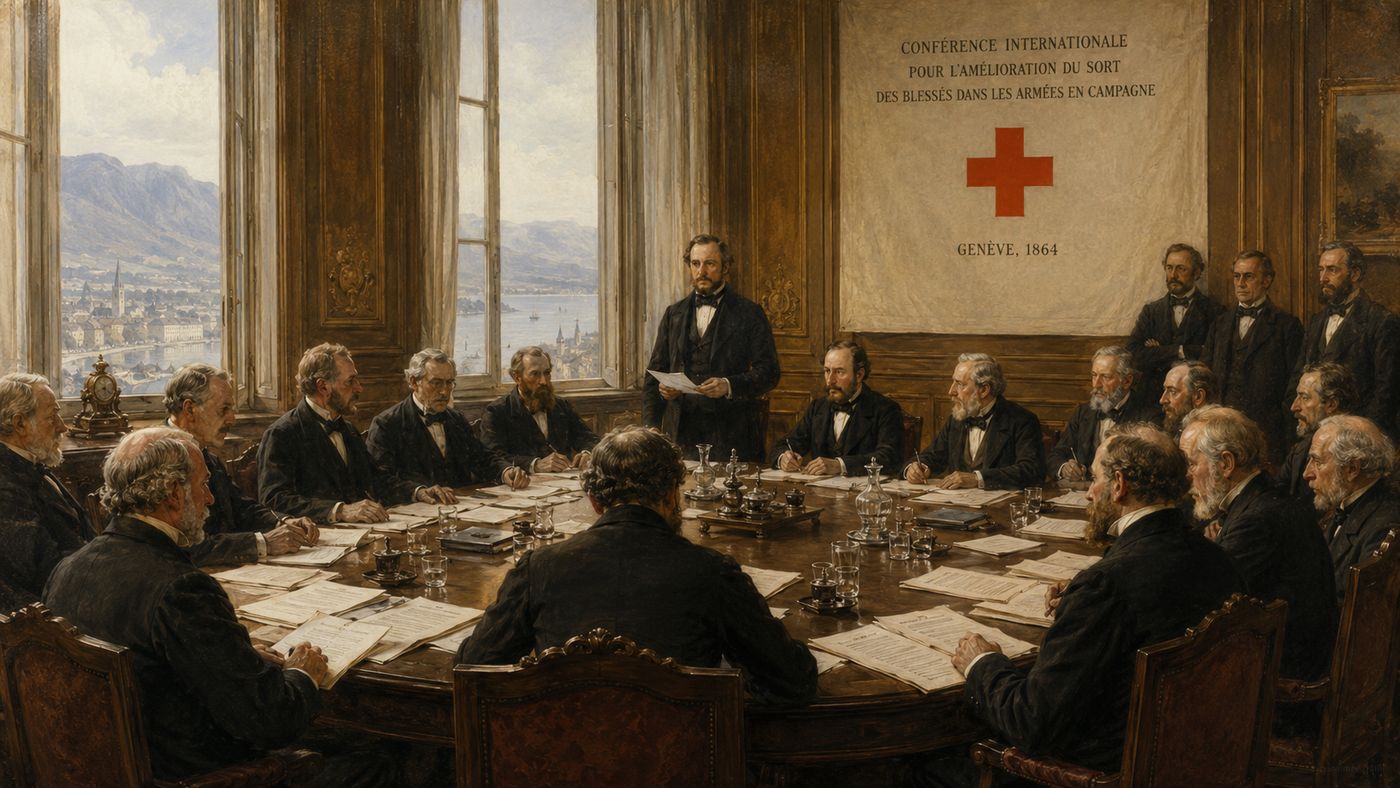
On August 22, 1864, representatives of sixteen nations gathered in Geneva and signed the first Geneva Convention — a treaty establishing, for the first time in international law, that wounded soldiers must be cared for regardless of which side they fought on, that medical personnel and facilities must be protected from attack, and that the neutral emblem of a red cross on a white background would mark those protections. The treaty, and the International Committee of the Red Cross that had advocated for it, were the creation primarily of Henry Dunant, a Swiss businessman who had witnessed the aftermath of the Battle of Solferino in 1859 — where 40,000 men lay dead or wounded and received almost no medical care — and had been so devastated by what he saw that he organized an improvised relief effort on the spot and then spent years building the institutional infrastructure to ensure it would never have to be improvised again. His book A Memory of Solferino, published in 1862, described what he had witnessed and proposed both a permanent volunteer relief organization and an international treaty protecting it.
The International Red Cross founded on August 22, 1864, has since grown into one of the largest humanitarian organizations in the world, operating in virtually every country and conflict zone and providing emergency relief, medical care, and protection to millions of people annually. The Geneva Conventions have been expanded and revised — most significantly in 1949, following the Second World War, to extend protections to civilians and prisoners of war — and have been ratified by 196 countries, making them among the most universally accepted instruments of international law in existence. Dunant himself, who had gone bankrupt and spent years in poverty after his humanitarian work consumed the attention he should have given his business, was awarded the first Nobel Peace Prize in 1901, sharing it with the pacifist leader Frédéric Passy. The symbol he chose — a red cross on white — reversed the colors of the Swiss flag, a simple visual acknowledgment of where the idea was born on August 22, 1864.
Forest Hills
On August 22, 1950, Althea Gibson walked onto the grass courts of the West Side Tennis Club in Forest Hills, New York, and became the first African American player — male or female — to compete in the U.S. National Championships, the tournament now known as the U.S. Open. Her invitation had not come easily: the United States Lawn Tennis Association had resisted integrating its major tournaments for years, and Gibson's path was smoothed in part by a public letter published in American Lawn Tennis magazine by four-time U.S. champion Alice Marble, who argued that the barrier against Black players was a moral embarrassment to the sport and to the country. Gibson had come up through the American Tennis Association, the Black tennis organization, and had already proved herself the best player in that circuit — but the segregated structure of American tennis had kept her out of the tournaments where the best competition and the professional opportunities lay.
The appearance at Forest Hills on August 22, 1950, was the beginning, not the end. Gibson lost in the second round that year, to the third-seeded Louise Brough, after coming within a point of an upset in a match stopped by rain and resumed the following day. She returned to the U.S. Nationals and to Wimbledon in subsequent years, steadily improving, and in 1956 became the first Black player to win a Grand Slam title, at the French Championships. In 1957 and 1958 she won both Wimbledon and the U.S. Nationals — six Grand Slam titles in total across three years that made her the dominant player in the world. She was named the Associated Press Female Athlete of the Year in both 1957 and 1958. After her amateur career ended, financial support for professional athletes in women's tennis was so limited that Gibson struggled economically for much of her adult life. She was inducted into the International Tennis Hall of Fame in 1971 and died in 2003 at the age of seventy-six. The first appearance at Forest Hills on August 22, 1950, was one of many firsts she accumulated over the following decade — each one a door that had required considerably more effort to open than the sport's gatekeepers had any right to make necessary.