The Denny's That Changed the World
Tomorrow, Wednesday, May 20, 2026, Nvidia will report its fiscal first-quarter earnings after the market close — and Wall Street's consensus estimate calls for $78.8 billion in revenue and $1.77 in adjusted earnings per share for a single three-month period. To put that in context: Nvidia's total annual revenue in 2019 was $11.7 billion. Its market capitalization today stands at roughly $5.4 trillion, making it the most valuable company in the history of publicly traded markets. Prediction markets put the odds of Nvidia beating expectations at 90 percent. The four largest hyperscalers — Microsoft, Meta, Alphabet, and Amazon — have collectively projected more than $700 billion in capital expenditures for 2026, most of it flowing toward the AI infrastructure that Nvidia's chips make possible. Jensen Huang, the company's co-founder and CEO for its entire 33-year existence, has predicted at least $1 trillion in demand tied to Nvidia's systems through 2027. And it all began — genuinely — at a Denny's restaurant on Berryessa Road in East San Jose, California, in late 1992.
From a Booth on Berryessa Road to the Backbone of the AI Revolution
On April 5, 1993, Jensen Huang, Chris Malachowsky, and Curtis Priem formally incorporated Nvidia — a name derived from "invidia," the Latin word for envy — after several months of planning that had coalesced over meals at that Denny's in San Jose. Huang was 30 years old, a Taiwanese-born electrical engineer who had come to the U.S. as a teenager, studied at Oregon State, and earned a master's degree from Stanford. Malachowsky and Priem had engineering experience at Sun Microsystems and IBM. Their shared conviction was specific: three-dimensional graphics were the future of computing, and the specialized processors required to render them — what would eventually be called the graphics processing unit, or GPU — didn't yet exist in the form they imagined. The early years were brutal. Nvidia nearly went bankrupt in its first decade, surviving a near-fatal bet on a flawed graphics standard called NV1 before pivoting to Direct3D and signing a contract with Sega that kept the company alive. In 1999, Nvidia launched the GeForce 256 and coined the term "GPU" — a processor that handled not just graphics rendering but the mathematical transformations that underlay it, moving work off the CPU and onto specialized silicon optimized for massively parallel computation. It was a technical architecture that, at the time, mattered almost exclusively to gamers.
The pivot that turned Nvidia from a gaming company into the most valuable corporation on earth happened not with a product launch but with a research paper. In 2006, Nvidia introduced CUDA — Compute Unified Device Architecture — a programming platform that allowed developers to use Nvidia's GPUs for general computation beyond graphics. The company invested over a billion dollars in CUDA development, an enormous bet with no obvious near-term payoff. For years, CUDA was used primarily by scientists and researchers at universities and national laboratories running physics simulations and climate models. Then, in October 2012, two researchers at the University of Toronto — Alex Krizhevsky and his supervisor Geoffrey Hinton — submitted a paper to an AI image-recognition competition called ImageNet. Their system, AlexNet, had been trained not on CPUs but on two Nvidia GeForce GTX 580 gaming GPUs using CUDA. It crushed the competition, reducing the error rate on the benchmark by nearly half compared to the previous year's best system. The paper ignited the era of deep learning. Within months, Google, Facebook, Microsoft, and Amazon were racing to acquire GPU clusters. Hinton would later win the Nobel Prize in Physics for the foundational work that AlexNet embodied. And Nvidia — whose gaming chip had accidentally become the essential infrastructure of artificial intelligence — found itself at the center of the most consequential technology transformation of the 21st century.
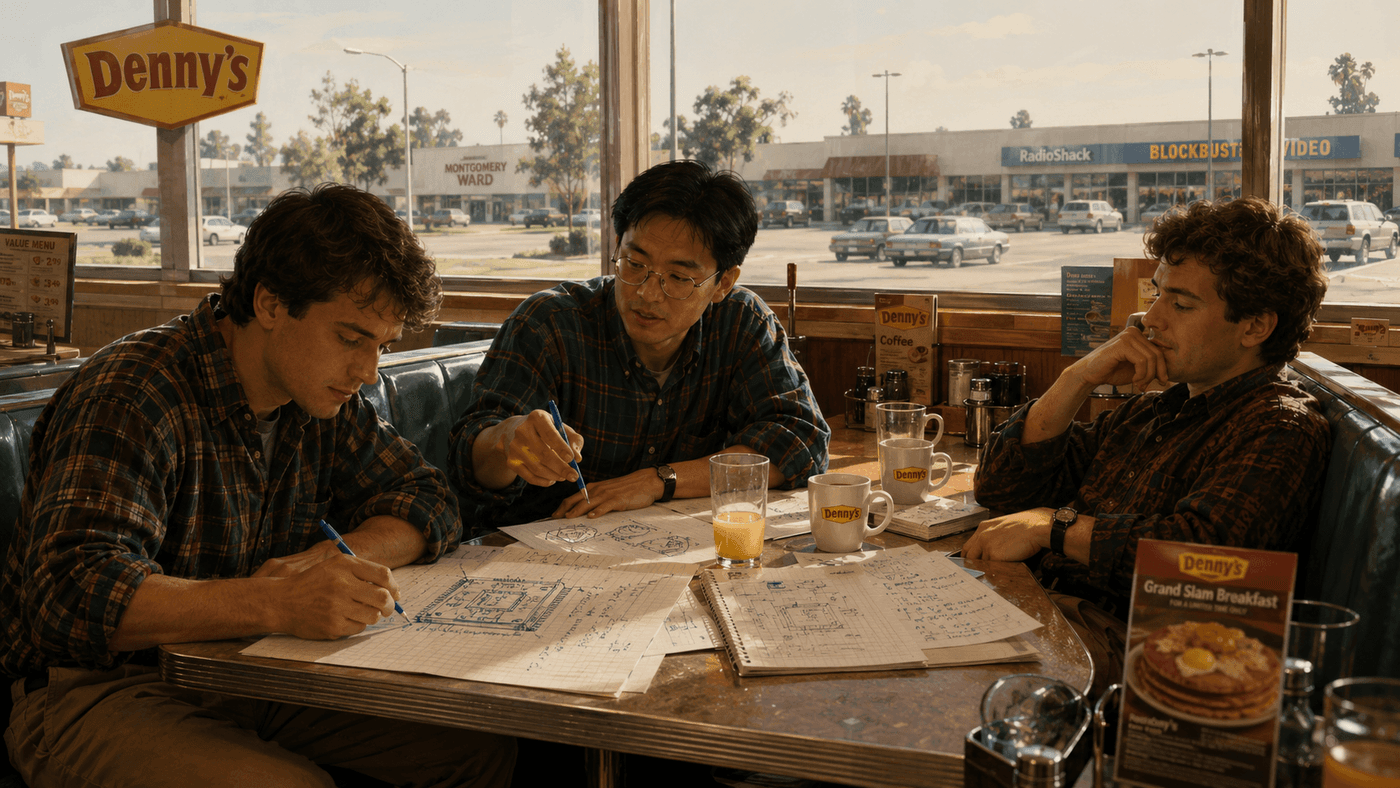
The Nvidia earnings report that Wall Street is fixated on tomorrow is, in one sense, a quarterly financial event — a data point in a spreadsheet. In another sense, it is a ledger of how thoroughly the world has reorganized itself around the GPU architecture that three engineers sketched out over coffee in 1992. Every ChatGPT response, every AI-generated image, every large language model, every self-driving vehicle system, every drug-discovery algorithm running in a pharmaceutical lab tonight is almost certainly running on Nvidia hardware. The company that Jensen Huang has led without interruption for 33 years — through near-bankruptcy, through the GPU era, through the CUDA bet, through AlexNet, through the explosion of generative AI — now supplies the computational substrate of the modern world. Tomorrow's numbers, whatever they are, will be read by historians as a marker of where that transformation stood in the spring of 2026. The Denny's on Berryessa Road is still there. The company it produced is now worth more than the entire GDP of Germany.