June 15: Defiance, Dissent, and the Law's Long Arc
The law has always been a battlefield of its own. June 15 marks three moments across eight centuries when the question of who holds power—and who is protected from its abuse—was put to the test. A young Black man walked across a stage at West Point in 1877 in the face of contempt and silence, claiming a commission the institution had tried to make impossible. Forty years later, Congress handed the government a sweeping new weapon to silence its critics in the name of wartime necessity. And seven centuries before either, a king knelt—however reluctantly—to the idea that even absolute power has limits. Together, these moments trace the long, uneven arc of law as both a shield and a sword.
The Long Walk Across the Plain
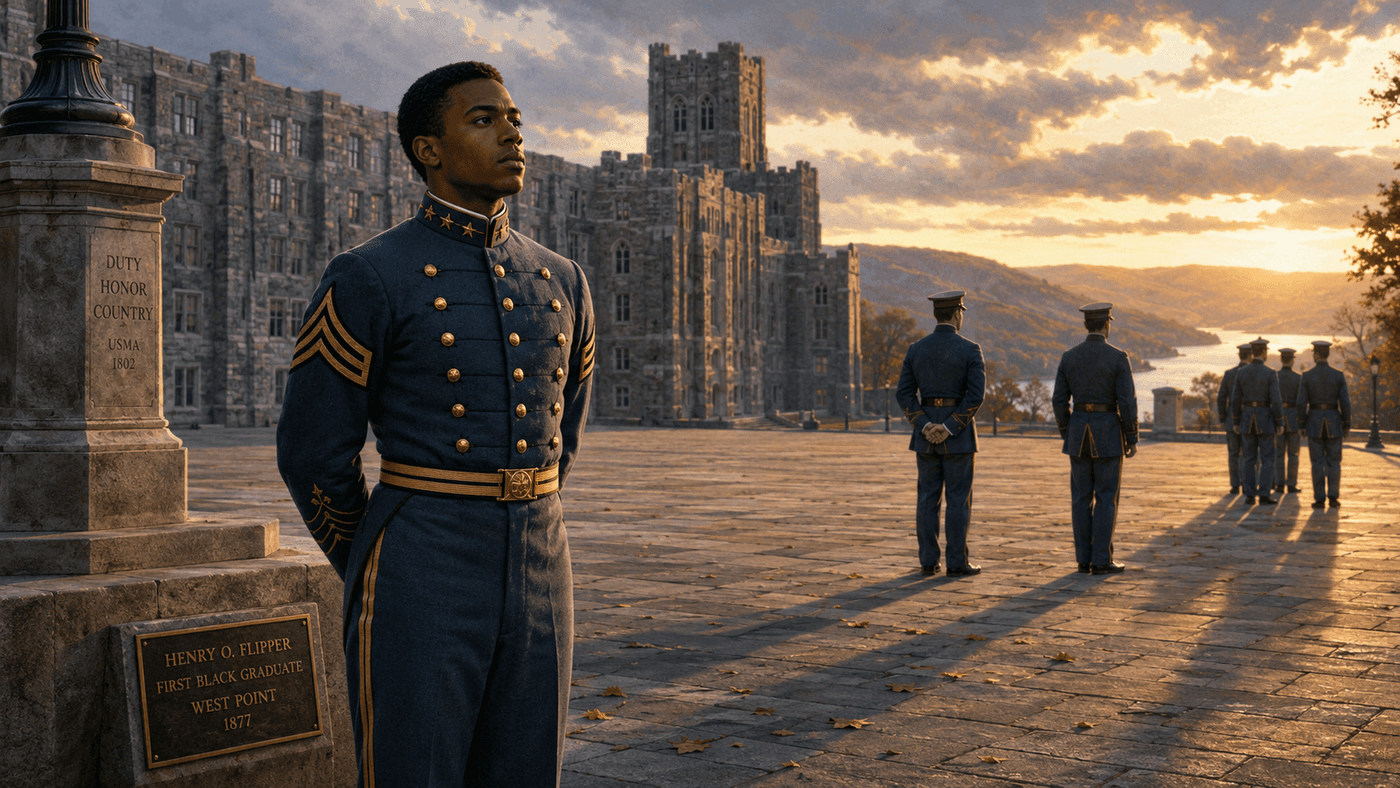
On June 15, 1877, Henry Ossian Flipper walked across the graduation stage at the United States Military Academy at West Point and became the first African American to earn a commission from the institution. It was a milestone achieved not with fanfare but with extraordinary endurance. From the moment Flipper arrived at West Point in 1873, he was subjected to a relentless campaign of social ostracism—his white classmates refused to speak to him, eat with him, or acknowledge his presence. He lived in near-total isolation for four years, studying alone, eating alone, drilling alone. He called it "the silence," and he survived it through a discipline of focus and pride that his tormentors could not break.
Flipper went on to serve with the Buffalo Soldiers on the Texas frontier, where he distinguished himself as an engineer, diplomat, and officer. But the Army was not finished with him: in 1881, he was court-martialed on dubious charges of embezzlement and conduct unbecoming an officer, convicted on the lesser charge, and dishonorably discharged—a verdict widely seen as retaliation for his very existence in the officer corps. He spent the rest of his life fighting the ruling, and though he died in 1940 without full vindication, the Army posthumously upgraded his discharge to honorable in 1976, and President Bill Clinton granted him a full pardon in 1999. A statue of Flipper now stands at West Point—on the same grounds where, for four years, no one would speak his name.
The Act That Never Expired
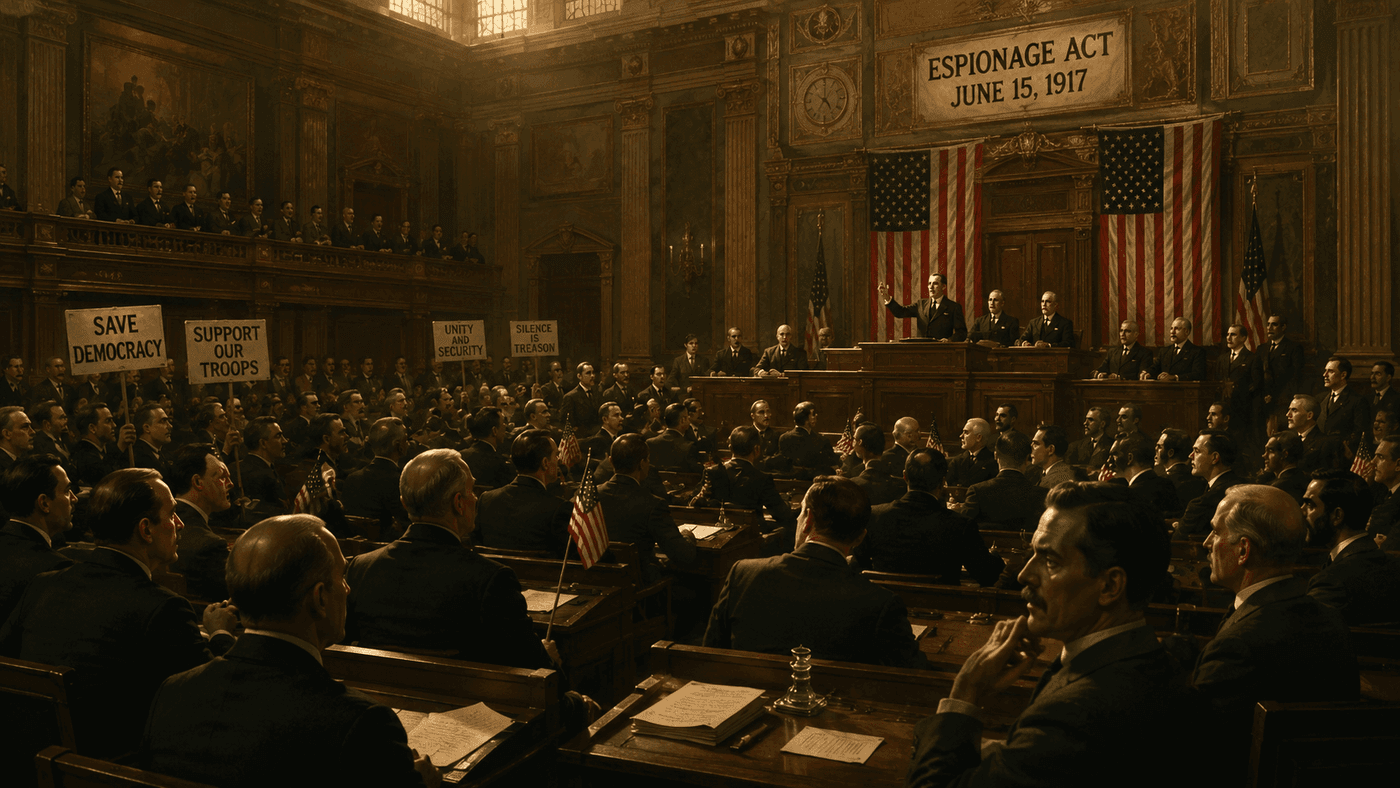
On June 15, 1917, just two months after the United States entered World War I, Congress passed the Espionage Act—one of the most consequential and controversial pieces of legislation in American history. On its face, the law was straightforward: it prohibited interference with military operations, recruitment, and the draft, and criminalized the willful transmission of information that could aid the nation's enemies. President Woodrow Wilson had pushed hard for it, and in the fevered atmosphere of wartime patriotism, it passed with broad support. Within months, the government was using it not just against foreign spies but against labor organizers, socialists, and antiwar activists—anyone whose speech could be construed as undermining the war effort.
The law's most famous early victim was Eugene V. Debs, the Socialist Party leader who was sentenced to ten years in prison in 1918 for a speech opposing the draft—a conviction the Supreme Court upheld. The Espionage Act was supposed to be a wartime measure, but it never went away. It was amended, expanded, and repurposed across the decades, becoming the statute of choice for prosecuting government leakers and whistleblowers in the twentieth and twenty-first centuries. Daniel Ellsberg, who leaked the Pentagon Papers in 1971, was charged under it. So were Chelsea Manning, Edward Snowden, and Reality Winner. The debate the law ignited in 1917—between national security and the freedom to dissent—is the same debate Americans are still having today.
Runnymede
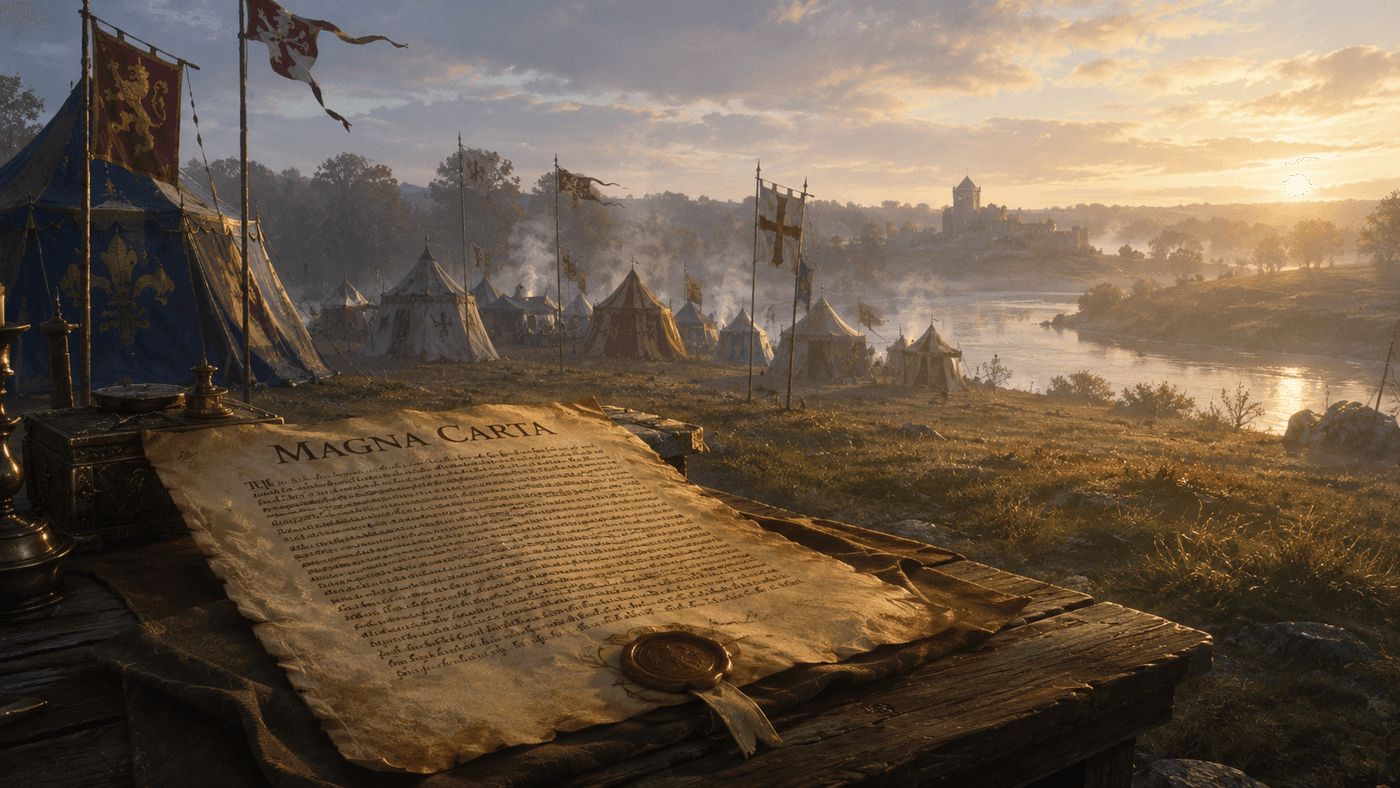
On June 15, 1215, in a meadow beside the River Thames called Runnymede, King John of England pressed his seal into the document his rebellious barons had forced upon him. The Magna Carta—the Great Charter—was in origin a practical political settlement, a list of grievances from the nobility demanding limits on royal taxation and arbitrary imprisonment. It was not a declaration of universal rights; most of its clauses concerned the privileges of feudal lords. King John had no intention of honoring it, and the Pope annulled it within weeks. Yet something in those 63 clauses refused to die. The idea that even a king was bound by law—that power itself had limits—proved more durable than the document's troubled birth suggested.
The Magna Carta's journey from disputed medieval charter to cornerstone of constitutional democracy runs directly through America. When the founders drafted the Constitution and the Bill of Rights, they were drawing on English common law traditions that traced their lineage to Runnymede. The Fifth Amendment's guarantee that no person shall be "deprived of life, liberty, or property, without due process of law" is a direct descendant of Magna Carta's promise that no free man shall be imprisoned or dispossessed except by the lawful judgment of his peers. The document that King John reluctantly sealed in 1215 was imperfect, self-interested, and almost immediately violated. But its core proposition—that law, not power, is sovereign—became the seed of every democratic constitution that followed, including the one that governs the United States today.