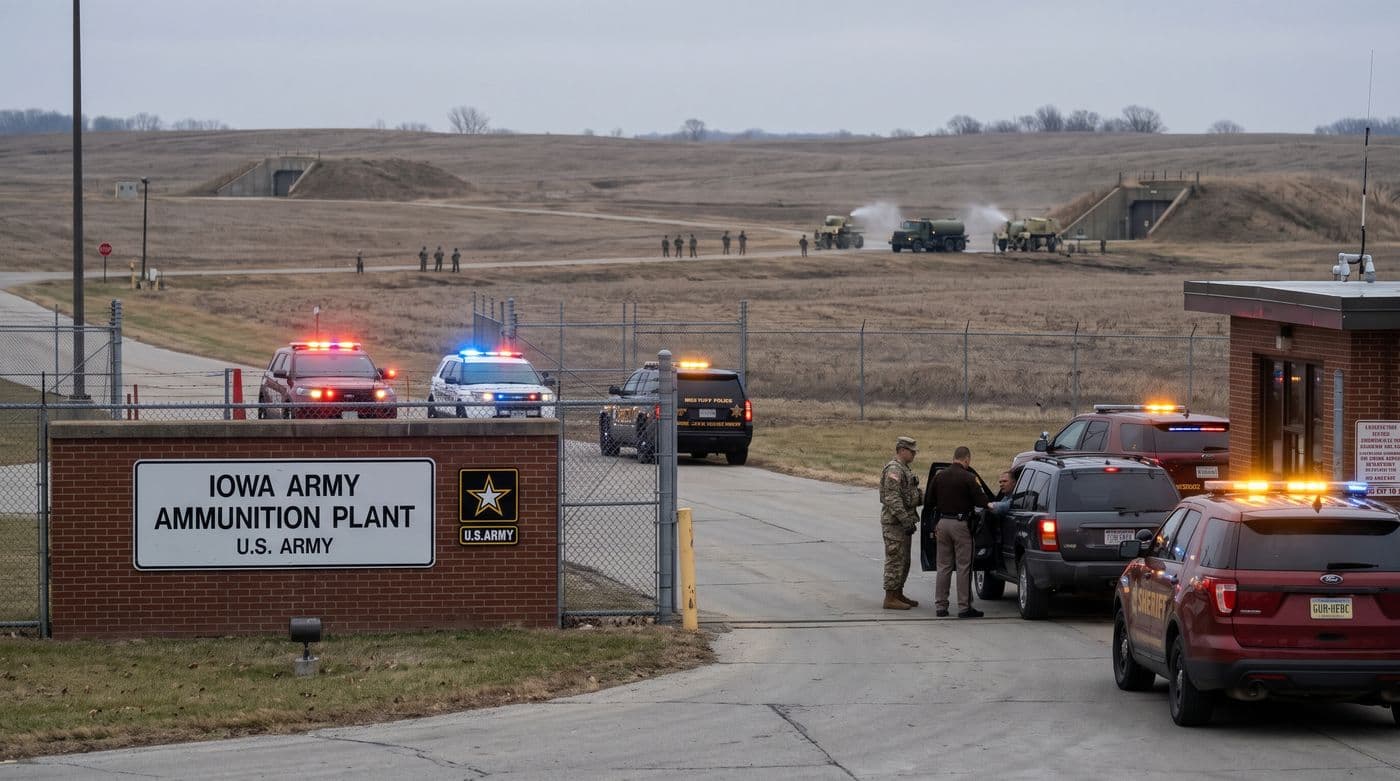
MIDDLETOWN, Iowa – The U.S. Army is moving forward with a plan to blow up nearly 5 tons of unstable, toxic lead explosives in rural Iowa, after a federal appeals court cleared the way.
The controlled detonation at the Iowa Army Ammunition Plant in Middletown is scheduled for around 9 a.m. Wednesday, Nov. 25. Army projections suggest it could send a plume of lead particles as far as 100 miles.
What's Being Destroyed
The Army is detonating 68 drums of lead azide, a chemical used to set off ammunition. The material has been stored at the plant for about 20 years.
According to the Army, the lead azide has gone through a process called "recrystallization," which made it highly unstable. The EPA has said the condition creates a risk of a spontaneous explosion, and that the material is too unstable to safely move or treat any other way.
Army officials say even moving or opening the drums could set off an explosion.
"We wanted to prevent having a high-order detonation because there is risk associated with that," acting Army Secretary Adam Telle said.
Residents Told to Leave

The Army recommended that local residents, especially children and pregnant women, evacuate. FEMA is supporting the relocation of all residents of Middletown, a town of about 400 people, and nearby affected areas.
To limit how much lead escapes, the soil around the storage bunkers will be soaked with water and misters will spray during the blast. The Army says it will issue a final estimate of the affected area after the detonation, and soil, air and water near the site will be tested before and after.
The blast could also cause ground vibrations and loud noise, and the Army has warned of possible localized window damage.
The Army says lead-containing dust could reach a wider area, and it is urging residents to wait for an all-clear before resuming outdoor activities.
A Legal Fight Over the Blast
The plan has faced fierce pushback.
The detonation was first scheduled for Friday, Nov. 20, then postponed. Environmental groups, including the Iowa Environmental Council and Sierra Club Iowa Chapter, went to court, arguing the lead dust could reach communities more than 100 miles away. Residents said they hadn't had enough time to prepare.
On Monday, President Donald Trump ordered the Army to hold off until the court weighed in. Later that day, a federal appeals court denied the environmental groups' emergency request to stop it.
Iowa's incoming governor, Rob Sand, said authorities should proceed based on the assessments of experts on the ground.
Why the Army Says It Can't Wait
Army officials say there is no safe alternative.
At a press conference Tuesday, Telle said experts agree that a controlled detonation is far better for public safety than an uncontrolled one. The Army has also warned that continued storage increases the risk of an uncontrolled explosion as temperatures drop.
Officials first learned about the deteriorating drums in March, during a routine inspection at the plant.