February 18: Huck Finn Published, Pluto Found, and Scientology Founded
February 18 connects three moments of discovery and creation. When Mark Twain published a novel that captured America's voice while confronting its racism, when a young astronomer spotted a faint dot that proved our solar system extended farther than anyone knew, and when a controversial figure formalized his teachings into a church that would attract celebrities and criticism in equal measure. These stories remind us that great literature challenges as much as it entertains, that patient observation reveals cosmic secrets, and that the line between philosophy and religion can be deliberately blurred.
All Modern American Literature Comes From This
On February 18, 1885, Mark Twain's Adventures of Huckleberry Finn was published in the United States, introducing readers to one of literature's most memorable narrators and controversial books. The novel follows Huck Finn, a barely literate boy, and Jim, an escaped enslaved man, as they raft down the Mississippi River seeking freedom. Twain wrote the novel in vernacular English, letting Huck tell the story in his own dialect-filled voice, capturing authentic American speech in ways no previous American novel had attempted. The book was immediately controversial, with some libraries banning it for its "coarse language" and portrayal of a boy who lies, steals, and rejects civilized society.
Huckleberry Finn became recognized as one of the great American novels, praised by Ernest Hemingway, who wrote that "all modern American literature comes from one book by Mark Twain called Huckleberry Finn." The novel's power lies in its moral complexity: Huck befriends Jim as an equal human being while society tells him enslaved people are property. Huck's crisis of conscience when he decides to "go to hell" rather than betray Jim represents one of literature's great moral moments. Yet the novel remains controversial for its repeated use of racial slurs and what some see as stereotypical portrayal of Jim, leading to ongoing debates about whether it should be taught in schools. The book published on this day demonstrated that great literature can be problematic and profound simultaneously, that capturing authentic American voices requires confronting America's ugliness, and that Twain understood that the highest morality sometimes means rejecting society's rules. Huckleberry Finn proved that novels written in vernacular could be literary art, that humor and social criticism could coexist, and that sometimes the most American thing is to light out for the territory ahead of civilization.

The Ninth Planet
On February 18, 1930, 23-year-old Clyde Tombaugh, a Kansas farm boy working as an assistant at Arizona's Lowell Observatory, discovered Pluto while comparing photographic plates of the night sky. For nearly a year, Tombaugh had been systematically photographing sections of sky, then examining the plates through a "blink comparator" that rapidly alternated between images taken days apart. Most objects remained fixed, but planets moved slightly against the stellar background. On this day, examining plates from January, Tombaugh noticed a faint speck that had shifted position. He had found the ninth planet, the object astronomers had been seeking since irregularities in Neptune's orbit suggested another world existed beyond it.
Pluto's discovery captivated the public, and the name suggested by 11-year-old Venetia Burney was adopted. The new planet seemed to complete the solar system. Yet Pluto proved puzzling: it was far smaller than expected, its orbit highly eccentric, and its composition more like a comet than a gas giant. Decades of observations revealed Pluto was merely the largest of many objects in the Kuiper Belt, a region of icy bodies beyond Neptune. In 2006, the International Astronomical Union controversially reclassified Pluto as a "dwarf planet," sparking public outcry from those who grew up with nine planets. The discovery announced on this day demonstrated that patient, systematic observation could reveal cosmic secrets, that our understanding of the solar system remains incomplete, and that scientific classification evolves as knowledge grows. Tombaugh's find expanded humanity's cosmic neighborhood, though the "planet" he discovered would eventually teach us that our solar system's architecture was more complex than we'd imagined. The young astronomer who spotted Pluto proved that dedication and sharp eyes matter as much as advanced degrees in making astronomical discoveries.

The Science Fiction Writer's Church
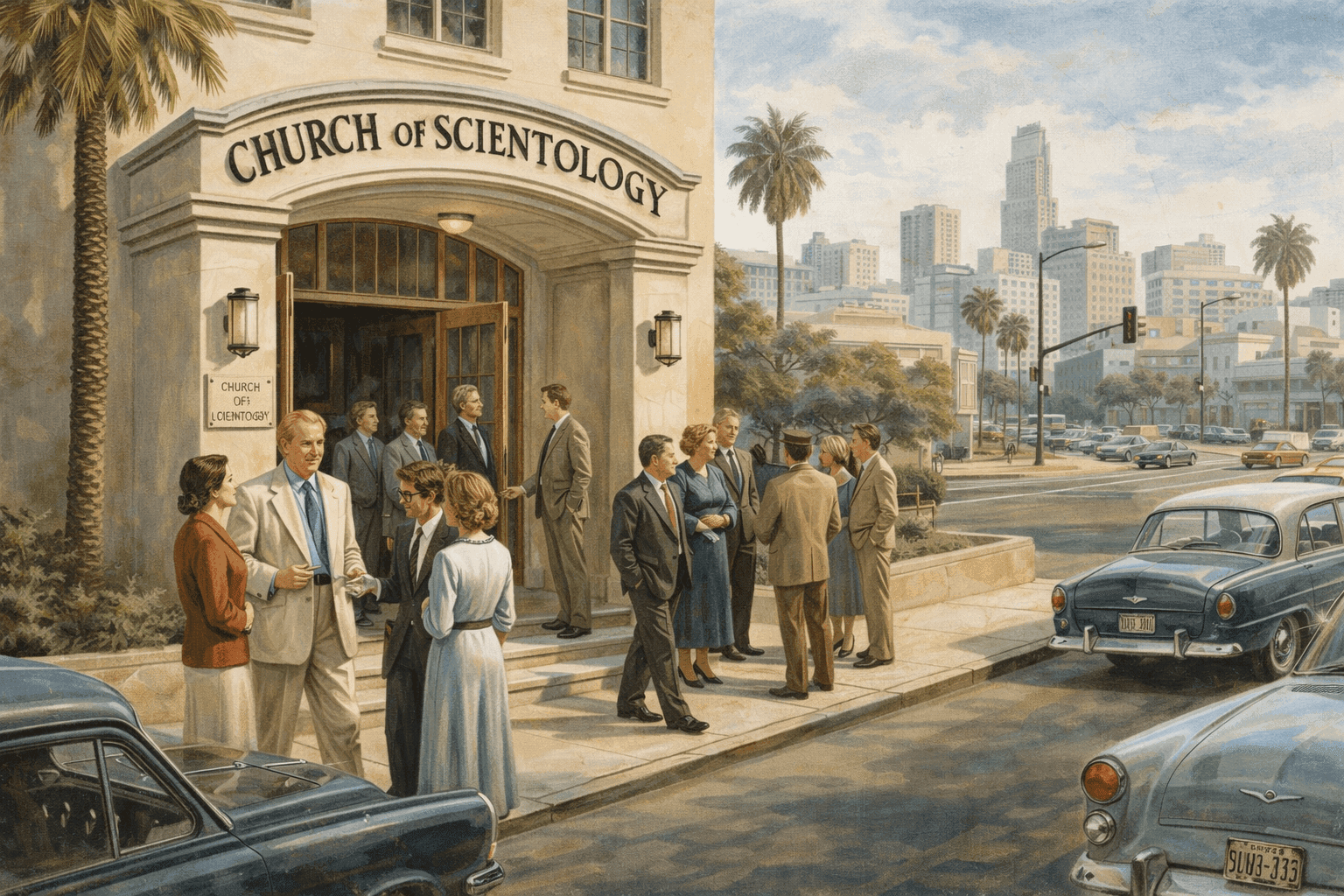
On February 18, 1954, L. Ron Hubbard established the first Church of Scientology in Los Angeles, formalizing his self-help philosophy "Dianetics" into an organized religion. Hubbard, a prolific science fiction writer who had published hundreds of stories, had introduced Dianetics in 1950 with a book claiming it could cure mental illness and unlock human potential through a process called "auditing." When financial and legal troubles threatened his organization, Hubbard reframed Dianetics as a religion, gaining tax-exempt status and constitutional protections. The Church of Scientology promised spiritual enlightenment through increasingly expensive courses designed to clear away "engrams" and achieve higher states of being.
Scientology became one of the 20th century's most controversial religious movements, attracting celebrities like Tom Cruise and John Travolta while facing accusations of being a cult that exploits members financially and psychologically. Critics pointed to Hubbard's statement that "the way to make a million dollars is to start a religion," to allegations of harassment against defectors and critics, and to the organization's aggressive legal tactics. Supporters described Scientology as a legitimate religion offering practical spiritual technology. The church founded on this day demonstrated how science fiction concepts could be marketed as spiritual truth, how charismatic leaders can build movements that blur lines between religion and business, and how organizations can use religious protection to shield controversial practices. Scientology proved that in America's religious marketplace, new faiths can emerge and thrive despite skepticism, that celebrity endorsements can legitimize fringe movements, and that religious freedom protections apply even to faiths that seem more like commercial enterprises. The church established on this day remains controversial, simultaneously defended as a sincere religion and criticized as a predatory organization, proving that line between faith and fraud remains contested territory.