
February 17: Remembering a Voice for Justice
Today, February 17, 2026, America reflects on the passing of Reverend Jesse Jackson, one of the most consequential civil rights leaders of the twentieth and twenty-first centuries. From the streets of Selma to the floors of the Democratic National Convention, from negotiating the release of hostages abroad to registering millions of new voters at home, Jackson spent more than six decades transforming the landscape of American politics and expanding the boundaries of what seemed possible. His voice—rhythmic, prophetic, urgent—called a nation to live up to its highest ideals, and his legacy reminds us that the work of justice is never finished, only carried forward by those who refuse to accept inequality as inevitable.
From Greenville to Greatness
Born Jesse Louis Burns on October 8, 1941, in Greenville, South Carolina, to a teenage mother and absent father, Jackson's early life was marked by the sting of segregation and the strength of Black community resilience. Adopted by his stepfather Charles Henry Jackson, he excelled as a student and athlete, earning a football scholarship to the University of Illinois before transferring to North Carolina A&T, a historically Black university where he found his calling in the burgeoning civil rights movement. After seminary training at Chicago Theological Seminary, Jackson joined Dr. Martin Luther King Jr.'s Southern Christian Leadership Conference, quickly becoming one of King's most trusted lieutenants and standing with him on the balcony of the Lorraine Motel on that terrible April evening in 1968 when an assassin's bullet ended King's life but not his movement.
In the decades that followed, Jackson became a force unto himself. He founded Operation PUSH (People United to Save Humanity) in 1971 and the Rainbow Coalition in 1984, organizations dedicated to economic justice and political empowerment for marginalized communities. His two presidential campaigns—in 1984 and 1988—shattered barriers and transformed American politics, proving that a Black candidate could compete seriously for the nation's highest office and building a multiracial coalition that presaged demographic and political shifts still unfolding today. Though he never won the presidency, Jackson's campaigns registered millions of new voters, forced the Democratic Party to confront issues of economic inequality and racial justice, and inspired a generation of young activists who saw in his candidacy both a challenge to the status quo and a vision of what America could become.
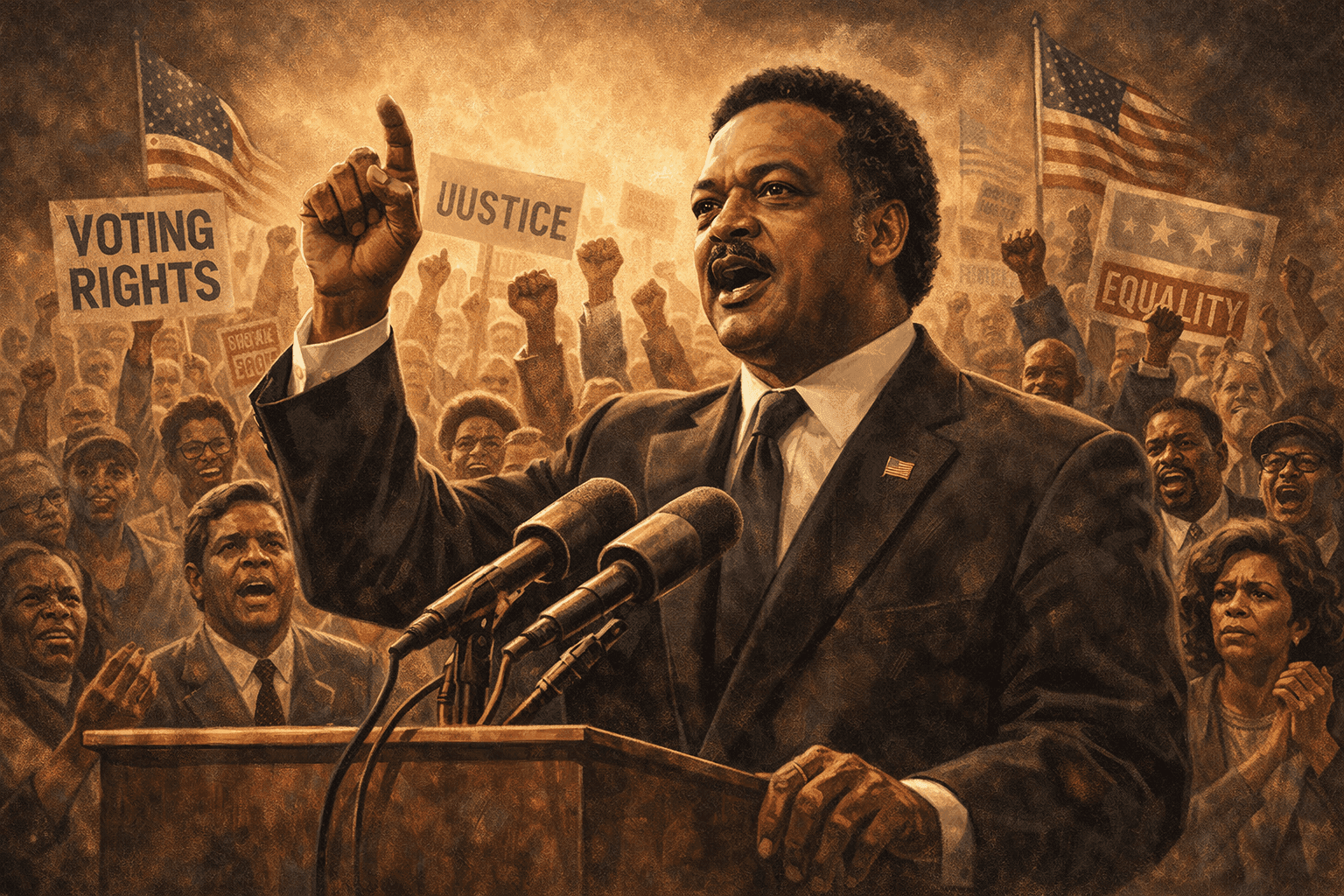
But Jackson's influence extended far beyond electoral politics. He became America's unofficial diplomat to the world's trouble spots, using moral persuasion and back-channel negotiations to secure the release of hostages and prisoners held in Syria, Cuba, and Iraq. He marched with striking workers, stood on picket lines outside corporate headquarters, and challenged companies to hire more minorities and do business with Black-owned firms. His weekly radio programs and newspaper columns kept issues of economic justice front and center in national discourse. And his Saturday morning speeches at Rainbow/PUSH headquarters in Chicago became a training ground for young organizers and a pulpit from which he could still speak truth to power, his voice perhaps a bit softer with age but his message as urgent as ever: "Keep hope alive."
As news of Jackson's passing spreads today, the tributes pour in from across the political spectrum, from presidents and civil rights icons to community organizers and ordinary citizens whose lives he touched. His family has announced plans for a series of memorial services that will take him from Chicago to Washington to Selma, retracing the geography of a movement he helped build. In recent years, as Parkinson's disease slowed his movements but not his spirit, Jackson had become a living bridge between generations of activists—the young people marching for racial justice in 2020 walking in footsteps he had helped forge in 1965. His passing marks the end of an era, but his legacy endures in every voter registration drive, every coalition built across racial lines, every young person who looks at the barriers before them and hears an echo of his words: "Our time has come." The work continues, carried forward by those who remember that justice, like hope, must be kept alive through action, courage, and an unwavering belief that a better world is possible.