
On this day in history, the first modern Olympic Games opened in Athens, Greece. They revived the ancient tradition of athletic competition and facilitated international unity and cooperation through sports. Organized by French educator Baron Pierre de Coubertin, the inaugural games attracted athletes from 14 nations, marking the beginning of a storied tradition that continues to captivate the world every four years.
A Vision Rekindled from Antiquity
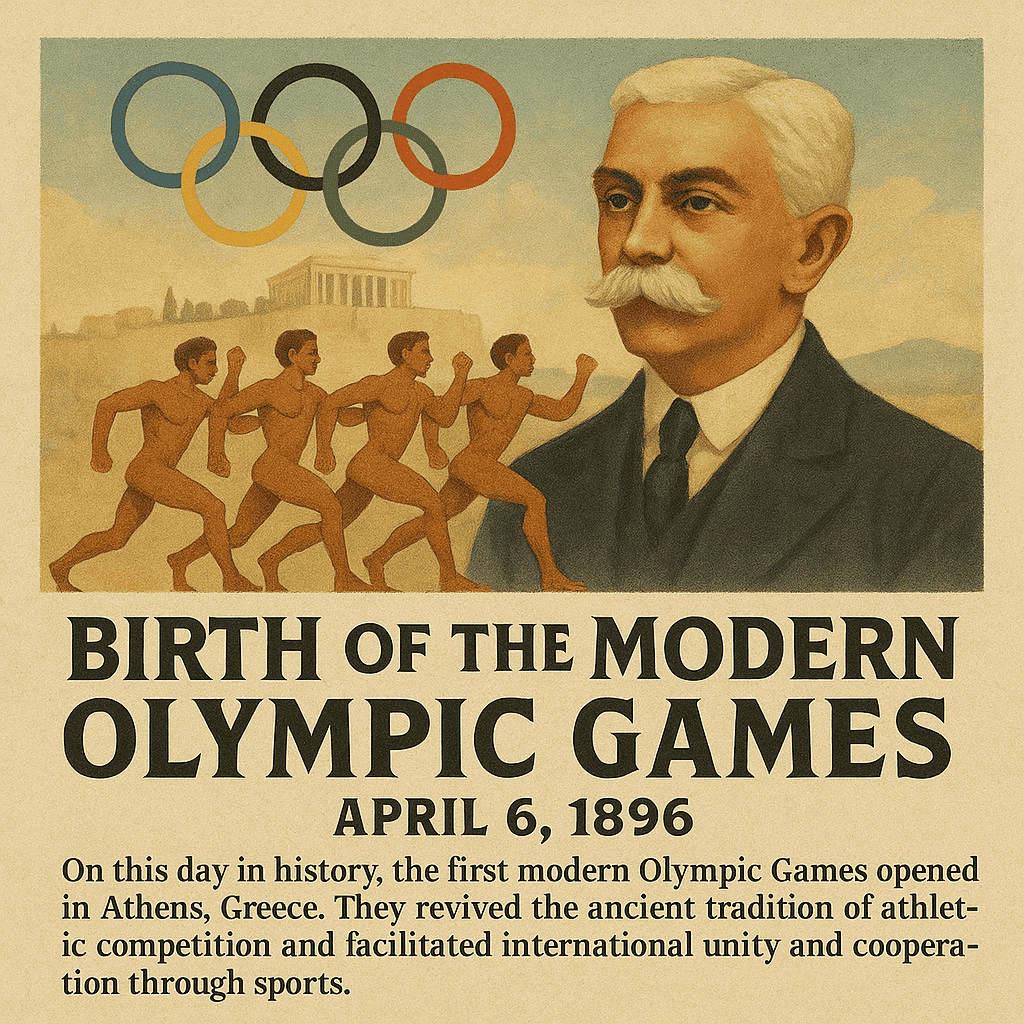
The Olympic Games had not been held for over 1,500 years when Baron Pierre de Coubertin first proposed their revival in 1894. Inspired by the ancient Greek tradition of athletic excellence and his belief in the power of sports to promote peace and understanding between nations, de Coubertin founded the International Olympic Committee (IOC). The decision to hold the first Games in Athens was both symbolic and practical—it paid homage to the Games’ Greek origins while aligning with Greece’s own aspirations to restore its classical heritage and elevate its status on the global stage.
When the Games officially opened on April 6, 1896, the atmosphere in Athens was electric. Held in the recently refurbished Panathenaic Stadium, which had been reconstructed entirely of marble, the event brought together over 240 athletes from Europe, the Americas, and beyond to compete in 43 events. These included track and field, gymnastics, wrestling, weightlifting, fencing, and cycling. Though the number of participating countries and athletes was small by today’s standards, the enthusiasm and symbolic power of the event were immense.
Symbol of Global Unity and Peace
The Athens Games laid the foundation for what would become a powerful symbol of international cooperation. The Olympics represented more than just athletic excellence—they provided a peaceful forum for nations to gather in competition rather than conflict. Although women were not yet allowed to compete in 1896, the stage was set for future inclusivity and the progressive evolution of the Games.
The symbolism of the Games was underscored by their emphasis on fair play, discipline, and the celebration of human potential. The Olympic motto “Citius, Altius, Fortius” (Faster, Higher, Stronger) would come to define not just athletic achievement, but a shared ideal of human progress. The Athens Games succeeded in demonstrating that sport could transcend political and cultural differences, even as the world stood on the cusp of a new, more turbulent century.
Legacy of the Modern Olympic Movement
The impact of the 1896 Games continues to resonate more than a century later. What began as a modest gathering in Athens has grown into the largest and most celebrated sporting event on the planet, involving over 200 nations and thousands of athletes in both Summer and Winter Games. The Olympic flame, torch relay, and the opening ceremonies—all hallmarks of today’s Games—find their roots in that 1896 revival.
Moreover, the Olympic movement has evolved to address contemporary challenges and promote broader goals, such as sustainability, gender equality, and human rights. From its origin in a marble stadium in Athens to today’s high-tech arenas, the Olympics serve as a reminder of what humanity can achieve when it unites in the spirit of peaceful competition and shared purpose.
As we reflect on April 6, 1896, we celebrate not only the rebirth of a historic tradition but also a legacy that continues to inspire and bring the world together, one Games at a time.