
May 9: Yesterday's Enemy, Today's Ally; The Pill Changes Everything; A Leader Lost to Terror
The world that existed on May 9 in three different years looks, in each case, fundamentally different from the one that preceded it — not because of a single dramatic rupture, but because of decisions made, pills approved, and lives lost that reset the terms on which the future would be negotiated. A nation that had plunged Europe into its worst catastrophe was welcomed into the Western defense alliance a decade later. A small white tablet approved by a federal agency gave women a form of reproductive autonomy that no previous generation had possessed. And a former prime minister, held for fifty-five days in a hidden room by political extremists, was found in the trunk of a car in Rome, dead — a reminder that democracy's enemies do not always come from outside its borders. Three different kinds of change, on the same date, in three different decades, each one irreversible.
From Rubble to Alliance
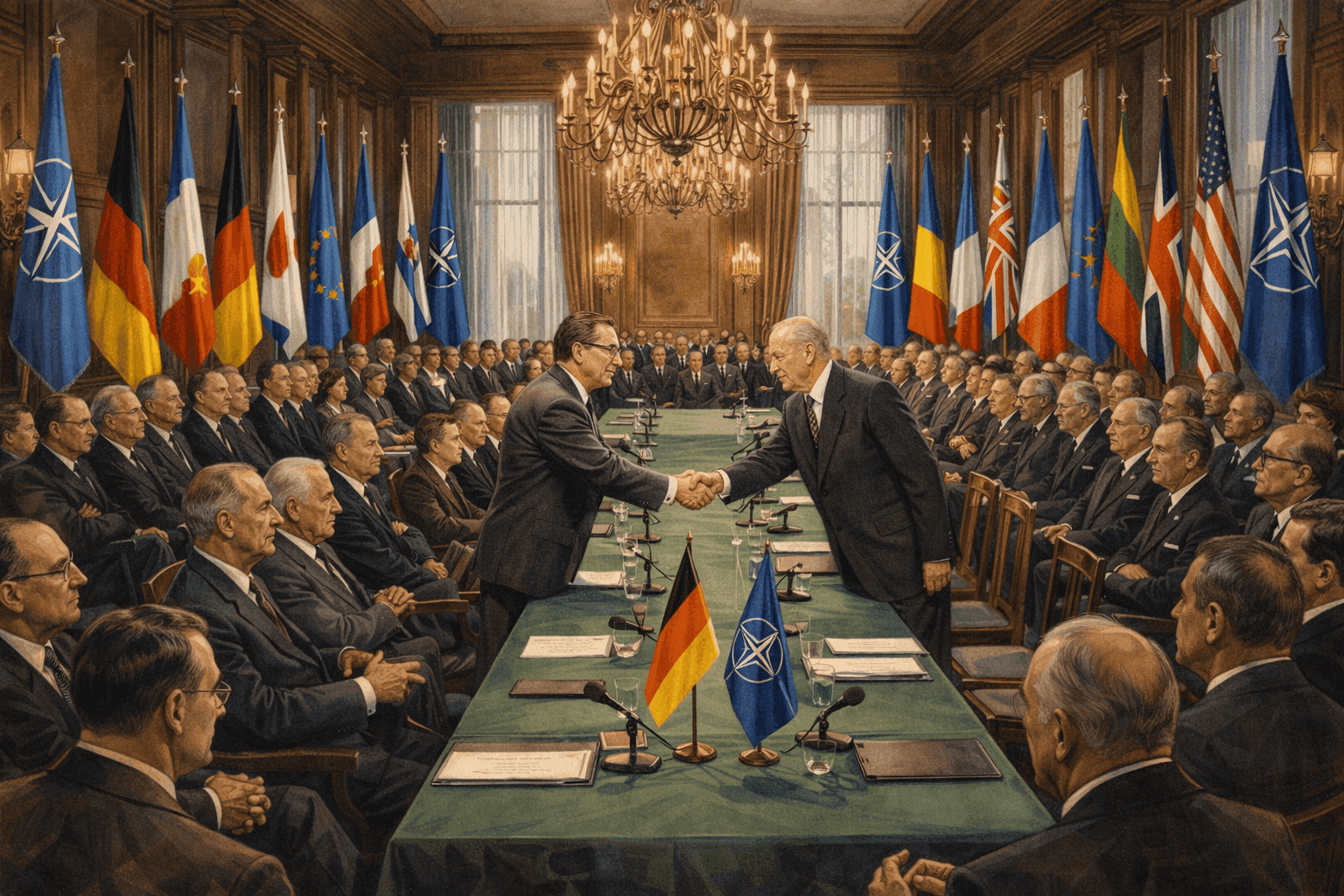
On May 9, 1955 — exactly ten years after V-E Day — West Germany was formally admitted to the North Atlantic Treaty Organization, completing one of the most remarkable political rehabilitations in modern history. A decade earlier, Germany's cities had been rubble, its government dissolved, its territory divided among four occupying powers, and its name synonymous with a war that had killed tens of millions of people and a genocide that had murdered six million Jews and millions of others. The idea that this same country would, within a decade, be welcomed as an equal partner into a Western military alliance was not obvious — it required the overcoming of profound grief and suspicion among former Allied nations, particularly France, and a deliberate, sustained effort by West German Chancellor Konrad Adenauer to anchor the new Federal Republic to the democratic West through institutions, treaties, and the frank acknowledgment of German guilt.
The strategic logic was cold and clear: the Soviet Union now occupied Eastern Europe and had stationed hundreds of thousands of troops in East Germany. NATO needed West German territory, West German soldiers, and West German industrial capacity to credibly deter Soviet expansion westward. France, which had been invaded by Germany twice in living memory and had insisted at the 1919 Paris Peace Conference on terms designed to permanently weaken its neighbor, swallowed its objections — partly through the creation of the Western European Union as a simultaneous framework that placed West German rearmament under multilateral oversight. West Germany joined NATO on May 9, 1955; the Soviet Union responded by forming the Warsaw Pact five days later. The Cold War's European architecture — two armed alliances facing each other across the Iron Curtain — was now complete. That West Germany stood firmly on the Western side of that line, and would remain there for the next thirty-five years until reunification, was among the defining facts of the postwar order.
The Pill
On May 9, 1960, the United States Food and Drug Administration approved Enovid — a combined oral contraceptive developed by chemist Carl Djerassi and gynecologist John Rock, and manufactured by G.D. Searle & Company — as the first birth control pill available for commercial prescription in the United States. The FDA's approval was technically limited to the treatment of menstrual disorders, a regulatory framing that reflected the political and social sensitivities surrounding contraception in 1960; within a year, Enovid had been approved explicitly for contraceptive use, and within five years more than six million American women were taking it. The pill's development had been financed in significant part by Margaret Sanger and heiress Katharine McCormick, both of whom had spent decades fighting for women's access to reliable contraception and who lived long enough to see the pill approved — Sanger died in 1966, McCormick in 1967.
The cultural consequences of the pill's approval on May 9, 1960, are almost impossible to overstate — and are still unfolding. For the first time in human history, women had access to a highly reliable, woman-controlled method of preventing pregnancy that was separated from the act of sex itself. The implications reached into every domain of women's lives: educational attainment, career planning, the timing and spacing of children, the negotiation of relationships, the understanding of female sexuality as something independent of reproduction. The relationship between the pill's approval and the feminist movements of the 1960s and 1970s is complex — the pill was in some respects both a product of and a catalyst for changing ideas about gender and autonomy — but the directional connection is clear. A woman who could reliably determine when she became a mother had a different relationship to every other choice in her life. The small white tablet approved by the FDA on this date in 1960 did not create that possibility from nothing. It made it real, at scale, for the first time.

The Years of Lead
On May 9, 1978, the body of Aldo Moro — five-time Prime Minister of Italy, leader of the Christian Democracy party, and the country's most prominent political figure — was found in the trunk of a red Renault parked on Via Caetani in Rome, equidistant between the headquarters of the Christian Democrats and the Italian Communist Party, a placement that investigators concluded was deliberate. Moro had been kidnapped fifty-five days earlier, on March 16, 1978, when Red Brigades terrorists ambushed his motorcade in Rome, killing his five bodyguards and seizing him in broad daylight in one of the most audacious political kidnappings in European history. The Red Brigades — a far-left armed group that believed parliamentary democracy was a facade for capitalist oppression — demanded the release of imprisoned comrades. The Italian government, under intense pressure from allies including the United States and the Vatican, refused to negotiate.
The fifty-five days of Moro's captivity were an agony for Italy — a country already convulsed by what became known as the anni di piombo, the "Years of Lead," a period of political violence from both the far left and far right that had claimed hundreds of lives through the 1970s. Moro wrote letters from captivity to government colleagues pleading for his life; they were largely dismissed as written under duress. His murder on May 9 — the method was never conclusively established; multiple shots at close range — provoked a national trauma whose reverberations shaped Italian politics for decades. The Red Brigades had intended to demonstrate the weakness of the Italian state. What they demonstrated instead was its resilience: the government did not fall, the institutions held, and the brigades were systematically dismantled by law enforcement in the years that followed. Moro's death, however, left a question that Italy has never fully answered — about what might have been possible had the politician who had spent his career trying to build a broad democratic coalition lived to pursue it.