
May 3: The Mind That Made Power Honest, A Mother's Fury Becomes a Movement, The Exxon Executive Who Never Came Home
Some of history's most consequential acts begin with an unflinching look at an uncomfortable truth. May 3 belongs to three figures who took that look and refused to turn away: a Florentine civil servant who wrote down what political power actually does, rather than what it claims to do, and in doing so became one of the most read and most reviled thinkers of the last five centuries; a California mother who stood at the edge of a grief that would have undone most people and transformed it, with extraordinary speed and discipline, into a movement that has saved hundreds of thousands of lives; and a case that forced an entire class of American executives to reckon with the fact that wealth and title offer no immunity from the most elemental forms of danger.
The Realist in the Room
On May 3, 1469, Niccolò Machiavelli was born in Florence, the son of a lawyer of modest means who gave his boy a classical education and an early familiarity with the Roman historians who would shape his thinking for life. Florence in the late fifteenth century was one of the most politically turbulent cities in Europe — a republic nominally governed by its citizens but in practice dominated by the Medici family, subject to the constant pressure of foreign powers, and navigated by men who understood that survival in public life required a clear-eyed understanding of how things actually worked rather than how they were supposed to work. Machiavelli entered the Florentine civil service in 1498, served as a senior diplomat and military administrator for fourteen years, and watched at close range as Cesare Borgia, Pope Julius II, and a succession of French and Spanish kings demonstrated the principles that he would later distill into the most controversial political treatise in Western history.
When the Medici returned to power in 1512 and the republic he had served was dissolved, Machiavelli was imprisoned, briefly tortured on suspicion of conspiracy, and exiled to his small farm outside Florence, where he wrote. The Prince, completed in 1513 and dedicated to Lorenzo de' Medici in an unsuccessful bid for employment, described the acquisition and maintenance of political power with a candor that scandalized readers for centuries — and that continues to provoke argument today. His central insight, stripped of its Renaissance context, is simply this: that political leaders who survive and succeed are those who understand that the world operates according to power and interest, not according to the moral principles they publicly profess, and that effective leadership sometimes requires the willingness to act accordingly. The name "Machiavellian" became a byword for amoral cunning — an unfair reduction of a thinker who was also a committed republican, a historian of genuine depth, and a man whose political realism was born from the painful experience of watching idealism fail. He died in 1527, still hoping for a return to public life that never came. The Prince has never gone out of print.

Candy
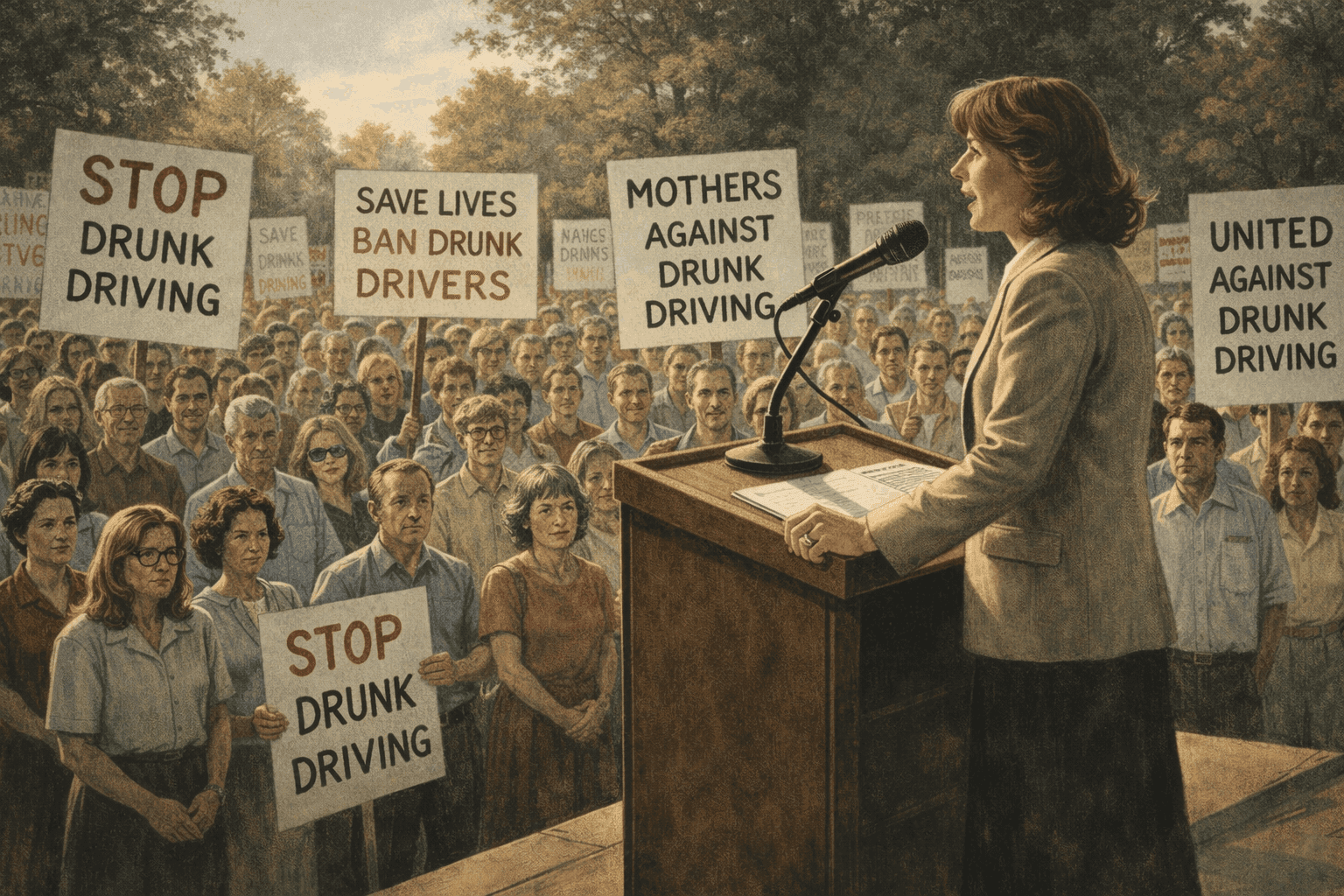
On May 3, 1980, thirteen-year-old Cari Lightner was walking to a church carnival with a friend near her home in Fair Oaks, California, when she was struck from behind and killed by a drunk driver. The man who killed her, Clarence Busch, had been arrested for drunk driving three times in the previous four years and had been out on bail for a previous hit-and-run at the time of the crash. He served less than two years in a work camp and a halfway house. Cari's mother, Candy Lightner — who had just turned thirty-three the day before her daughter died — was told by police investigators that Busch would likely serve no jail time at all and advised her, essentially, not to expect justice from the system as it existed. She took that information and turned it into an organization.
Mothers Against Drunk Driving was founded by Candy Lightner in 1980, within months of Cari's death, initially from her home in Sacramento with a group of five women who shared her experience of loss and her conviction that the laws, the penalties, and the culture around drunk driving in America were catastrophically inadequate. Within two years MADD had chapters in every state. Within three it had the ear of Congress and the White House: a Presidential Commission on Drunk Driving issued recommendations in 1983 that directly influenced federal legislation raising the national drinking age to twenty-one, a change the organization had championed. The statistics that followed were unambiguous. Drunk driving fatalities in the United States dropped from approximately 21,000 per year in 1980 to fewer than 10,000 by the early 2000s — a reduction attributed in significant part to MADD's advocacy, public education campaigns, and the legal changes it helped produce. By any measure, the organization that Candy Lightner built from grief has saved more than 400,000 lives in the four decades since Cari walked toward a church carnival and did not come home.
The Driveway on Redhill Road
In late April 1992, Sidney Reso — the president of Exxon International and one of the most senior executives at one of the world's largest corporations — disappeared from his driveway in Morris Township, New Jersey, on his way to work. The kidnapping had been meticulously planned by Arthur Seale, a former Exxon security manager, and his wife Irene, who believed they could extract a ransom from the corporation while keeping Reso alive as collateral. The plan unraveled from the beginning: Reso was shot during the abduction and sustained a wound that was never properly treated. He died in captivity on May 3, 1992, of dehydration and the effects of his untreated injury, held in a wooden storage box in a storage unit while the Seales continued negotiating with Exxon for $18.5 million. His death transformed what the kidnappers had conceived as a financial crime into a murder.
The Seales were arrested in June 1992 after FBI agents traced ransom drop instructions to a pay phone. Arthur Seale pleaded guilty to murder, extortion, and kidnapping and received a life sentence; Irene Seale received twenty years. The case prompted a significant reassessment of corporate security practices for senior executives, accelerating the adoption of security protocols — varying routes to work, driver training, executive protection details — that have since become standard for the highest levels of corporate leadership. Sidney Reso was sixty years old and had worked for Exxon for thirty-one years. He had left home on an ordinary morning. The Reso case sits in the record not as a story about corporate power but as a reminder of something simpler and more unsettling: that the most ordinary moments of daily life — a driveway, a morning commute — can be the most exposed, and that no title or position provides the kind of safety that most of us assume, without thinking about it, that we have.