May 23: Franklin's Gift to Every Reader, The Ambush That Closed a Legend, A Wave from Chile
The world can change your vision gradually and without announcement — something that was clear becomes blurred, something distant becomes frightening, something that seemed fixed turns out to have been moving toward you at hundreds of miles per hour. May 23 understands this. An aging founding father who could no longer read without discomfort and could no longer see at a distance without squinting solved both problems at once with a single practical innovation. Two Depression-era outlaws who had built a mythology around their running discovered that the road eventually ends. And a tsunami generated by the largest earthquake in recorded history traveled silently across the Pacific for fifteen hours before announcing itself on a Hawaiian shoreline with a force that no warning system then in place was adequate to address. Three stories about the moment the world comes into focus — or disappears from view entirely.
Two Lenses, One Frame
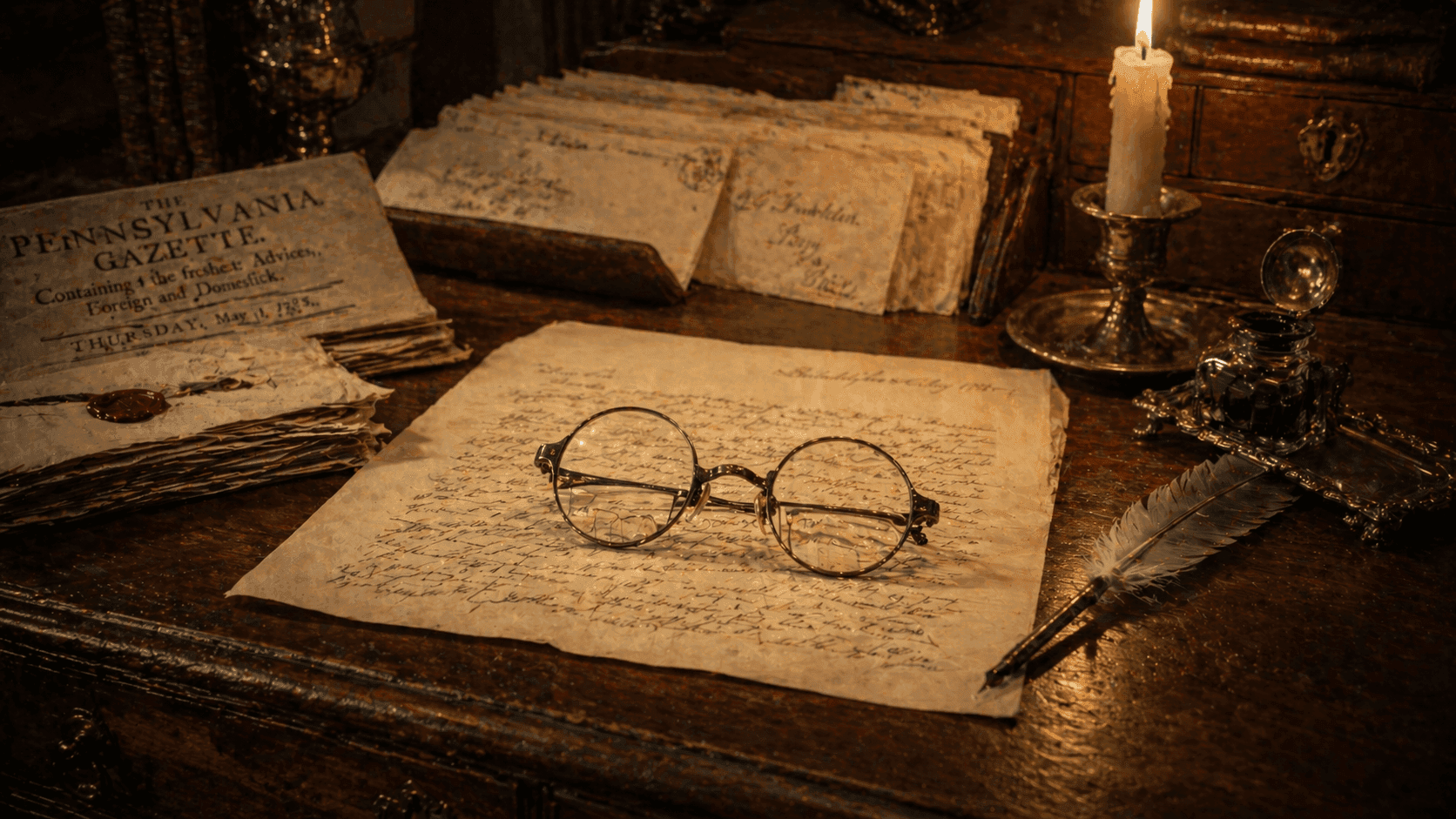
On May 23, 1785, Benjamin Franklin wrote to his friend George Whatley describing an invention he had devised to solve what he called the "double inconvenience" of needing two pairs of spectacles — one for reading and one for distance — and the nuisance of constantly switching between them. His solution was characteristically direct: he had his optician cut both lenses in half horizontally and mount the reading lens in the bottom of each frame and the distance lens in the top. The wearer could look up through the distance lens and down through the reading lens, shifting focus without changing glasses. He called them "double spectacles"; the world would come to call them bifocals. Franklin was seventy-nine years old, had been wearing spectacles for decades, and had arrived at the invention through the same process of observational problem-solving that had produced his lightning rod, his stove, and his foundational experiments in electricity — not through laboratory research but through paying close attention to a practical annoyance and thinking carefully about how to remove it.
The bifocal lens is one of those inventions whose ubiquity has made it nearly invisible — it is so embedded in daily life that it requires an effort to notice it as an invention at all. An estimated 150 million people in the United States alone wear prescription eyeglasses, and bifocal and progressive lens technology — the direct descendants of Franklin's divided frames — constitutes a substantial portion of that market. Franklin himself wore bifocals for the last five years of his life, using them when he signed the Constitution of the United States in 1787, at the Paris peace negotiations, and at the countless diplomatic dinners and correspondence sessions that filled his old age. He was, by any measure, one of the most productive elderly men in American history, and the glasses that let him see — both near and far — were his own invention. The lens that clarified the world for Benjamin Franklin is still clarifying it, for millions of people, every day.
Ambush on the Sailes Road
On the morning of May 23, 1934, on a rural road in Bienville Parish, Louisiana, a posse of six law enforcement officers — including former Texas Ranger Frank Hamer, who had been specifically hired to track and end the Barrow Gang — waited in concealment on either side of a stretch of highway near the small community of Sailes. When a stolen tan Ford V-8 sedan came around a bend and slowed near a truck that had been planted as a decoy, the officers opened fire. The car contained Clyde Barrow and Bonnie Parker. Both were killed in the fusillade, which lasted an estimated ten to fifteen seconds and involved approximately 130 rounds. Barrow was twenty-five years old; Parker was twenty-three. They had been together for approximately two and a half years, during which time their gang had committed thirteen murders, multiple robberies, and a series of prison breaks and escapes that had made them the most wanted fugitives in the country.
The mythology that attached itself to Bonnie and Clyde almost immediately after their deaths is one of the more instructive examples of how the Depression era processed its own discontents. In a time of mass unemployment, bank failures, and the collapse of the economic systems that ordinary people had trusted, the couple's serial bank robberies gave them a Robin Hood framing that their actual conduct did not support — they were not notably charitable, and most of their victims were not banks but small-town stores and gas stations. The violence they left behind was real and personal and ugly. And yet the image persisted, sustained by Bonnie's own poems written from the road, by the photographic record the couple themselves cultivated, and by Arthur Penn's 1967 film that transformed them definitively into cultural icons. The gap between the mythology and the reality is itself part of the story — of what America has sometimes needed its outlaws to represent, regardless of what they actually were. The road outside Sailes ended the reality. The mythology, as mythology tends to, kept going.

Fifteen Hours Across the Pacific
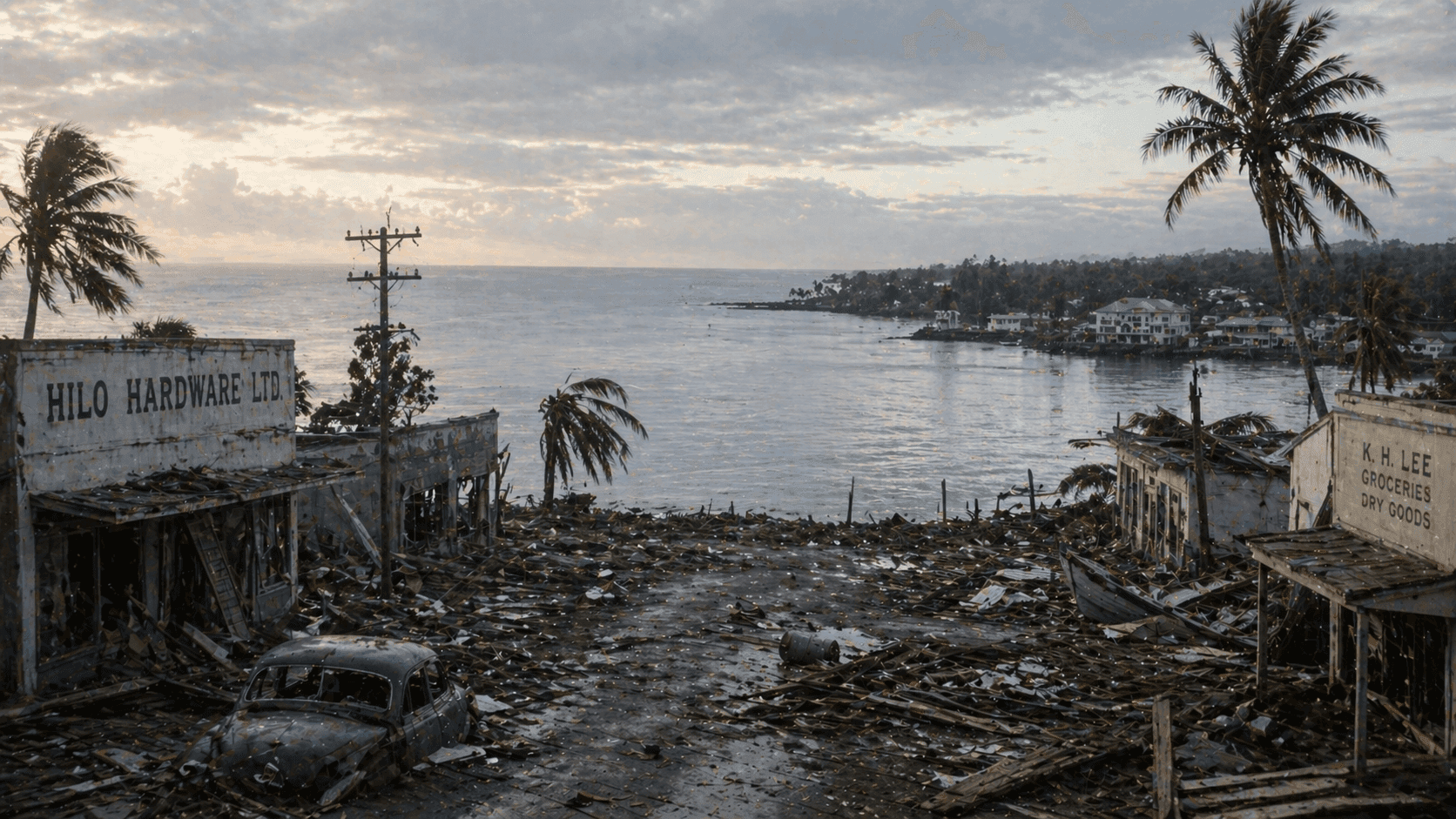
On May 22, 1960 — the previous day in Chile, fifteen hours before it arrived in Hawaii — a magnitude 9.5 earthquake struck the coast of southern Chile, releasing more energy than any seismic event in recorded history and generating a series of tsunami waves that spread outward across the Pacific at speeds approaching 500 miles per hour. By the time the waves reached the Hawaiian Islands in the early morning hours of May 23, 1960, local time, warnings had been issued and many residents in the Hilo area on the Big Island had been urged to evacuate. Some did. Others, hardened by a pattern of tsunami warnings that had not produced significant waves in recent years, stayed or returned after an initial retreat. Shortly after midnight local time, a series of massive waves struck the Hilo waterfront, penetrating up to a mile inland, destroying the downtown commercial district, and killing sixty-one people. Damage to Hilo was estimated at $23 million — an enormous sum in 1960 — and entire city blocks were reduced to rubble.
The 1960 Chilean earthquake and its Pacific-wide tsunami killed an estimated 1,655 people in total, with fatalities not only in Hawaii but in Japan, the Philippines, and the Chilean coast itself, where the seismic destruction was catastrophic. The disaster exposed critical weaknesses in the Pacific Tsunami Warning System, which had been established after a 1946 tsunami killed 159 people in Hilo and which should, in theory, have provided adequate warning for the 1960 event. The warnings had been issued — but the decision of many Hilo residents not to evacuate, and the system's inability to communicate the scale of the threat with sufficient urgency, revealed the gap between warning and response that disaster planners have been working to close ever since. The rebuilt Hilo waterfront was redesigned with the lesson of May 23, 1960 incorporated into its planning: the former downtown area nearest the bay was converted to parks and open space, a buffer zone where a future wave would find less to destroy. The city adapted, as cities must, to the knowledge that the ocean it faces is, at intervals, capable of crossing itself to deliver consequences born on another continent.