May 21: Clara Barton Builds a Lifeline, Earhart Crosses the Atlantic Alone, A Program That Must Not Be Forgotten
May 21 asks something of its reader. Two of its stories belong to the great tradition of individuals who looked at what the world was and decided it should be something better — a Civil War nurse who built an organization out of her conviction that suffering demanded a systematic response, and a pilot who climbed into a single-engine plane in Newfoundland and aimed it east, alone, into weather and mechanical problems and the dark Atlantic, and landed in a field in Ireland fifteen hours later. The third story belongs to a different register entirely: a reminder that the same era that produced Earhart's courage also produced a government program whose explicit purpose was to kill the people it had decided had no right to live. These stories do not resolve into a simple lesson. They require holding the full range of what human beings are capable of — in a single decade, on a single date — without flinching from any of it.
The Angel of the Battlefield
On May 21, 1881, Clara Barton signed the documents establishing the American Red Cross in Washington, D.C., capping a campaign she had been waging for nearly a decade against the reluctance of American politicians who believed the Geneva Convention — which the Red Cross treaty was built around — would commit the United States to foreign entanglements. Barton, who had earned the nickname "Angel of the Battlefield" for her personal delivery of medical supplies to Union soldiers during the Civil War, had encountered the International Red Cross while living in Europe in the early 1870s and had been present during the Franco-Prussian War to witness its operations firsthand. She returned to the United States determined to establish an American chapter and spent years lobbying successive administrations before President James Garfield's election in 1880 provided the political opening she needed. She was fifty-nine years old when the American Red Cross was officially constituted.
Barton's particular contribution to the American Red Cross went beyond its founding: she insisted that the organization's mandate extend beyond wartime relief to include domestic disasters — floods, fires, epidemics, famines. This "American Amendment" to the Red Cross framework was initially resisted by the International Committee but eventually adopted, establishing the model of the peacetime humanitarian organization that the American Red Cross still operates under today. Barton led the organization through its response to the Johnstown Flood of 1889, the Galveston hurricane of 1900, and numerous other disasters, directing relief operations well into her seventies. She was eventually forced out of the organization she had founded in 1904, amid disputes over governance and administration that do not diminish the scale of what she built. The American Red Cross has since responded to virtually every major American disaster and continues to provide blood, shelter, and relief to millions of people annually. The document Barton signed on May 21, 1881 is still, in its essential purposes, the organization's operating charter.

Harbour Grace to Londonderry
On May 20, 1932 — departing at 7:12 p.m. local time to arrive on May 21 after crossing the Atlantic — Amelia Earhart lifted her red Lockheed Vega 5B off the runway at Harbour Grace, Newfoundland, and pointed it east. She was thirty-four years old, and she was flying alone into the North Atlantic without the benefit of the favorable tailwinds that had assisted Charles Lindbergh's 1927 crossing. Within hours she encountered icing that coated the wings and sent the aircraft into an uncontrolled spin that dropped her into a cloud layer before she recovered; her altimeter failed; she smelled flames from a small fire in the exhaust manifold; and a gauge malfunction left her uncertain of her fuel level. She considered turning back and concluded the Atlantic was too wide. Fifteen hours and eighteen minutes after takeoff, she descended through clouds and found herself over the Irish coast, landed in a farmer's pasture near Londonderry, and walked out of her plane to tell a startled farmhand that she had just come from America.
Earhart had already been the first woman to cross the Atlantic by air — as a passenger in 1928, an experience she described as being "just baggage" — and was determined to make the crossing on her own terms. The 1932 solo flight accomplished that definitively, earning her the Distinguished Flying Cross, the first ever awarded to a woman, and the Gold Medal of the National Geographic Society, among other honors. She went on to set numerous other aviation records before disappearing over the central Pacific Ocean on July 2, 1937, during an attempted circumnavigation of the globe. Her fate remains officially unknown — the most famous unresolved mystery in aviation history, and a question that has generated more theories, expeditions, and documentaries than any other disappearance in the twentieth century. The flight she completed on May 21, 1932, arriving in a Northern Ireland pasture with a failed altimeter and a cracked manifold, was the one that could not be taken from her.

Aktion T4
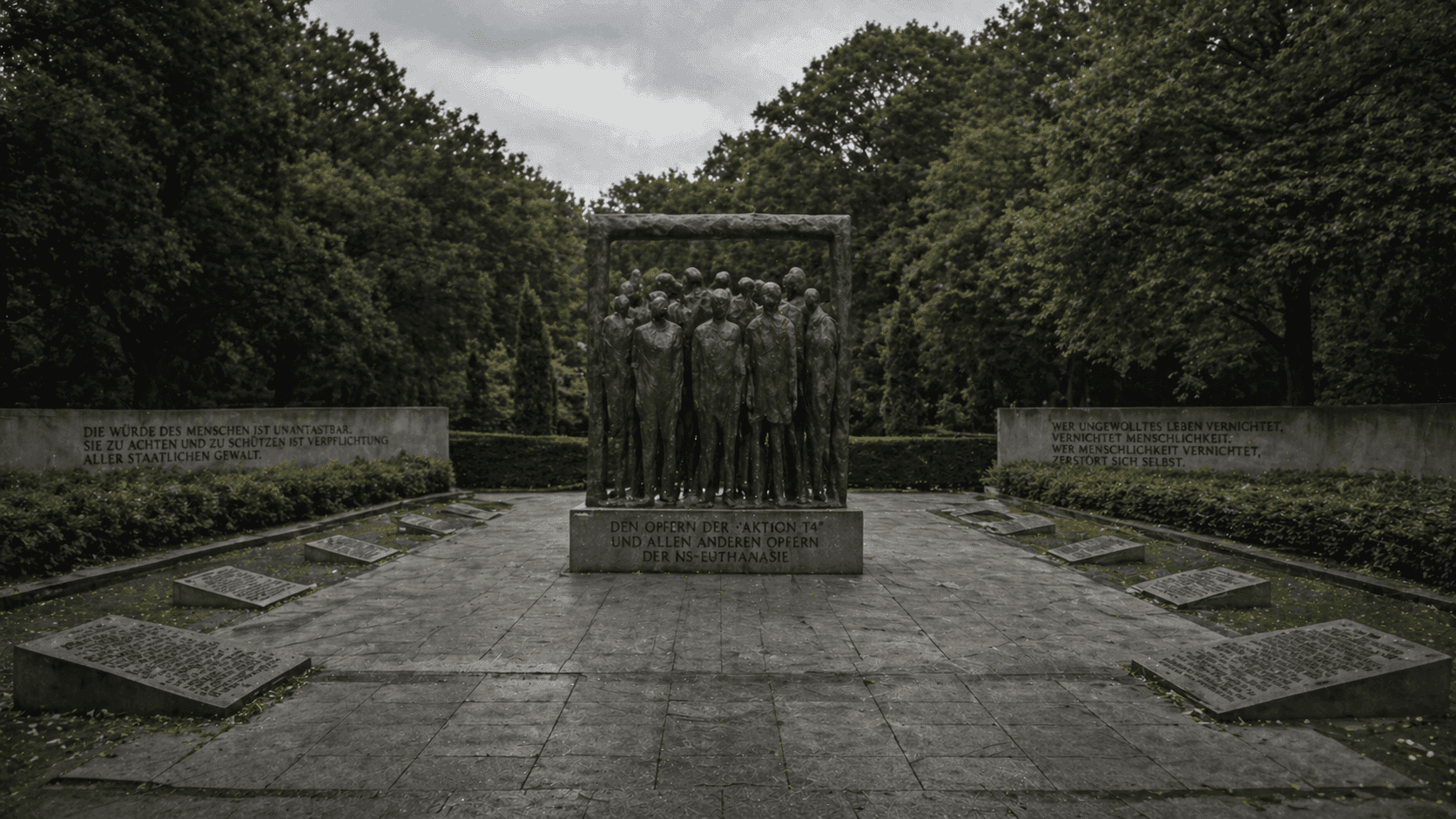
On May 21, 1940, mass killings were carried out in East Prussia as part of Aktion T4 — the name derived from the address of the Berlin office that coordinated it, Tiergartenstrasse 4 — the Nazi regime's systematic program for the murder of people with physical disabilities, intellectual disabilities, psychiatric conditions, and neurological disorders. The program had begun in 1939, authorized by a secret order personally signed by Adolf Hitler, and operated through a network of killing centers disguised as medical facilities, where patients transferred from hospitals and psychiatric institutions were murdered, initially by starvation and lethal injection, and later by carbon monoxide poisoning in purpose-built gas chambers. Physicians, nurses, and administrators participated in the killing under the regime's rubric of "mercy death" — a language of compassion applied to a program of murder whose victims had no voice in their own fate.
Between 1939 and 1941, when public protests from German Catholic and Protestant clergy — most notably Bishop Clemens von Galen of Münster — prompted Hitler to issue a formal halt order, an estimated 70,000 to 200,000 people had been killed. The program did not end; it continued covertly throughout the war, with estimates of total victims ranging from 200,000 to 300,000. Aktion T4 is significant in the history of the Holocaust not merely as a parallel atrocity but as its direct technical precursor: the gas chambers, the crematoria, the administrative apparatus of systematic industrial murder were developed and tested under T4, and the personnel who operated them were subsequently transferred to the Operation Reinhard death camps in occupied Poland where six million Jews and millions of others were murdered. The disabled people killed under Aktion T4 are among the Holocaust's least remembered victims. Their deaths were the rehearsal for an even larger crime, carried out by a state that had decided some lives were not worth living — a decision that has no moral floor once it is accepted in any form.