May 19: The Queen Who Changed England, The Desert Legend Comes Home to Rest, A Wedding at Windsor
May 19 is a date that has always understood theater — the Tower of London in 1536, the dusty Dorset lanes of 1935, the ancient chapel at Windsor in 2018. Each of its three stories belongs to a figure who understood, whether they chose it or not, that their life was being watched: a queen whose ambition and intelligence reshaped the Church of England and whose execution was the final act of a drama that had transfixed a continent; a soldier and writer whose wartime exploits had already been mythologized by the time he died at forty-six on a country road; and a prince who married a biracial American actress before a global audience and, in doing so, placed a quiet question before one of the oldest institutions in the world. Spectacle, legacy, and the complicated business of being a public person — May 19 has always had an eye for the stage.
The Price of the Crown
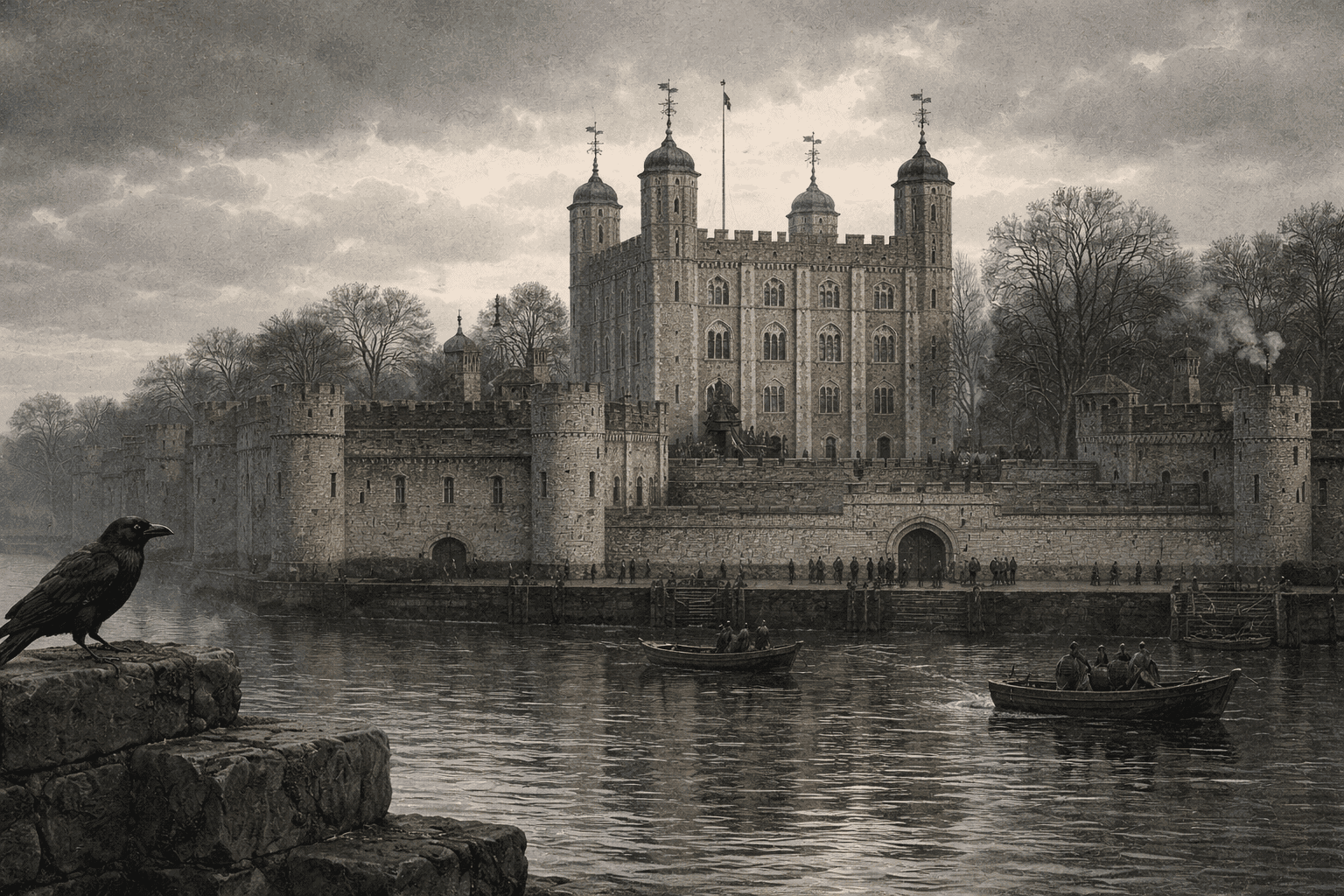
On May 19, 1536, Anne Boleyn was led to the scaffold on Tower Green — a private execution, away from the public gaze, a courtesy that distinguished queens from commoners even at the moment of their deaths — and beheaded with a sword, in the French style she had reportedly requested. She was somewhere between twenty-five and thirty-five years old; her exact birth date is not known. She had been Queen of England for approximately three years, having displaced Catherine of Aragon in Henry VIII's affections and then in his legal arrangements — an displacement that required Henry to break with Rome, dissolve his first marriage in defiance of papal authority, and establish himself as the Supreme Head of the Church of England. The English Reformation, in other words, began in significant part as a consequence of Henry's determination to marry Anne Boleyn. The reverberations of that break with Rome shaped English history for centuries. Anne did not live to see most of them.
Her fall from favor was as swift as her rise had been calculated. She had given Henry a daughter — the future Elizabeth I — but not the son he required, and two subsequent pregnancies had ended badly. By early 1536, Henry was interested in Jane Seymour, and Anne's enemies at court moved against her with the efficiency of people who had been waiting for the moment. She was accused of adultery with five men, including her own brother George — charges whose evidentiary basis historians have debated for centuries, with the majority concluding that they were fabricated to provide legal grounds for her removal. She was tried, convicted, and condemned within a matter of weeks. On the morning of her execution she reportedly said she had heard the executioner was very good, adding that she had a little neck — a sentence that has been quoted for nearly five centuries as evidence of either extraordinary courage or extraordinary composure in the face of the inevitable. The daughter she left behind would reign for forty-four years as Elizabeth I, one of England's greatest monarchs. The mother she never really knew was dead at Anne's age before Elizabeth was three years old.
Lawrence
On May 19, 1935, T.E. Lawrence — Thomas Edward Lawrence, known to the world as Lawrence of Arabia — died at Bovington Camp hospital in Dorset, six days after crashing his motorcycle on a country road near his cottage, Clouds Hill, while swerving to avoid two boys on bicycles. He was forty-six years old, and he had been, for the previous two decades, one of the most celebrated and most elusive men in Britain. His wartime role as a British liaison officer attached to the Arab forces of Prince Faisal during the Arab Revolt against the Ottoman Empire between 1916 and 1918 — the desert raids, the capture of Aqaba, the advance on Damascus — had made him famous long before his own account, Seven Pillars of Wisdom, gave the story its literary form. David Lean's 1962 film would cement the legend for a global audience. The legend had been building since the armistice.
Lawrence spent the postwar years in complicated flight from the fame he had partly cultivated and entirely resented. He attended the Paris Peace Conference as part of the British delegation, argued passionately for Arab self-determination and the promises he believed Britain had made to its Arab allies, and was appalled when those promises were superseded by the Sykes-Picot agreement's colonial carve-up of the Middle East. He resigned his position at the Foreign Office in protest, enlisted in the RAF under a false name, was exposed by the press, was discharged, re-enlisted under another alias, and spent his final years as an ordinary enlisted man, working on high-speed boats and writing. The crash on the Dorset road was exactly the kind of random, inglorious end that myth-making tends to smooth over. He had survived desert warfare, Ottoman capture and torture, and two decades of public life to be undone by a country lane and two boys on bicycles. The myth survived the man, as it always does.
St. George's Chapel
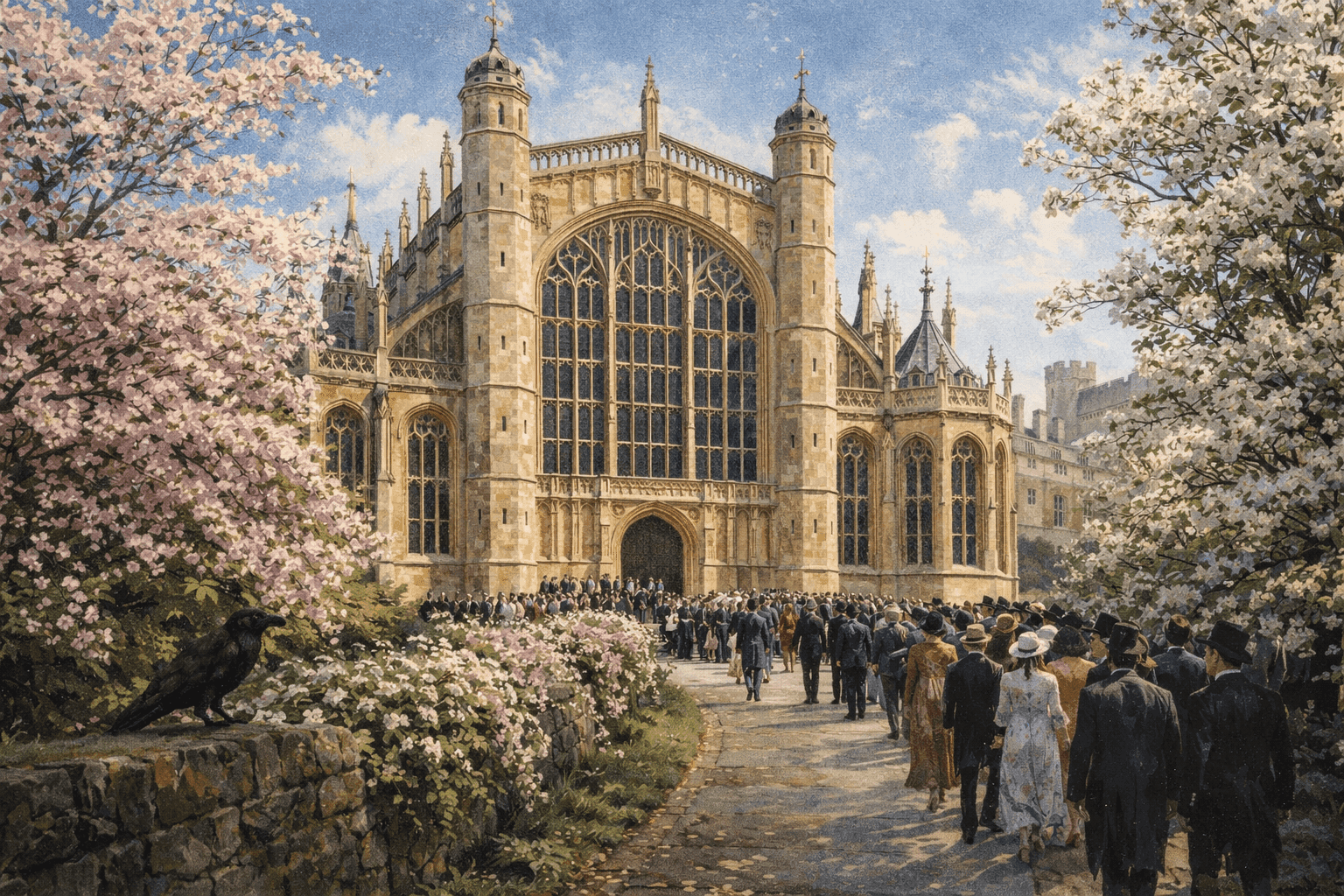
On May 19, 2018, Prince Harry — Henry Charles Albert David, Duke of Sussex, sixth in line to the British throne — married Meghan Markle, an American actress of mixed race and a divorced woman, in a ceremony at St. George's Chapel at Windsor Castle that was watched by an estimated two billion people worldwide. The wedding was, by design, a departure from the template of recent royal occasions: the ceremony included a sermon by American Episcopal Bishop Michael Curry, a performance of Ben E. King's "Stand by Me," and the presence of Meghan's mother, Doria Ragland, sitting alone in a pew in a pale green ensemble, the composed and dignified representative of a family whose background bore no resemblance to the world her daughter was entering. The contrast between the centuries of English institutional tradition in the chapel and the specific modernity of the occasion was not incidental — it was the point.
The years that followed the Windsor wedding were turbulent enough to make the day itself feel, in retrospect, like the calm before a storm. Harry and Meghan's 2021 interview with Oprah Winfrey, in which they made allegations about the royal family including concerns raised about the skin color of their unborn child, provoked an international controversy that divided opinion sharply along lines of race, nationality, and attitudes toward the monarchy. The couple stepped back from royal duties in 2020, relocated to California, and began building an independent public life that placed them in ongoing tension with the institution Harry had been born into. The fairy tale that May 19, 2018, seemed to promise — of a monarchy renewing itself, of tradition and modernity finding accommodation — did not, at least in the short term, arrive on the schedule the wedding suggested. What it did provide was a photograph: a Black American woman in a Givenchy dress, walking the last portion of the aisle alone at Windsor Castle, on the arm of a prince who had come down the aisle to meet her.