May 18: A Pope Is Born in Poland, The Mountain Lets Go, A Social Network Goes Public
May 18 is a date that understands scale — the scale of a single human life lived in full view of the world, the scale of a geological event that rearranged a piece of the Pacific Northwest in a single morning, and the scale of a technology company's arrival on a public market where the valuation of human connection was being calculated for the first time. Each story is about the moment something that had been building for years — a vocation, a geological pressure, a social network — finally breaks through the surface in a way that makes its true dimensions visible. The boy in Wadowice, the mountain in Washington, the company in Menlo Park: none of them arrived without warning. All of them arrived larger than anyone had quite expected.
Wadowice
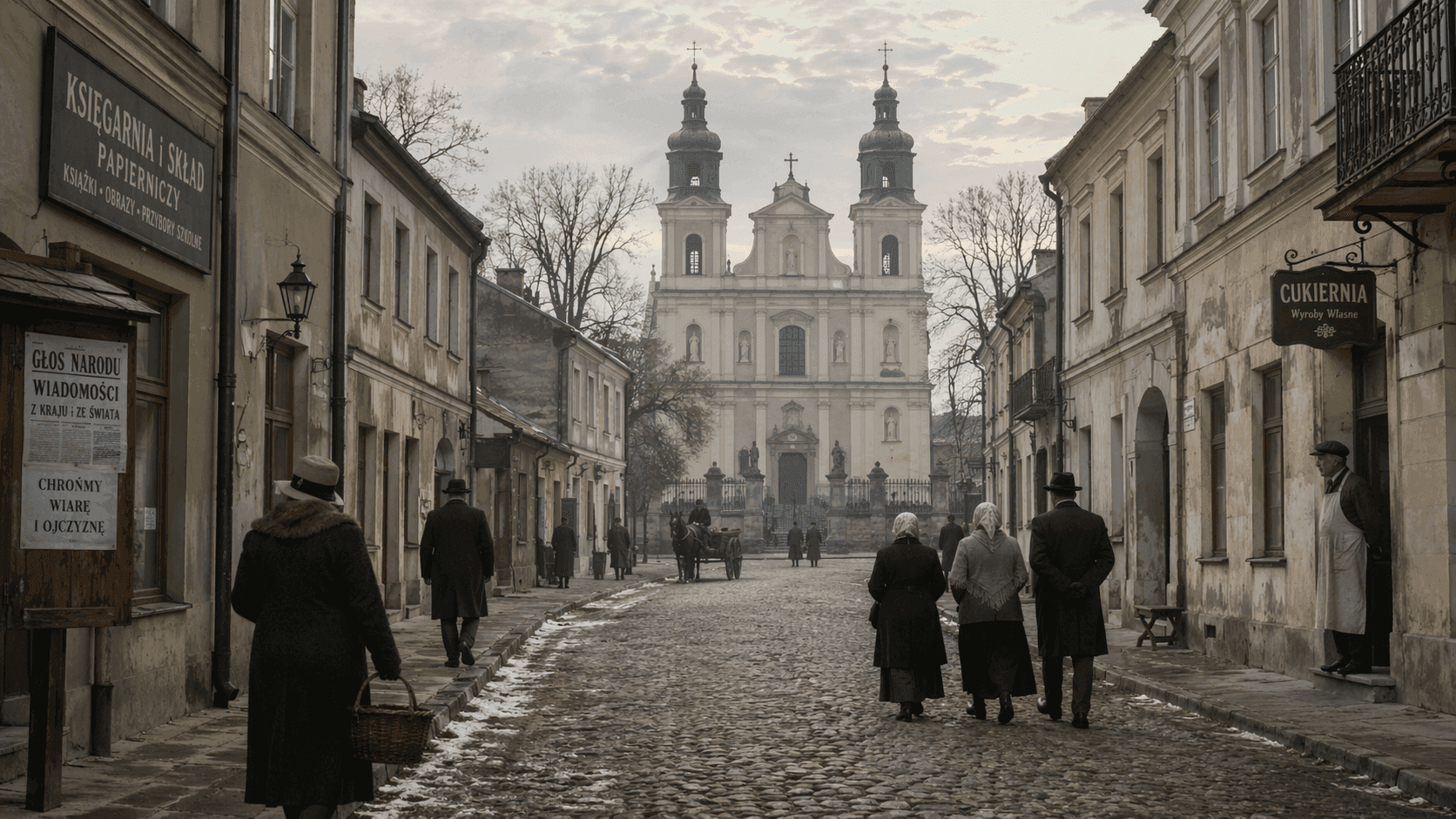
On May 18, 1920, Karol Józef Wojtyła was born in Wadowice, a small town in southern Poland, the third child of a retired army officer and a schoolteacher who died of kidney failure when Karol was eight. His older brother Edmund, a physician, died of scarlet fever when Karol was twelve. His father died when Karol was twenty, leaving him entirely alone in the world at an age when most young men are still beginning to understand it. Poland, in the meantime, had been occupied by Nazi Germany since 1939; Wojtyła worked in a quarry and a chemical factory under the occupation to avoid deportation to Germany, while secretly studying for the priesthood in an underground seminary organized by the Archbishop of Kraków, Cardinal Adam Sapieha, who had taken a particular interest in the brilliant young man's formation. He was ordained in 1946, sent to Rome for doctoral studies, returned to Poland, and rose through the Church's ranks with a speed that owed as much to the quality of his mind and the force of his personality as to patronage.
We have encountered John Paul II twice before in this series — his attempted assassination in St. Peter's Square on May 13, 1981, and his death on April 2, 2005 — and the arc of his papacy is by now familiar: the first non-Italian pope in 455 years, elected in October 1978 at fifty-eight years old; the travels to 129 countries; the role in the collapse of communism in Eastern Europe; the theological conservatism that set limits on the Church's accommodation of modern social change; the gestures of reconciliation toward Judaism, Islam, and other faiths that his predecessors had not made. What his birthday on May 18 invites us to consider is the beginning of that arc — the Wadowice childhood, the occupied Poland, the underground seminary, the losses accumulated so early and so completely that they might have undone a lesser person. The papacy he built was shaped by everything the boy in Wadowice survived before anyone outside Poland had heard his name.
8:32 a.m.
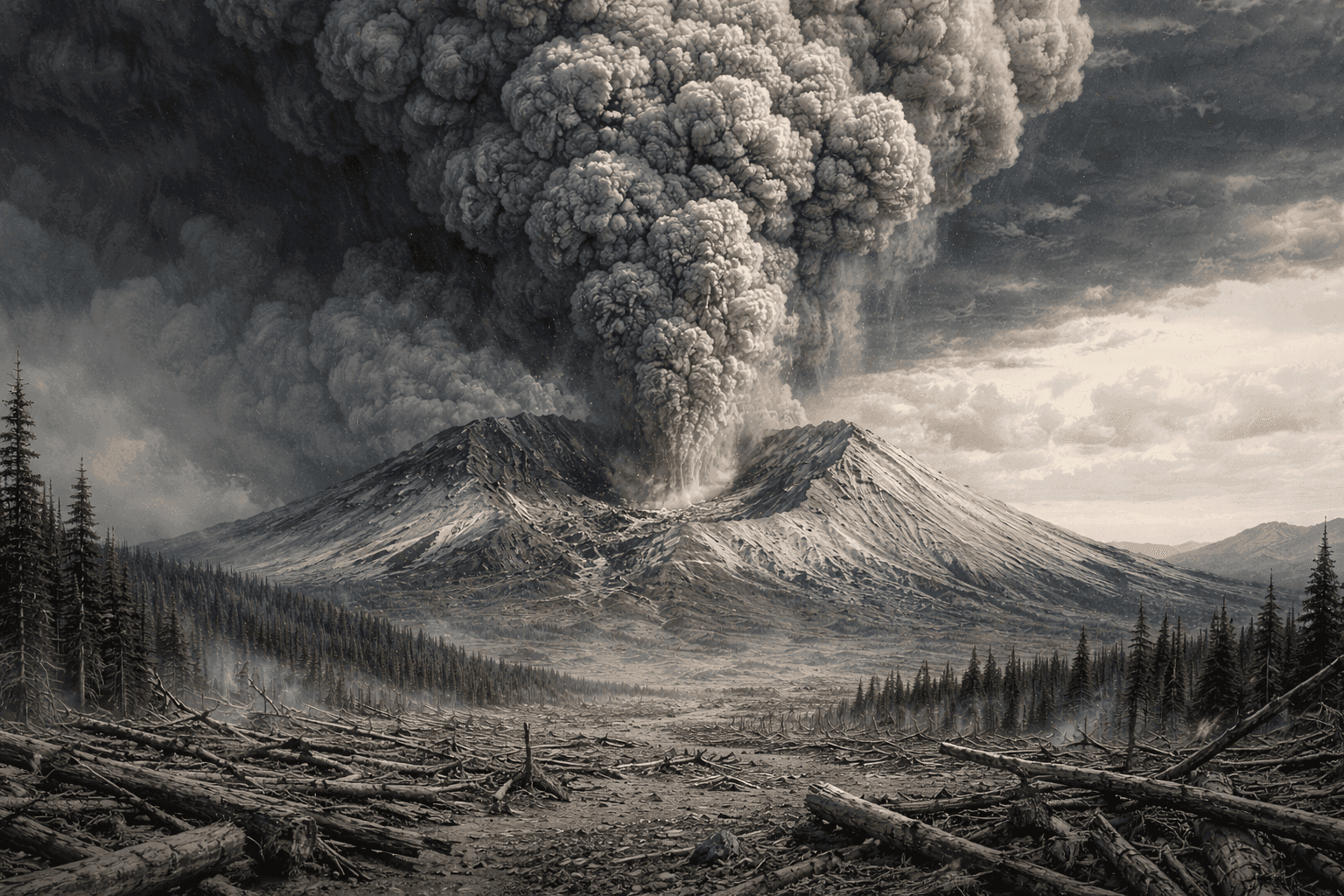
At 8:32 in the morning on May 18, 1980, a 5.1-magnitude earthquake triggered the collapse of the north face of Mount St. Helens in Washington State — the largest landslide in recorded history — which in turn depressurized the magma chamber beneath the volcano and released a lateral blast of superheated gas, ash, and rock moving at speeds of up to 670 miles per hour across a 230-square-mile area of forest to the mountain's north. The blast flattened trees like matchsticks across an estimated 150,000 acres, incinerated everything within a direct blast zone, and sent a column of ash 80,000 feet into the atmosphere that circled the globe within two weeks. Fifty-seven people died, including volcanologist David Johnston, who was monitoring the mountain from an observation post six miles away and managed to radio "Vancouver! Vancouver! This is it!" seconds before the blast reached him. The mountain lost 1,300 feet of elevation and an entire side of its perfect cone in the space of a few minutes.
Mount St. Helens had been showing signs of unrest since March 1980, and scientists — many of whom paid with their lives for the accuracy of their predictions — had warned that a major eruption was imminent. The volcano sits in the Cascade Range, part of the Pacific Ring of Fire, and its 1980 eruption was not geologically unusual; what made it singular was the documentation. Never before had a major volcanic eruption in the continental United States been so thoroughly monitored, photographed, and studied in real time. The photographs of the eruption — the ash column, the lateral blast, the devastated forest — became some of the most widely published geological images in history and permanently changed the way Americans thought about the power of the natural world within their own borders. The landscape around Mount St. Helens has recovered with a completeness and speed that surprised even the ecologists who studied it — the blasted forest slowly reforested, the ash-covered lake filled again with life, and the volcano itself rebuilt a new dome within its crater. The mountain that destroyed itself on May 18, 1980, is still there — quieter now, but not finished.
The $16 Billion Question
On May 18, 2012, Facebook began trading on the NASDAQ stock exchange under the ticker symbol FB, raising approximately $16 billion in the largest technology IPO in American history to that point, at a valuation of roughly $104 billion. The company that Mark Zuckerberg had launched from his Harvard dormitory in February 2004 had, in eight years, accumulated more than 900 million active users — a number that represented, at the time, approximately one in eight people on earth. The IPO was among the most anticipated and most scrutinized in American financial history; the days before trading began were marked by escalating concerns about the company's mobile advertising revenue and long-term growth prospects, and the stock's performance on its first day of trading — it barely held its offering price of $38 — disappointed many of the institutional investors who had expected the kind of first-day surge that had accompanied earlier technology listings.
The IPO's mixed opening turned out to be a poor indicator of what Facebook would become. The stock, after falling significantly in its first months of trading, recovered and then rose dramatically as the company solved its mobile advertising problem — a business model transformation that turned out to be among the most profitable in corporate history. By the early 2020s, Facebook's parent company Meta had a market capitalization that periodically exceeded a trillion dollars, and its platforms — Facebook, Instagram, and WhatsApp — were used by more than three billion people. The May 18, 2012 IPO had placed a number on something that was genuinely difficult to price: the value of a platform that had made itself indispensable to human social life, and that had, in doing so, accumulated a level of knowledge about human behavior, preference, and psychology that had no historical precedent. What that knowledge was being used for — and what it was doing to the societies it had embedded itself within — would become one of the defining debates of the following decade. The $16 billion raised on May 18, 2012, was the beginning of a much larger reckoning.