May 17: Separate Is Not Equal, The Zip Code Closes, Love Is Legal in Massachusetts
Some dates are where history keeps its appointments with itself — where the long, slow work of social change reaches a point of formal recognition that the world had been waiting for longer than it knew. May 17 has hosted two of those appointments, fifty years apart: a Supreme Court ruling that dismantled the legal architecture of American apartheid, and a city clerk's office in Cambridge, Massachusetts, that opened its doors at midnight and married the first same-sex couples in American history. Between them, the decade's most popular teen drama wrapped its decade-long run. Together, the three stories offer a compressed portrait of what the late twentieth century was actually about: the expanding circle of who the law's protections are understood to include, and the culture that both reflected and shaped that expansion.
Nine to Zero
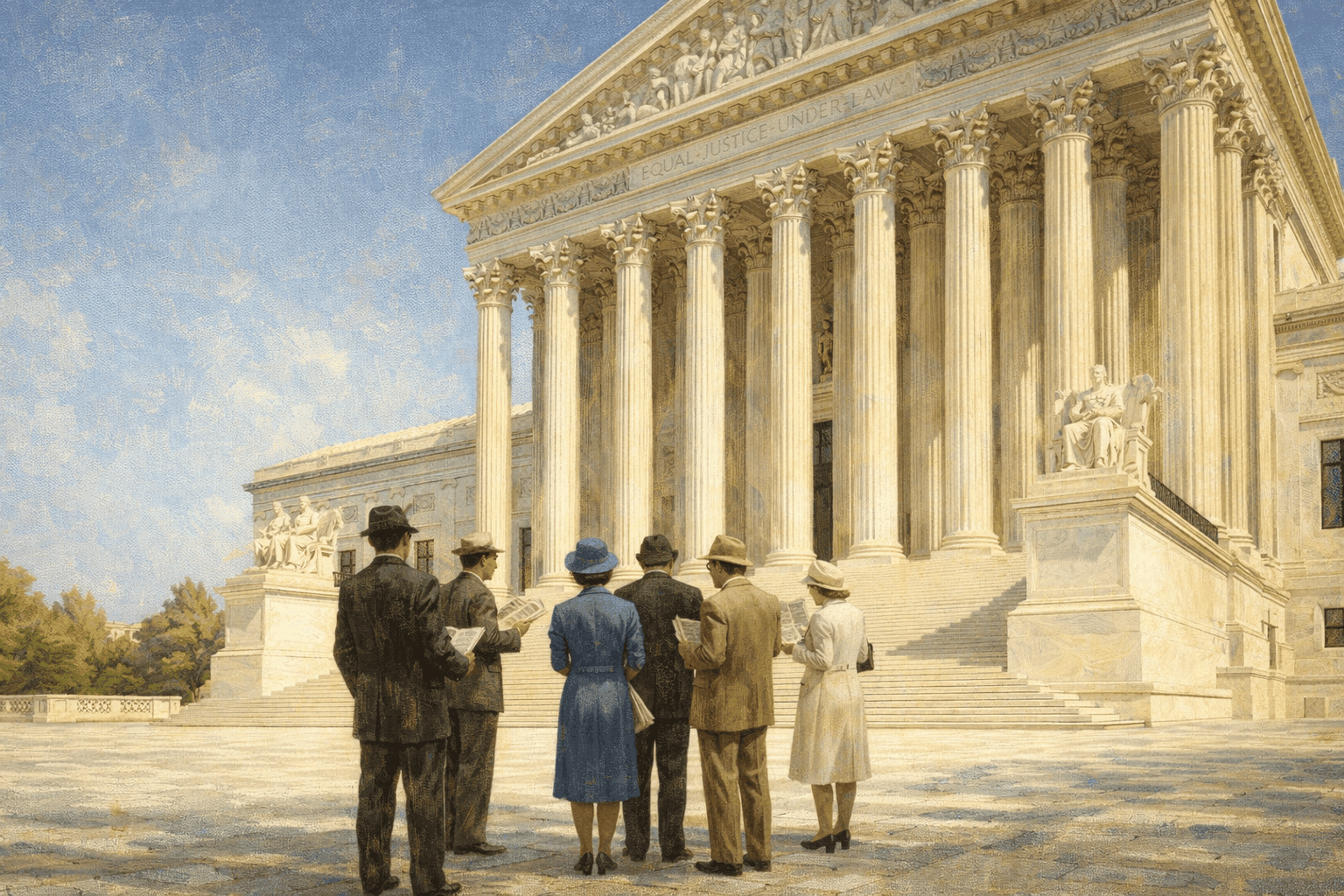
On May 17, 1954, Chief Justice Earl Warren read the unanimous opinion of the United States Supreme Court in Brown v. Board of Education of Topeka, and with a single sentence — "We conclude that in the field of public education the doctrine of 'separate but equal' has no place" — overturned the legal foundation of American racial segregation that had stood since Plessy v. Ferguson in 1896. The case had been brought on behalf of thirteen Black families in Topeka, Kansas, led by Oliver Brown, whose daughter Linda was required to walk a considerable distance to a Black elementary school when a white school was much closer to their home. The NAACP's legal team, led by Thurgood Marshall — who would later become the first Black Supreme Court Justice — had argued not merely that the facilities provided to Black children were inferior, but that the act of separation itself was a harm, that it communicated inferiority by law and damaged the psychological development of children who were told by their government that they must be kept apart. The Court agreed, unanimously, on all nine votes.
The decision's implementation was contested and slow — the Court's 1955 follow-up ruling, Brown II, called for desegregation "with all deliberate speed," a phrase that Southern states interpreted as an invitation to delay for decades, and many did. The integration of Central High School in Little Rock, Arkansas, required the intervention of the 101st Airborne Division in 1957. School desegregation battles continued through the 1970s and, in many forms, continue today — American schools remain significantly segregated by race, driven now by residential patterns and funding structures rather than explicit legal mandate. But May 17, 1954, remains one of the most consequential dates in the history of American law: the day the Court unanimously declared that the constitutional guarantee of equal protection meant what it said, that the government of the United States could not by statute sort its children by race and call the result equality. The nine justices who signed that opinion did not end segregation. They named it, plainly and without equivocation, for what it was.
The Last Summer in Beverly Hills
On May 17, 2000, Beverly Hills, 90210 aired its series finale on Fox, closing a ten-year run that had begun in October 1990 and had, somewhat improbably, become one of the defining cultural artifacts of the decade in between. Created by Darren Star, the show had originally followed the Walsh family — transplants from Minneapolis adjusting to the culture shock of Beverly Hills — but evolved over ten seasons into an ensemble drama following a shifting cast of characters through high school, college, and young adulthood, addressing topics including drug addiction, eating disorders, date rape, HIV/AIDS, and domestic violence alongside the more standard teenage fare of romance and rivalry. It was, for its time, both more serious and more glamorous than its predecessors in the genre, and it launched the careers of actors including Jason Priestley, Shannen Doherty, Luke Perry, and Jennie Garth.
The show's finale drew respectable ratings but nothing approaching the cultural event that the Friends farewell four years later would become — by 2000, 90210 had been in its long, gradual decline for several seasons, its original cast largely departed and its audience considerably diminished. What the finale marked, more than the end of a specific series, was the close of a television era — the moment before reality television fundamentally reshaped what Fox and the networks that followed its model were willing to put on the air. Beverly Hills, 90210 represented the peak of a particular kind of aspirational teen drama: earnestly produced, socially conscious in its way, and built on the premise that fictional characters living glamorous lives could illuminate real experiences for the audience watching them. The zip code, for a decade, had meant something. On May 17, 2000, the lights went out on it.

Cambridge, Midnight
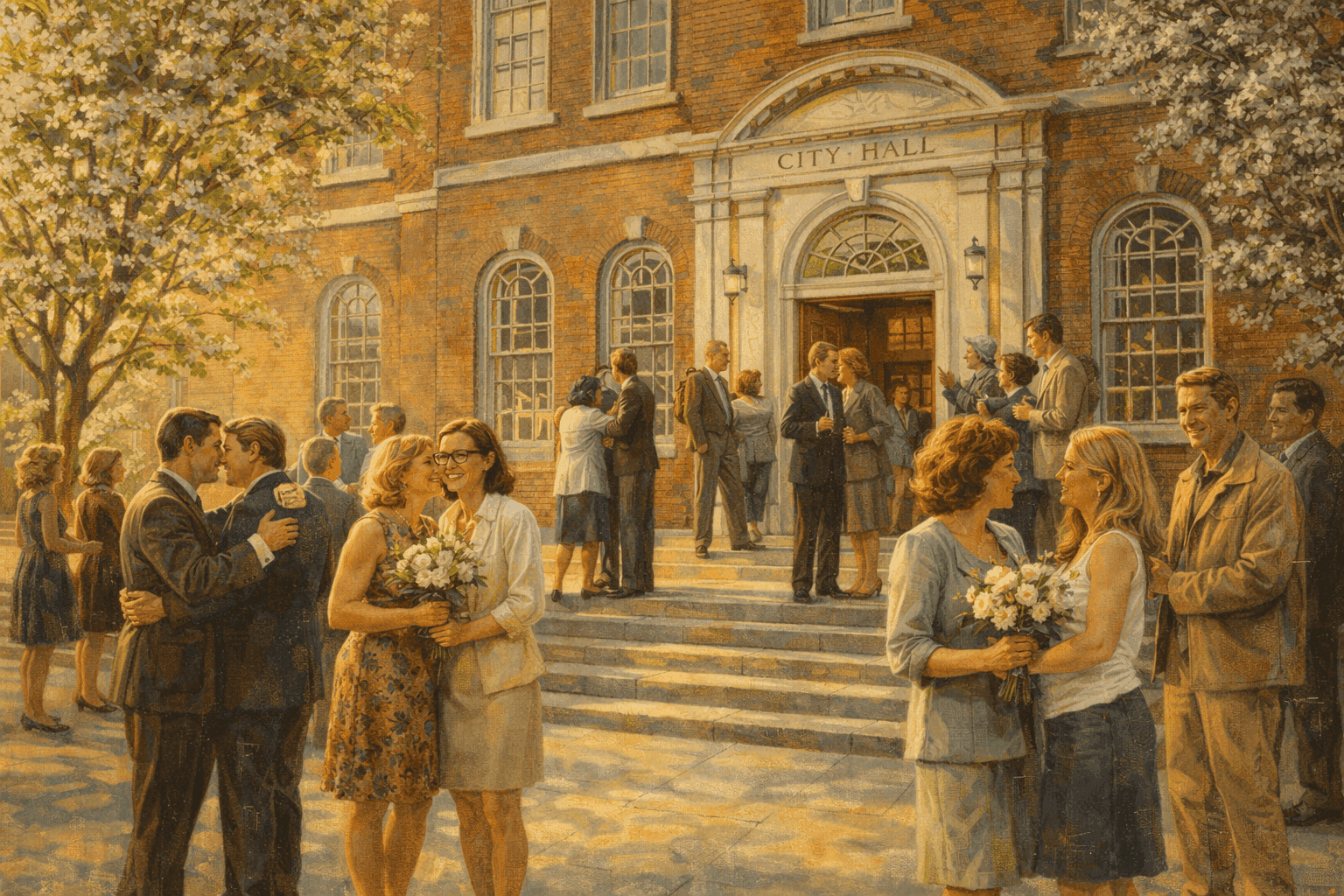
On May 17, 2004 — exactly fifty years after Brown v. Board of Education — Massachusetts became the first state in the United States to issue marriage licenses to same-sex couples, following the Massachusetts Supreme Judicial Court's landmark ruling in Goodridge v. Department of Public Health the previous November. City and town clerks across the state had been authorized to begin issuing licenses at midnight, and many did. In Cambridge, the city clerk stayed past midnight to marry couples who had waited through years of legal argument for the right to walk to a municipal counter and receive the same document that different-sex couples had always been entitled to obtain. Tanya McCloskey and Marcia Kadish, both of Malden, Massachusetts, were among the first couples married in the country. Hundreds of couples were married across Massachusetts in the hours and days that followed, their weddings documented by press photographers whose images traveled around the world.
The Goodridge decision and the marriages it enabled were immediately contested — Governor Mitt Romney sought to block implementation, and efforts to pass a constitutional amendment banning same-sex marriage in Massachusetts began almost immediately. The national political reaction was fierce: President George W. Bush called for a federal constitutional amendment defining marriage as between a man and a woman, and the issue became a defining fault line in the 2004 presidential election. But the marriages in Massachusetts held, the amendment efforts failed, and the precedent set on May 17, 2004 spread: Iowa in 2009, then New York, then an accelerating cascade of states and federal court decisions, culminating in the Supreme Court's ruling in Obergefell v. Hodges in 2015, which extended marriage equality to all fifty states. The arc from Cambridge at midnight on May 17, 2004, to Obergefell eleven years later is among the fastest expansions of civil rights recognition in American legal history — a measure of both how long the injustice had persisted and how completely, once the door opened, the argument was resolved.