May 11: The Dust That Reached Washington, A President's Fateful Decision, The Music That Never Stopped
Some of history's most consequential moments arrive wearing the clothes of ordinary events — a weather report, a presidential memo, a hospital room in Miami. May 11 holds three of those moments across three decades: a dust storm so vast that it darkened the skies of the Eastern Seaboard and forced a government to reckon with what industrial agriculture had done to the American land; a quiet authorization that expanded a military advisory mission in Southeast Asia and set in motion a chain of decisions that would define a generation; and the death, at thirty-six, of a musician whose short life produced a body of work that has outlasted every government that was in power when he made it. Each story is about consequences that arrive far from where they started — dust from Oklahoma in the streets of Washington, a signature in Washington in the rice paddies of Vietnam, a voice from Kingston in the ears of a world that is still, decades later, paying attention.
The Black Blizzard
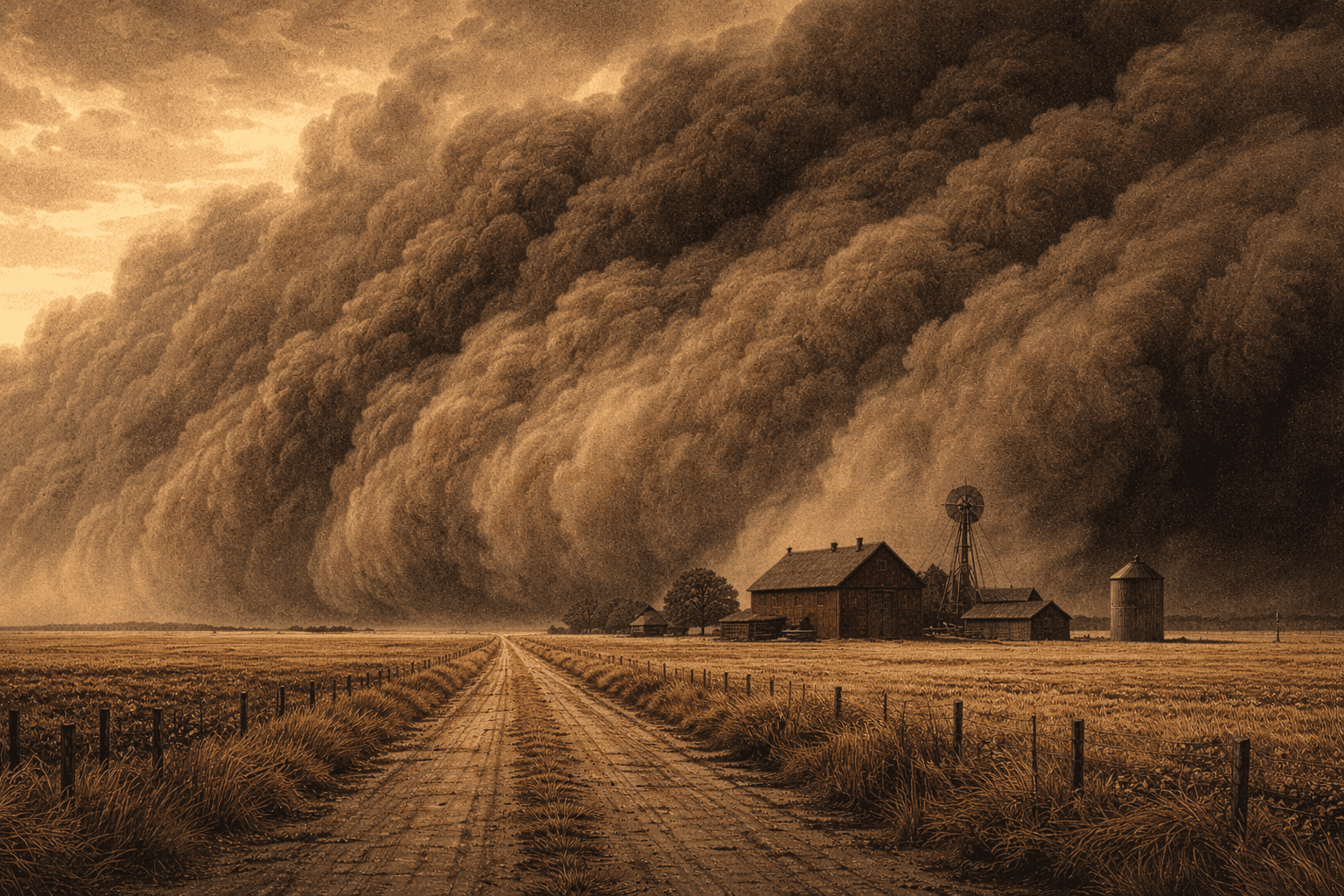
On May 11, 1934, a massive dust storm — one of the largest and most far-traveling of the Dust Bowl era — swept off the southern Great Plains and carried an estimated 350 million tons of topsoil eastward across the continent. By the time the storm reached the East Coast, it had darkened the skies of Washington, D.C., deposited a thin film of prairie dust on the decks of ships three hundred miles out in the Atlantic, and left a visible haze over New York City. Senators in Washington reportedly could not see across the Senate chamber through the dust-thickened air. The storm had originated in the same short-grass prairies that had been deep-plowed by generations of wheat farmers responding to wartime commodity prices and the optimistic rhetoric of boosterism that had described the semi-arid Plains as agriculturally limitless. The native grasses that had held the soil for millennia were gone. The wind took what was underneath.
The May 11, 1934 storm was a political event as much as a meteorological one. It arrived at a time when Congress was debating the administration's proposed Soil Conservation Act, and the spectacle of Great Plains topsoil descending on the Capitol steps made the abstract crisis concrete in a way that no Senate testimony could have managed. Hugh Bennett, the soil scientist known as "Big Hugh" who had been the act's most persistent advocate, was testifying before a Senate committee when word came that the dust cloud was approaching Washington — he reportedly slowed his presentation deliberately, waiting for the storm to arrive and make his argument for him. It worked. The Soil Conservation Act passed in 1935, establishing the Soil Conservation Service and beginning the long, slow work of replanting native grasses and teaching farmers the practices that would, over decades, help stabilize what the Dust Bowl had nearly destroyed. The storm of May 11, 1934, was not the worst of the Dust Bowl — Black Sunday, which we covered on April 14, was larger and more devastating — but it was the one that the men with the power to respond finally had to watch arrive at their own doorstep.
The Memo That Started a War
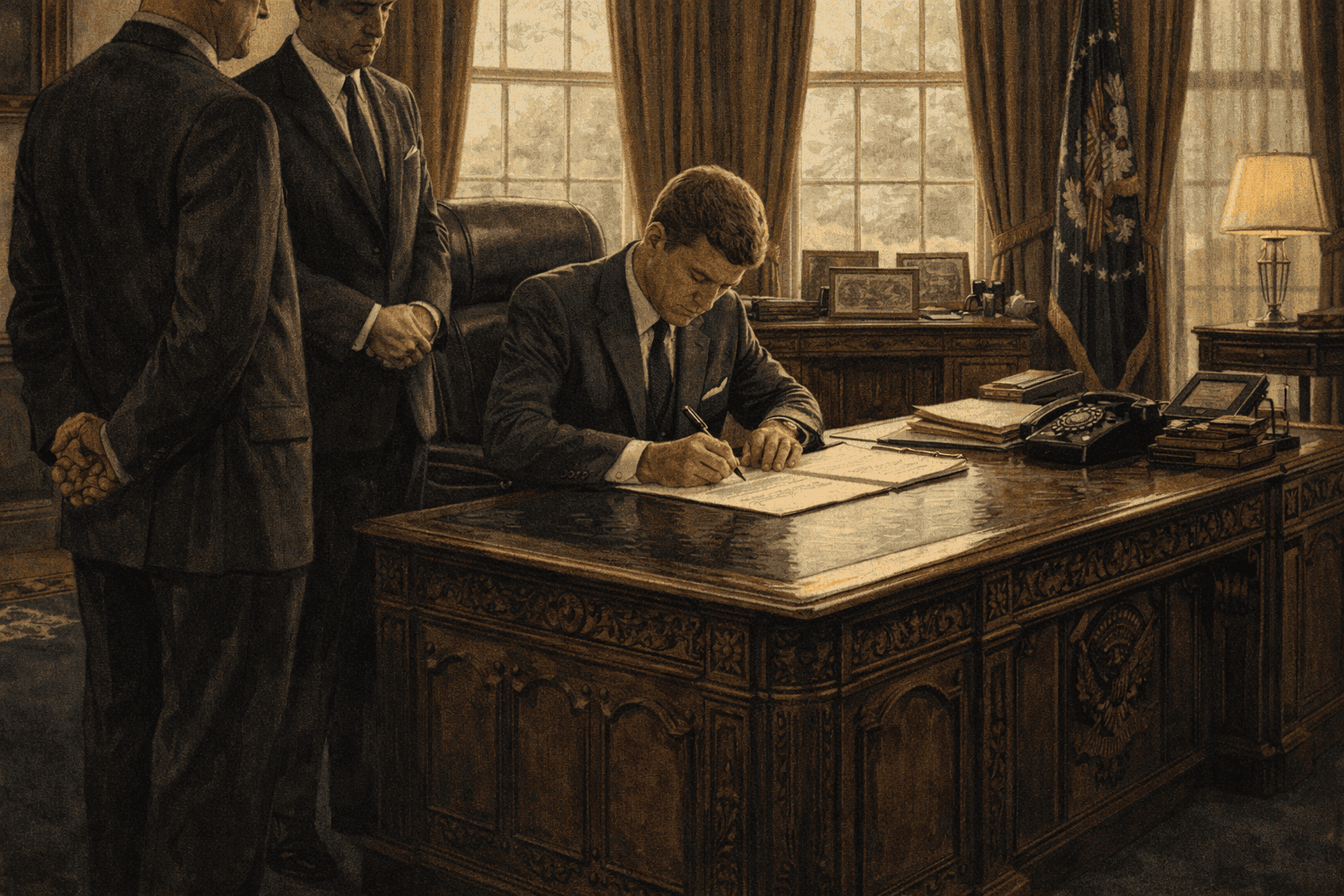
On May 11, 1961, President John F. Kennedy signed National Security Action Memorandum 52, authorizing an increase in the number of U.S. military advisors in South Vietnam from roughly 700 to approximately 1,000, and expanding their training and support mission. The decision was framed as a limited, technical adjustment — a modest increase in advisory personnel to shore up the South Vietnamese government's capacity to resist the communist insurgency supported by North Vietnam. Kennedy was seven weeks into his presidency, still absorbing the consequences of the Bay of Pigs disaster, and under intense Cold War pressure to demonstrate that the United States would not allow another country to fall to communism as China had in 1949 and Cuba in 1959. Vietnam, in this framing, was a test case for the doctrine of counterinsurgency — the theory that American military expertise, applied surgically, could help a friendly government defeat a guerrilla insurgency without large-scale American combat involvement.
The theory did not survive contact with the reality. By the time Kennedy was assassinated in November 1963, there were more than 16,000 American military personnel in Vietnam, and American advisors were engaged in combat operations. Under Lyndon Johnson, the commitment escalated dramatically: by 1968, more than 500,000 American troops were deployed in Vietnam. The war that Kennedy's May 11, 1961 memorandum helped initiate would cost more than 58,000 American lives, an estimated two million Vietnamese civilian lives, and a decade of national trauma that reshaped American politics, culture, and the country's relationship with its own government. Whether Kennedy would have escalated as Johnson did, or would have eventually found a way out, is one of the most debated counterfactuals in American history. What is not debatable is that the authorization signed on May 11, 1961, was one of the early links in a chain whose full length no one in the room that day had fully reckoned with.
One Love
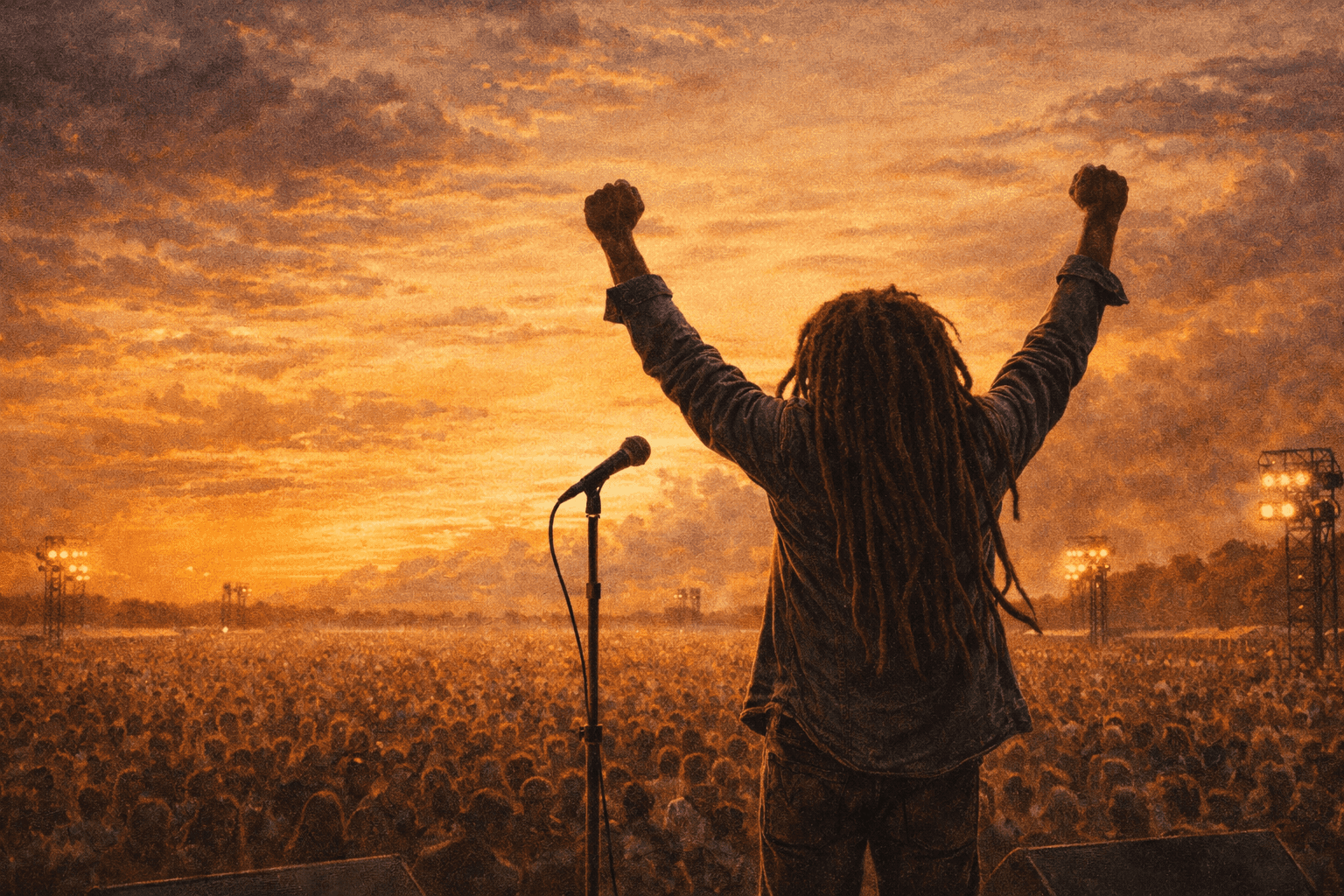
On May 11, 1981, Bob Marley died of cancer at the Cedars of Lebanon Hospital in Miami, Florida, at the age of thirty-six. The cancer — an acral lentiginous melanoma that had originated under the nail of his right big toe, first noticed in 1977 — had spread to his brain, lungs, and liver despite treatment at a clinic in Bavaria that he had chosen in preference to amputation, which his Rastafarian faith led him to decline. He had performed his last concert in Pittsburgh in September 1980, been taken ill on a morning jog in Central Park days later, and spent his final months aware that he was dying. His last words to his son Ziggy, reported in the years since, were a quiet instruction about money not being able to buy life — a sentiment so consistent with everything he had ever written that it is difficult to know whether it was reported accurately or simply felt true enough to preserve.
We encountered Bob Marley earlier in this series, at the One Love Peace Concert in Kingston in April 1978, where he attempted to bring rival political factions together through the force of music and presence. His death on May 11, 1981, closes a life whose brevity is still startling when measured against its output and its reach. In thirty-six years, Marley had produced a body of music — with the Wailers and as a solo artist — that brought reggae to a global audience and turned Rastafarian philosophy, Jamaican political experience, and the history of the African diaspora into anthems that resonated far beyond any of those specific contexts. He received the Jamaican Order of Merit posthumously in 1981. He was inducted into the Rock and Roll Hall of Fame in 1994. His album Legend, a posthumous compilation released in 1984, has sold more than 30 million copies and remains one of the best-selling albums in history. The music that began in Trenchtown, Kingston, and traveled to every continent is still traveling. Thirty-six years was not enough — and turned out to be more than sufficient.