May 1: A Skyscraper Touches the Sky, The King Takes a Bride, When the Cameras Turn
Fame is a complicated bargain. It offers visibility, adulation, and a place in the public imagination — and it extracts, in return, the privacy of ordinary life and the mercy of being forgotten when things go wrong. May 1 presents three very different encounters with that bargain: a skyscraper that became, almost immediately, one of the most recognized structures on earth and the permanent symbol of a city's refusal to be diminished by hard times; a rock and roll king whose wedding made headlines around the world and whose marriage would eventually become as famous for its ending as its beginning; and a celebrated athlete whose fall from grace became a public reckoning with the distance between the image a career creates and the character it may or may not reflect.
The Tallest Thing Anyone Had Ever Built
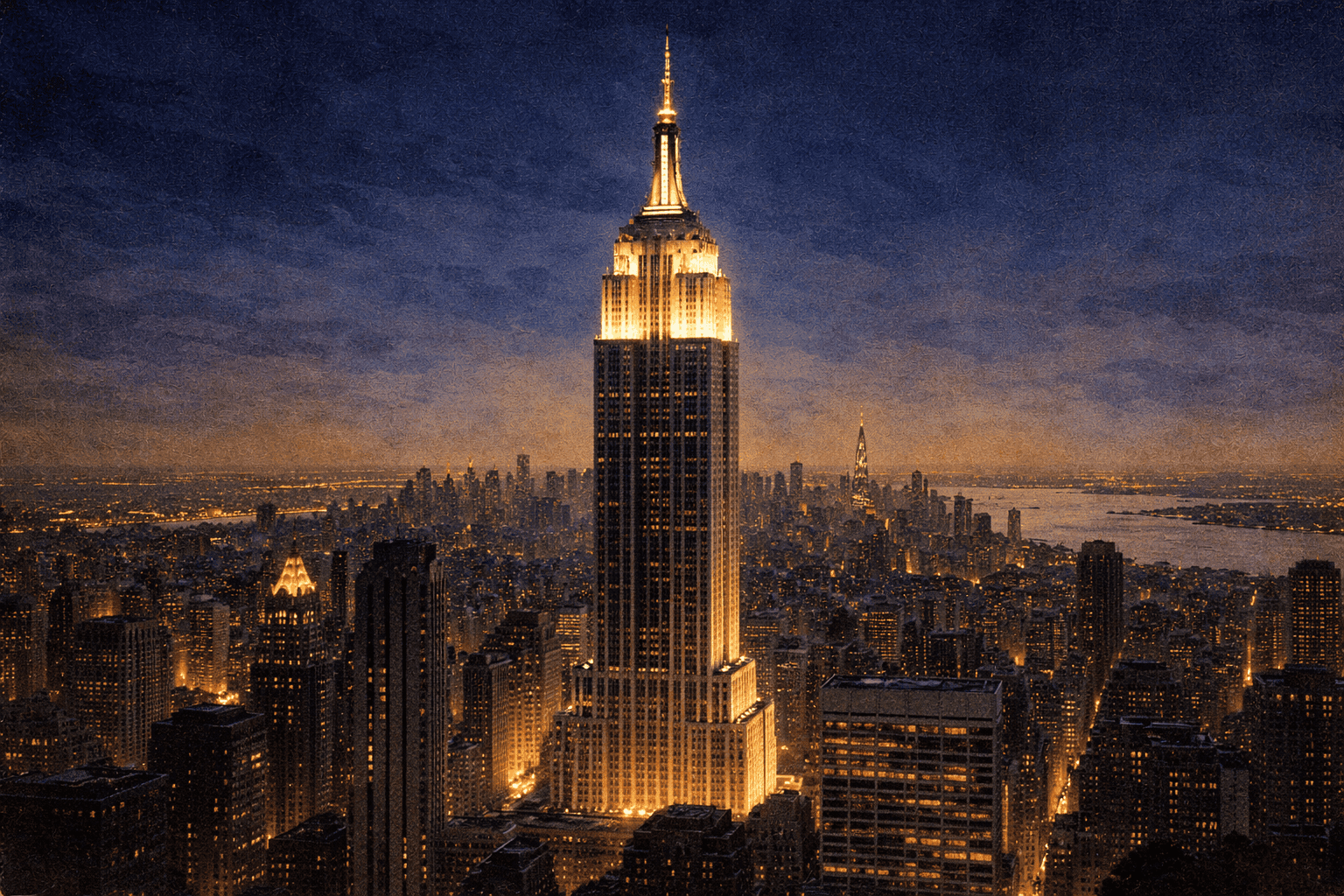
On May 1, 1931, President Herbert Hoover pressed a telegraph key in Washington, D.C., and the lights of the Empire State Building came on for the first time, officially dedicating a structure that had risen from bedrock to its full 1,250-foot height in just 410 days — a construction pace so extraordinary that workers were completing an average of four and a half floors per week at peak production. The building had been conceived in the late 1920s, when New York's skyline was engaged in a genuine race for altitude, and construction had begun in March 1930, by which point the stock market had already crashed and the Great Depression was tightening its grip on the country. The 3,400 workers who built it — many of them recent immigrants, many of them Mohawk ironworkers whose fearlessness at height had made them indispensable to the city's steel-frame construction industry — were building in a city that had lost a third of its workforce to unemployment. The Empire State Building was, in this sense, both a product of the optimism that had preceded the crash and a defiant assertion of it in the crash's aftermath.
It was the tallest building in the world for forty-one years, until the World Trade Center's North Tower surpassed it in 1972. It was the first building to have more than one hundred floors. It has been struck by lightning an average of twenty-three times per year since its construction. It has appeared in more films than any other building in the world, beginning with King Kong in 1933. Its observation deck has welcomed more than 110 million visitors. But the statistic that perhaps best captures its cultural weight is simpler: when people around the world are asked to picture New York City, the building that appears most reliably in the mental image is not the Chrysler Building, not the Brooklyn Bridge, not any structure built in the ninety-plus years since — it is the Empire State Building, lit in whatever colors the season requires, rising above a skyline it has anchored for nearly a century. It was built in hard times, by workers who needed the work, for a city that needed to believe it was still capable of building impossible things. On both counts, it delivered.
Viva Las Vegas
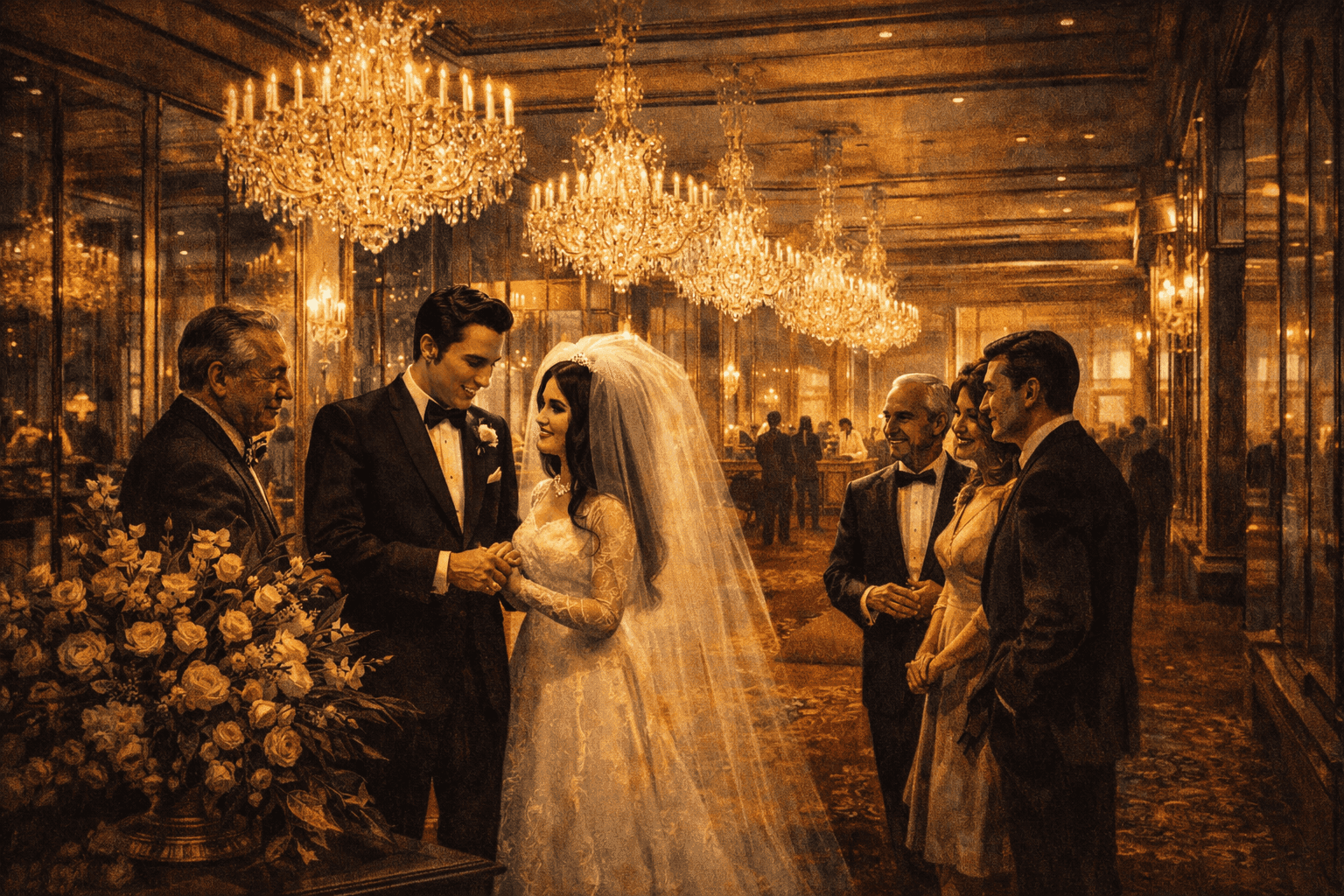
On May 1, 1967, Elvis Presley married Priscilla Beaulieu in a private suite at the Aladdin Hotel in Las Vegas — a ceremony that lasted eight minutes, was attended by fourteen guests, and generated press coverage wildly disproportionate to its intimacy. They had met in 1959 when Elvis was stationed in Germany with the U.S. Army and Priscilla was fourteen years old, the daughter of an Air Force officer. He had brought her to Graceland in 1963, when she was seventeen, ostensibly to finish high school in Memphis under the supervision of his father and stepmother. The relationship had been the subject of persistent public curiosity for years by the time they wed, and the wedding — brief, Vegas, and closed to the public — did nothing to diminish that curiosity. Photographs of the couple leaving the ceremony, Priscilla in a white chiffon gown and her elaborate upswept hair, Elvis in a brocade tuxedo, became some of the most reproduced images of the era.
The marriage lasted six years. Priscilla filed for divorce in January 1973, citing irreconcilable differences. Their daughter Lisa Marie, born in February 1968, remained the most direct and lasting bond between them. What the marriage's trajectory revealed — and what the public's enduring fascination with it has always reflected — was the particular difficulty of sustaining ordinary human intimacy inside the machinery of extraordinary fame. Elvis, by 1967, was not a person who moved through the world in the way ordinary people do; his life at Graceland, surrounded by the Memphis Mafia, performing on terms entirely dictated by Colonel Tom Parker's commercial calculations, was structured in ways that left little room for the reciprocity that marriage requires. Priscilla's own account of those years, published in her 1985 memoir, describes a life of considerable loneliness alongside considerable glamour. The wedding on May 1, 1967, was a genuine beginning. What it was a beginning of took years to fully understand.
The Distance Between the Court and the Courtroom
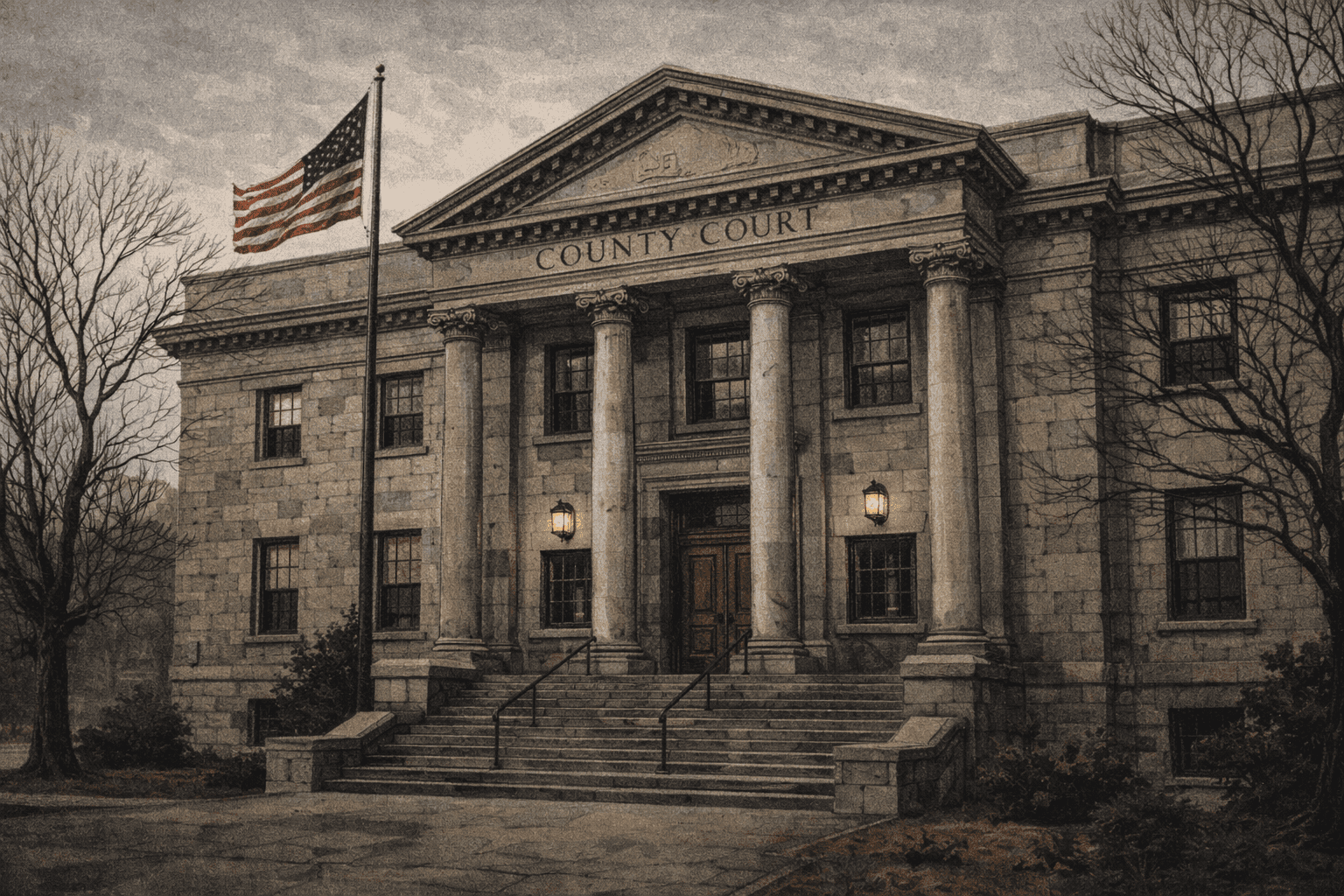
On May 1, 2002, former NBA All-Star Jayson Williams was indicted by a New Jersey grand jury on charges including aggravated manslaughter in the death of Costas "Gus" Christofi, a limousine driver who had been shot in Williams's bedroom at his Hunterdon County estate on February 14, 2000. Williams had retired from basketball in 1999 following a leg injury and had been building a second career as a television sports analyst when the shooting occurred — a gathering of friends and the Harlem Globetrotters that had ended with Williams, by his own eventual account, handling a shotgun carelessly and firing it accidentally. The two-year gap between the incident and the indictment had been filled with the kind of legal maneuvering and public speculation that surrounds high-profile cases, and the charges that were finally filed — which also included tampering with evidence and witness tampering — painted a picture considerably more troubling than mere accident.
The legal proceedings that followed were prolonged and complicated. Williams was ultimately acquitted of the most serious charges but convicted of aggravated assault in 2004; a retrial ended in a plea agreement in 2010, and he served eighteen months in state prison. Costas Christofi, who had driven a limousine to supplement his income and support his family, was forty-six years old when he died. His name belongs in any account of this story, alongside the legal and celebrity narrative that has tended to crowd it out. The Jayson Williams case became, in the years that followed, a reference point in discussions about the accountability of the famous and the particular danger of the assumption — held by some celebrities and sometimes accommodated by the systems around them — that the rules that apply to everyone else apply to them with less force. The court, in the end, disagreed.