March 5: Blood on Snow, A Tyrant Dies, A Probe Flies Past Giants
March 5 has witnessed three moments when the course of history pivoted—through violence in a Boston street that would help birth a nation, through the death of a dictator whose passing released millions from fear, and through a spacecraft's flyby of Jupiter that revealed alien worlds beyond anything imagination had conceived. Each event reminds us that history turns on such moments: when crowds confront power, when tyrants fall, when humanity reaches beyond its planetary cradle to touch the cosmos.
The Massacre That Sparked Revolution
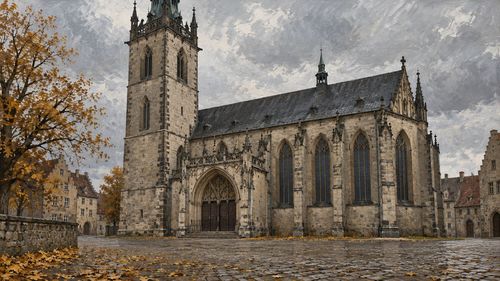
On March 5, 1770, a cold evening in Boston erupted in gunfire when British soldiers fired into a crowd of colonists who had been harassing them outside the Custom House. Five colonists died, including Crispus Attucks, a man of African and Native American descent who became the first casualty of the coming revolution. The incident began with insults and snowballs thrown at a lone sentry, escalated when reinforcements arrived, and ended with panicked soldiers firing into the crowd. Captain Thomas Preston and eight soldiers faced murder charges, defended by future president John Adams, who believed even British soldiers deserved fair trials. Most were acquitted; two received reduced sentences.
What made the Boston Massacre historically significant wasn't the death toll—five people killed in a street confrontation—but how patriots transformed it into propaganda. Paul Revere's engraving depicted an organized massacre of innocent civilians by uniformed soldiers firing on command, rather than the chaotic clash it actually was. The image spread throughout the colonies, crystallizing anti-British sentiment and demonstrating the power of narrative to shape political reality. The event became a rallying point, commemorated annually until revolution finally came. The Boston Massacre showed how violence, even small-scale and ambiguous, could be wielded as a political weapon more powerful than muskets. Those five deaths became martyrdom; that cold March night became the moment when reconciliation became impossible and independence became inevitable.

The Tyrant's Last Hours
One hundred eighty-three years later, on March 5, 1953, Joseph Stalin died in his dacha outside Moscow, ending 29 years of brutal rule over the Soviet Union. He had suffered a stroke days earlier, though fear was so pervasive that guards hesitated to enter his room when he failed to emerge, delaying medical care for hours. Stalin's death came just months after announcing a new purge—the "Doctors' Plot"—suggesting that even in his final years, the paranoia and violence that defined his rule continued unabated. His inner circle reportedly found him collapsed on the floor, and some historians suspect they delayed calling doctors, perhaps hoping the stroke would solve their dictator problem for them.
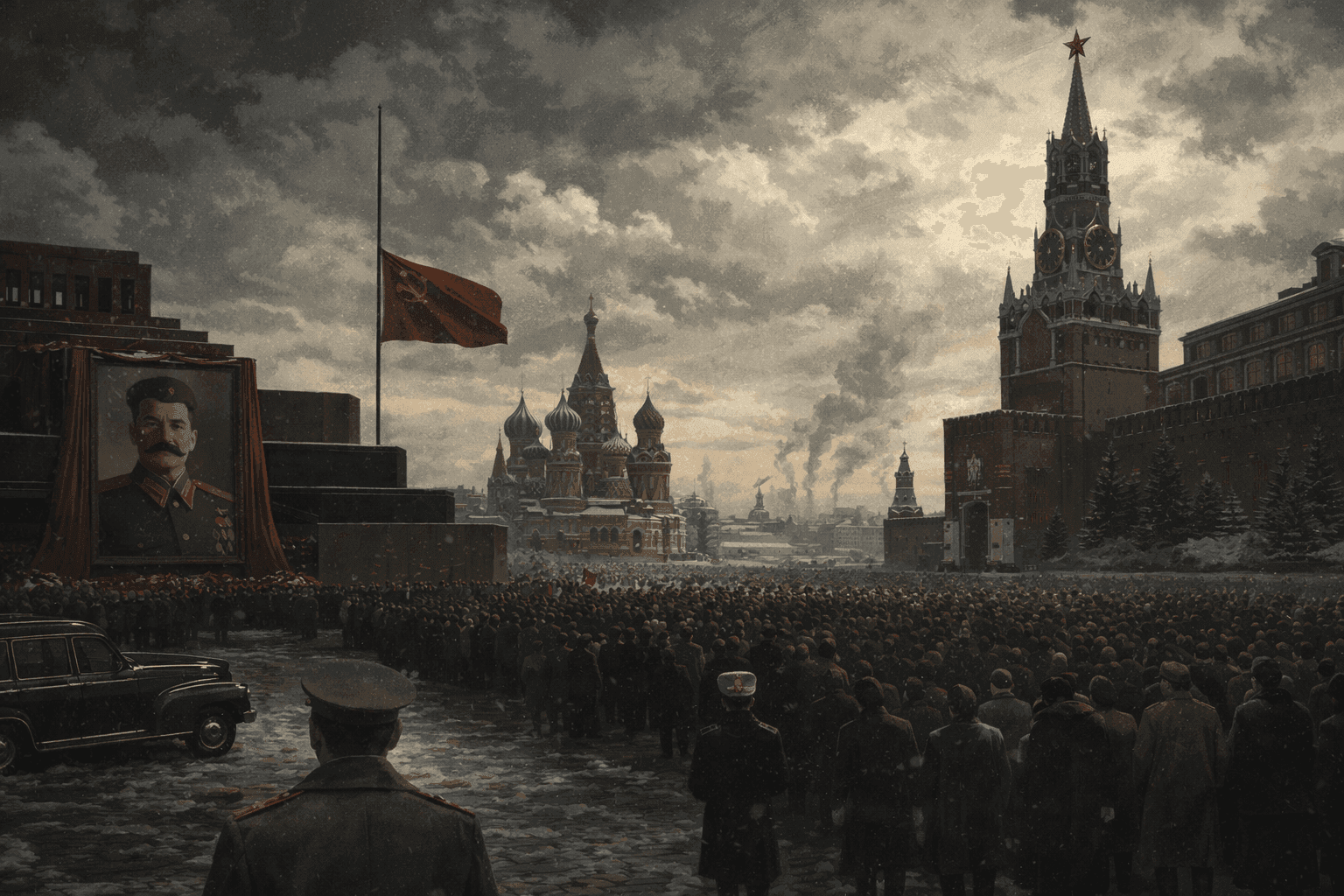
Stalin's death unleashed complex emotions across the Soviet Union and beyond. Millions genuinely mourned the leader whose propaganda had elevated him to godlike status. Millions more experienced relief mixed with terror—what would come next? The funeral procession in Moscow turned deadly as crowds crushed each other trying to view his body. Within weeks, Nikita Khrushchev began consolidating power, and within three years he would denounce Stalin's "cult of personality" in the Secret Speech that began de-Stalinization. Stalin left behind an empire built on industrialization achieved through forced labor, military victory purchased with millions of lives, and a system of repression so thorough it had killed millions of Soviet citizens through purges, forced collectivization, and the Gulag. His death didn't immediately end Soviet authoritarianism, but it ended the worst of the terror. The tyrant who had seemed immortal proved mortal after all.
Journey to Jupiter
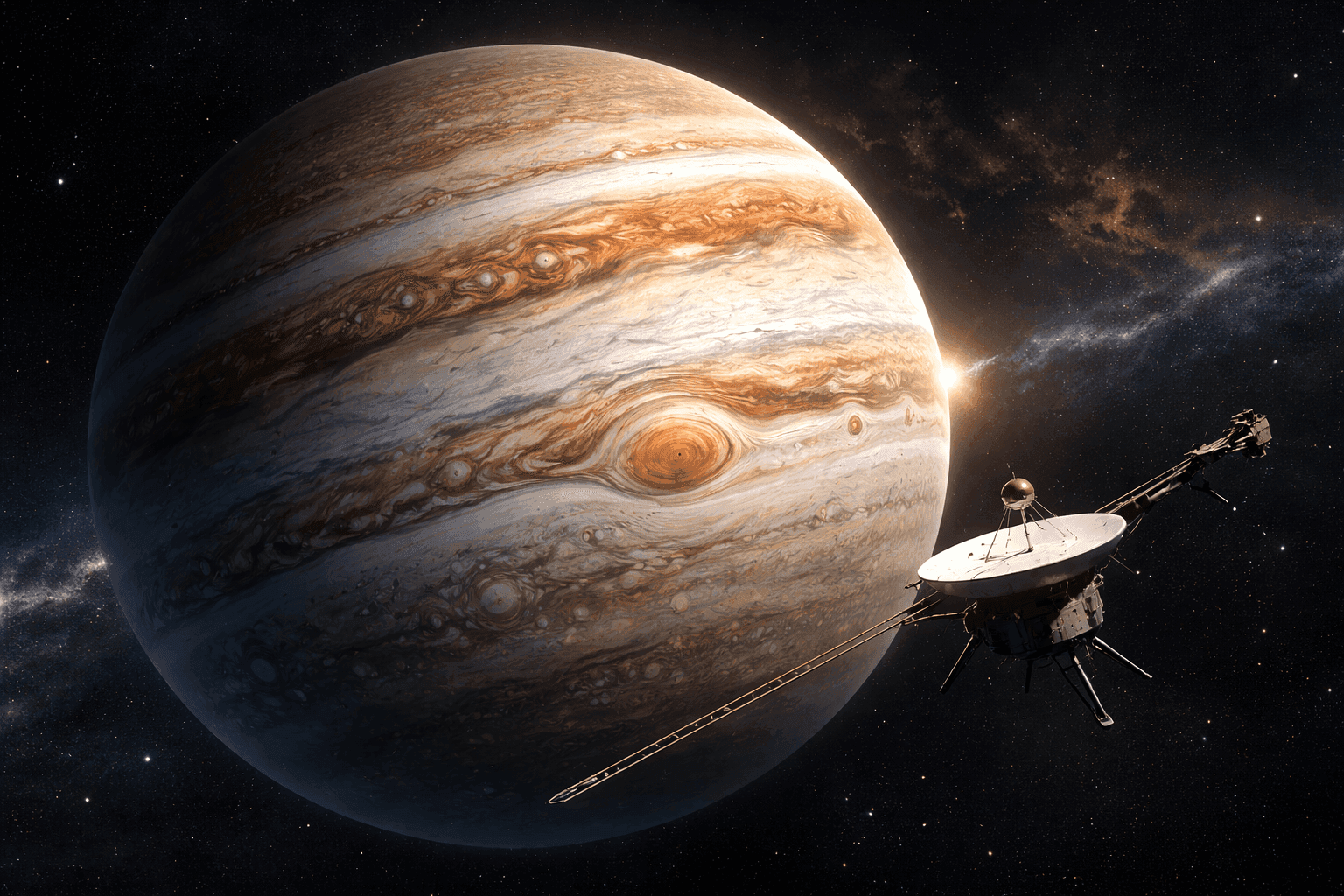
On March 5, 1979, twenty-six years after Stalin's death, Voyager 1 made its closest approach to Jupiter, passing within 217,000 miles of the gas giant's cloud tops. The spacecraft, launched in 1977, spent months photographing Jupiter as it approached, revealing a world of stunning complexity. The Great Red Spot—a storm larger than Earth that had been observed for centuries—appeared in unprecedented detail. Voyager discovered that Jupiter's faint rings actually existed, detected volcanic activity on the moon Io (the first active volcanism found beyond Earth), and returned images of Europa's icy surface that hinted at a subsurface ocean potentially capable of harboring life.
The Jupiter encounter transformed humanity's understanding of the outer solar system. Voyager's cameras captured swirling atmospheric bands, massive storms, and lightning strikes in Jupiter's atmosphere. Its instruments measured intense radiation belts and detected aurorae at the planet's poles. The discoveries at Jupiter's moons proved equally revolutionary—Io's volcanoes, Europa's fractured ice, Ganymede's magnetic field, and Callisto's ancient cratered surface each revealed worlds more complex and dynamic than anyone had anticipated. After Jupiter, Voyager 1 would continue to Saturn, then out toward interstellar space, where it continues traveling today—humanity's most distant emissary, carrying a golden record with sounds and images from Earth should any alien civilization ever intercept it. The Jupiter flyby proved that exploration reveals not just answers but better questions, that the universe is stranger and more magnificent than we imagine, and that humans can build machines that extend our vision across the solar system and beyond.