March 14: Einstein Born, Pi Celebrated, Hawking Dies
March 14 belongs to physics and mathematics in ways both profound and playful. The date witnessed the birth of the 20th century's most iconic scientist, whose theories rewrote our understanding of reality itself. It coincidentally matches the digits of an irrational number so fundamental to mathematics that enthusiasts created a holiday in its honor. And it marked the death of another physics giant who, imprisoned in a failing body, expanded human understanding of the cosmos and communicated that understanding to millions. Together, these events remind us that human curiosity about the universe's fundamental nature—whether expressed through revolutionary theories, mathematical constants, or accessible science communication—represents one of our species' most remarkable characteristics.
A Patent Clerk Reimagines Reality
On March 14, 1879, in Ulm, Germany, Pauline Einstein gave birth to Albert, a child who seemed unremarkable in his early years. He spoke late, leading teachers to doubt his intelligence. He clashed with authoritarian German schools and dropped out before completing his gymnasium education. He failed his first attempt at the entrance exam for the Swiss Federal Polytechnic. Yet this supposedly slow child would become the 20th century's most recognizable scientist, the man whose wild white hair and knowing smile became synonymous with genius itself. Einstein's story demonstrates that conventional measures of intelligence often miss actual brilliance.
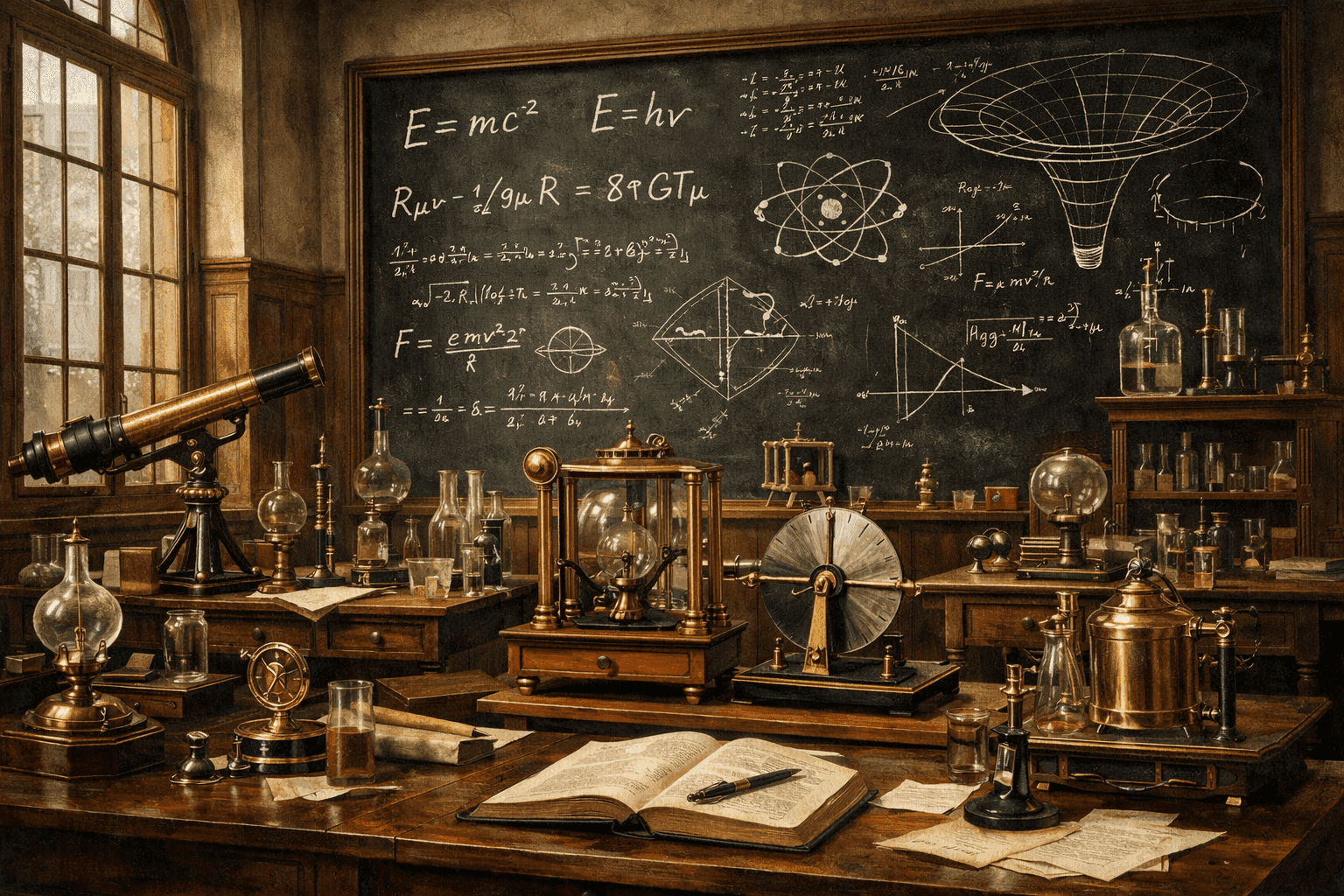
In 1905, while working as a patent clerk in Bern—unable to secure an academic position—Einstein published four papers in the journal Annalen der Physik that revolutionized physics. One explained the photoelectric effect (earning his Nobel Prize), one proved atoms exist through Brownian motion analysis, and two introduced special relativity, showing that space and time are relative rather than absolute, that energy equals mass times the speed of light squared (E=mc²). A decade later, general relativity revealed that gravity isn't a force but the curvature of spacetime caused by mass. Einstein demonstrated that Newton's centuries-old framework, while useful, was fundamentally incomplete. His theories predicted phenomena—like gravitational waves and black holes—that wouldn't be confirmed until decades after his death in 1955. Einstein became a cultural icon, the archetypal genius whose equations few understood but whose brilliance everyone recognized. He proved that reality operates on principles wildly different from common sense, that time can slow down, that space can bend, and that the universe is stranger than our everyday experience suggests.
The Irrational Number Gets a Holiday
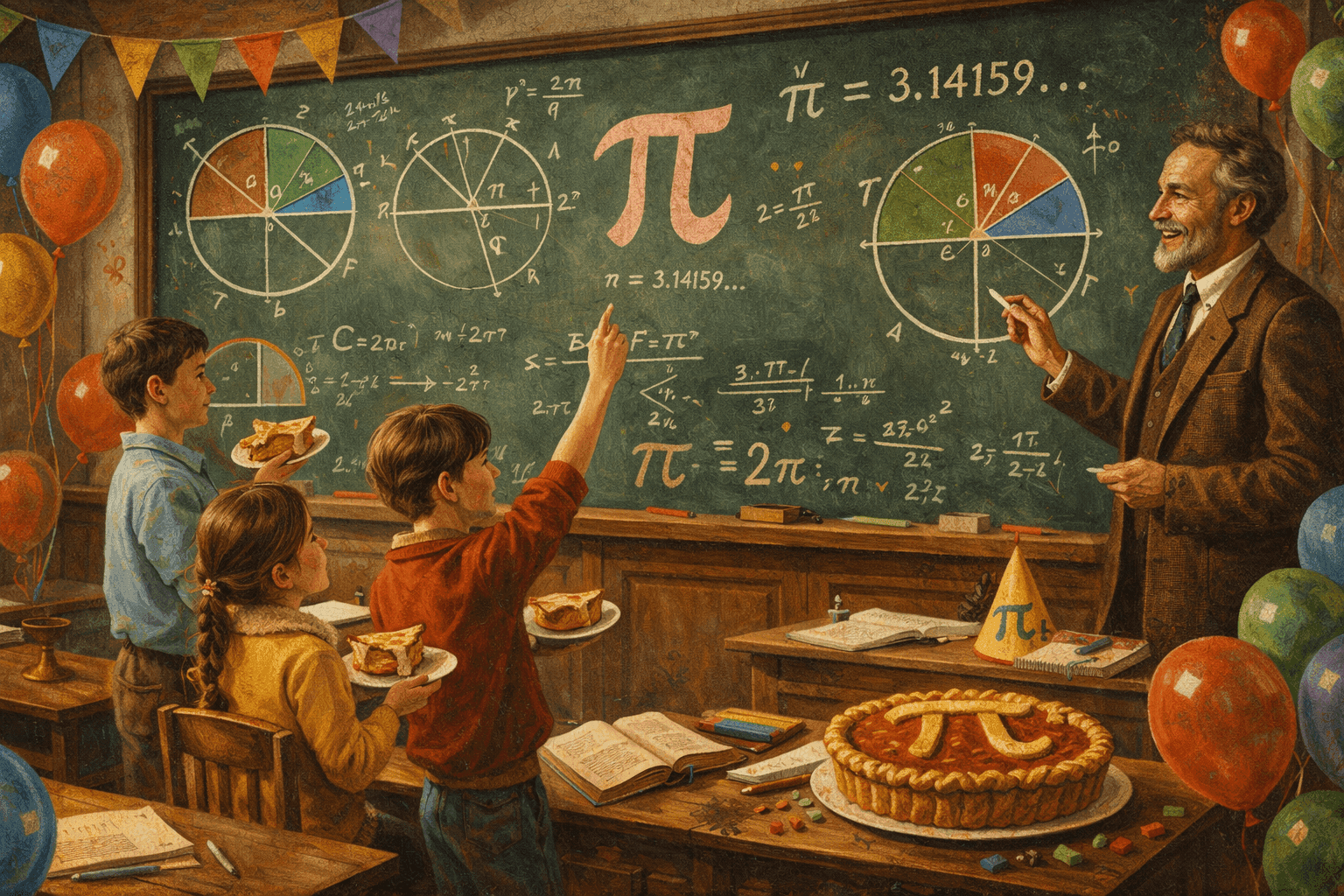
Einstein's birthday created an irresistible coincidence: March 14 can be written 3/14, matching the first three digits of pi (π ≈ 3.14159...), the ratio of a circle's circumference to its diameter. This mathematical constant appears throughout mathematics and physics—in Einstein's equations, in quantum mechanics, in signal processing, in statistics. It's irrational, meaning its decimal expansion never ends or repeats, continuing infinitely without pattern. In 1988, physicist Larry Shaw at San Francisco's Exploratorium noticed the date coincidence and organized the first Pi Day celebration, complete with circular marching and fruit pies. The playful tradition spread.
Pi Day became an excuse to celebrate mathematics in accessible ways—pie-eating contests, memorization competitions, math-themed activities in schools. In 2009, the U.S. House of Representatives passed a resolution recognizing March 14 as National Pi Day. The holiday works because it makes mathematics approachable, transforming an abstract constant into something worth celebrating with dessert. Pi connects the ancient (Archimedes calculated it to remarkable precision) with the modern (computers have calculated trillions of digits). It appears in places that seem unrelated to circles—probability theory, quantum mechanics, cosmology. Pi Day reminds us that mathematics underlies reality in beautiful and surprising ways, that numbers and equations aren't just tools but fundamental to how the universe works. And that even mathematicians appreciate a good pun and some pie.
The Mind That Wouldn't Quit
On March 14, 2018—Einstein's 139th birthday and Pi Day—Stephen Hawking died at his home in Cambridge, England, at age 76. The symmetry was fitting for a man who spent his life exploring the universe's deepest mysteries while trapped in a body progressively paralyzed by motor neuron disease. Diagnosed at 21 with a condition that typically kills within years, Hawking was given two years to live. He survived more than five decades, becoming perhaps the most recognizable scientist since Einstein himself, his computerized voice and wheelchair as iconic as Einstein's wild hair.
Hawking made groundbreaking contributions to cosmology and black hole physics. He proved that black holes aren't entirely black—they emit radiation (now called Hawking radiation) through quantum effects near the event horizon, eventually evaporating. He worked on understanding the universe's origin and whether time had a beginning. But perhaps his greatest achievement was making complex physics accessible to millions. His 1988 book A Brief History of Time became an international bestseller, selling over 25 million copies despite containing equations most readers couldn't follow. Hawking demonstrated that severe disability couldn't prevent brilliant contribution, that humor and humanity could coexist with profound intellect, and that science communication matters as much as scientific discovery. His death on Pi Day and Einstein's birthday felt cosmically appropriate—one genius departed on the day that celebrated another's birth and the mathematical constant both their theories employed. Hawking proved that the human spirit's reach exceeds the body's limitations, that curiosity about the universe's fundamental nature remains one of humanity's noblest pursuits, regardless of whether we can move our own limbs or only our minds.