
March 10: A Voice Transmits, A Nation Rises, A Slayer Debuts
March 10 has witnessed three moments when boundaries were crossed and possibilities expanded. An inventor transmitted the human voice across wire for the first time, collapsing the distance between rooms and eventually continents. Tibetans rose against occupation, sparking an uprising that would send their spiritual leader into exile and launch a decades-long struggle for cultural survival. And a television show debuted that would rewrite the rules about who could be a hero, using supernatural horror to explore very real experiences of adolescence, power, and responsibility. Each moment reflects humanity's persistent drive to connect, to resist, and to tell stories that challenge who we think we are.
Mr. Watson, Come Here
On March 10, 1876, Alexander Graham Bell spoke into his experimental device and became the first person to successfully transmit intelligible speech electrically. "Mr. Watson, come here, I want to see you," he said to his assistant Thomas Watson, who was in an adjacent room. Watson heard the words clearly through the receiver and came running. The moment was both mundane—a simple request between colleagues—and revolutionary. Bell had achieved what many thought impossible: converting the human voice into electrical signals, transmitting them through wire, and reconverting them back into sound that could be understood. Three days earlier, Bell had received his telephone patent; now he had proof it actually worked.
The telephone's impact would be difficult to overstate. Within decades, telephone networks connected cities, then continents. Distance became increasingly irrelevant to human connection—you could conduct business, maintain relationships, coordinate emergencies, or simply chat with someone thousands of miles away as if they were in the next room. The telephone transformed commerce, governance, journalism, and personal life. It enabled corporations to span continents, allowed families separated by immigration to maintain bonds, and created new forms of intimacy and immediacy. Bell's first transmitted words weren't profound philosophy or memorable poetry—they were a practical request. That ordinariness was the point. The telephone wasn't just for special occasions; it made instant voice communication normal, expected, mundane. Bell's invention didn't just transmit his voice across a room; it fundamentally altered human relationships by making presence independent of physical proximity.

Uprising on the Roof of the World
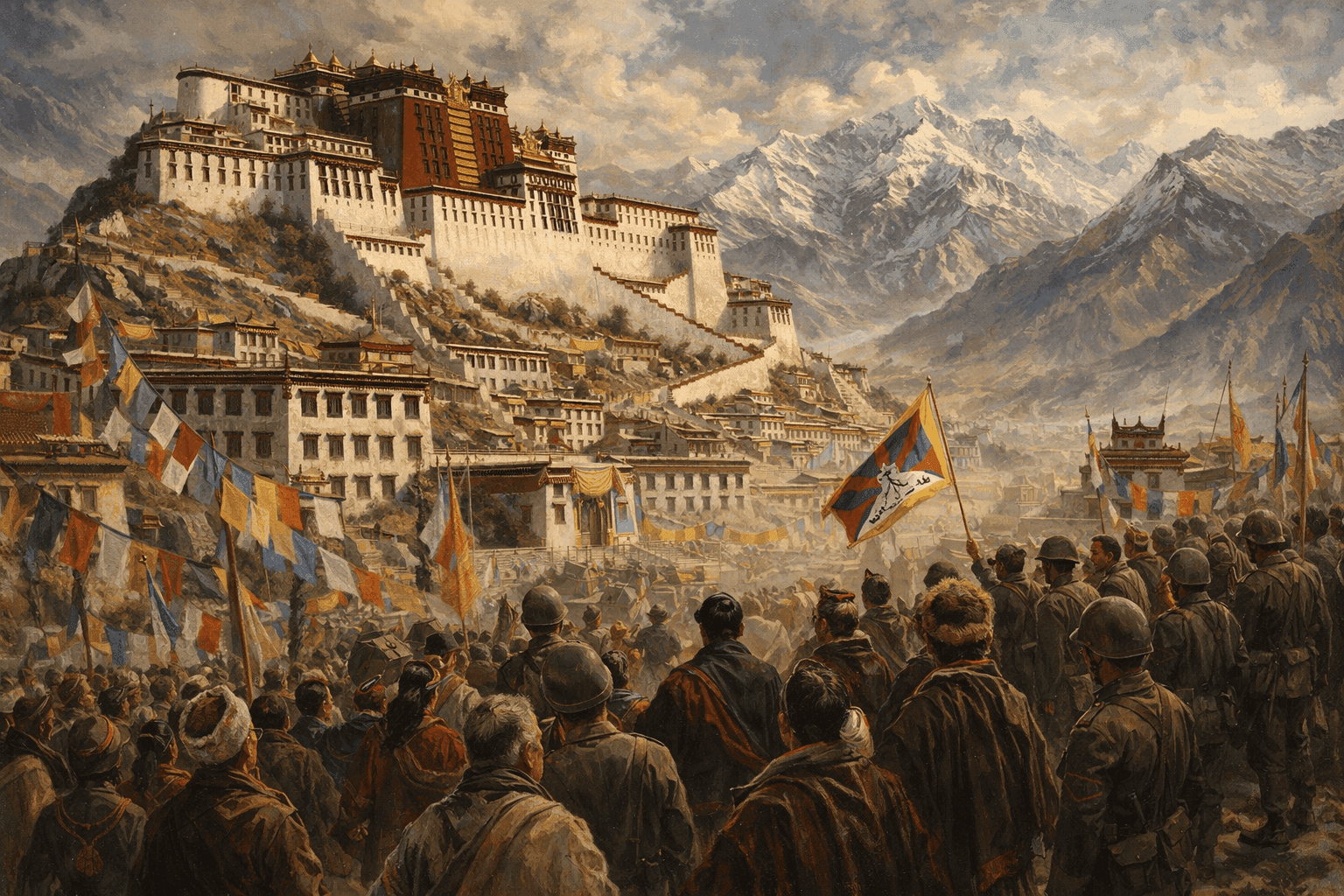
Eighty-three years after Bell's breakthrough, on March 10, 1959, Tibetans in Lhasa rose in widespread revolt against Chinese occupation. China had invaded Tibet in 1950, claiming the region as historically Chinese territory. For nine years, tensions simmered as Chinese authorities gradually dismantled Tibet's traditional governance and restricted religious practices. By March 1959, rumors spread that Chinese forces planned to abduct the 14th Dalai Lama, Tibet's spiritual and political leader. Tens of thousands of Tibetans surrounded the Dalai Lama's summer palace to protect him, effectively besieging themselves as Chinese troops encircled the area.
The uprising was brutally suppressed. Chinese forces shelled the palace and monasteries, killing thousands of Tibetans. On March 17, the Dalai Lama, then 23 years old, fled Lhasa disguised as a soldier, beginning a harrowing two-week journey across the Himalayas to India where he established a government-in-exile that continues today. The failed uprising led to decades of repression: destruction of monasteries, prohibition of religious practices, forced resettlement of ethnic Chinese into Tibet, and systematic efforts to eradicate Tibetan culture. Yet it also launched an international movement for Tibetan autonomy. The Dalai Lama became a global figure advocating nonviolent resistance and Buddhist values, winning the Nobel Peace Prize in 1989. The March 10 uprising remains commemorated annually as Tibetan Uprising Day, a reminder of a people's persistent struggle to preserve their identity against overwhelming power determined to erase it.
The Chosen One
On March 10, 1997, thirty-eight years after the Tibetan uprising, Buffy the Vampire Slayer premiered on The WB network. Created by Joss Whedon, the show followed Buffy Summers, a teenage girl "chosen" to battle vampires, demons, and forces of darkness while navigating high school, relationships, and identity. The premise inverted horror movie conventions where blonde girls were always victims; here, the blonde cheerleader was the hero, the one who fought back. What began as a cult show about supernatural battles became something more ambitious: a seven-season exploration of power, responsibility, trauma, and what it means to be a hero when you never asked for the role.
Buffy used monsters as metaphors for adolescent experiences—a controlling boyfriend literally becomes a demon, a popular girl who makes you invisible has actually turned invisible, your fears manifest as literal demons. But the show also tackled serious themes: death, depression, addiction, abusive relationships, and the costs of sacrificing yourself for others. Buffy died twice saving the world. She struggled with depression after being resurrected. She made terrible decisions and had to live with consequences. The show's genius lay in treating teenage experiences—first love, social hierarchies, finding your identity—with the same gravity as apocalyptic battles. Buffy influenced a generation of television creators, demonstrating that genre shows could be literarily ambitious, that female heroes could be complex and flawed, and that shows marketed to teenagers could explore profound questions about power and responsibility. The girl who fought vampires became a cultural icon not despite being a teenage girl, but because the show insisted her experiences and struggles mattered as much as any traditional hero's journey.