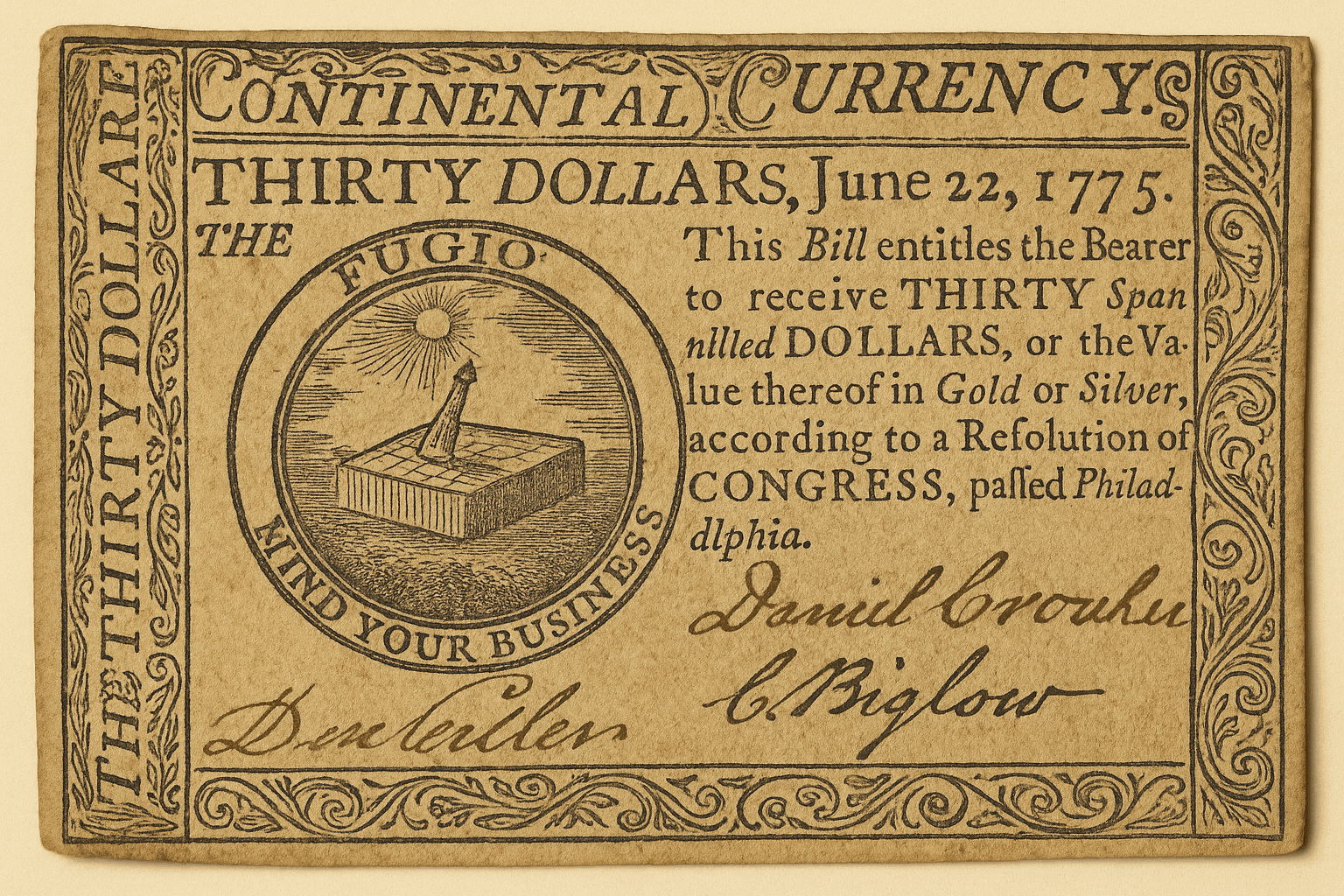
On June 22, 1775, the Continental Congress took a bold step in support of American independence by authorizing the issuance of Continental Currency. This move came just two months after the outbreak of hostilities at Lexington and Concord and marked the first attempt by the colonies to create a unified national currency.
As the fledgling nation mobilized for war, Continental Currency became a vital instrument for financing the Revolution—even as it faced daunting economic obstacles.

A Nation’s First Dollar
The decision to print paper money was driven by necessity. The Continental Congress had no power to levy taxes and required a means to fund the Continental Army, purchase supplies, and manage wartime logistics. Backed only by the promise of future redemption, the notes—often inscribed with patriotic slogans like “United Colonies” and “Death to Counterfeiters”—quickly entered circulation.
The currency came in various denominations and featured elaborate designs in an effort to deter counterfeiting. Benjamin Franklin himself had contributed to the printing process, using distinctive paper and type to make replication more difficult.
Challenges of Confidence
Despite these efforts, the new currency was plagued by issues that undermined its effectiveness. With no central banking system and limited oversight, the printing of money became excessive. Rapid inflation soon followed, and by the later years of the war, the phrase “not worth a Continental” became a popular expression of the currency’s diminished value.
Counterfeiting, particularly by British agents seeking to destabilize the colonial economy, further eroded public trust. The flood of fake notes in circulation exacerbated inflation and compounded the young government’s economic woes.
A Crucial but Flawed First Step

Though Continental Currency ultimately failed as a stable medium of exchange, its significance cannot be understated. It was a foundational step in the development of a national financial system and a demonstration of the colonies’ commitment to self-governance.
The experience underscored the need for a strong and centralized monetary policy—lessons that would later inform the creation of the U.S. Treasury, the Constitution’s financial provisions, and the establishment of a national bank.