October 28: Liberty Unveiled, the Arch Completed, Chandler Gone
October 28: Liberty Unveiled, the Arch Completed, Chandler Gone
Three October 28ths defined by monuments — one raised to freedom, one to westward ambition, and one built quietly across thirty years in the living rooms of people who loved a character who made them laugh while carrying something heavy
Monuments take many forms. Some are built of copper on an island in a harbor, their torches visible for miles. Some are bent into 630 feet of stainless steel over a river that once marked the boundary between the known and the unknown. And some are built, invisibly and over decades, in the way a performer inhabits a character so completely that when they are gone, the character goes with them and something in the culture goes quiet. October 28 has seen all three kinds of monument raised — and in the case of the last one, lowered. A torch lifted. An arch closed. A room that used to be full of laughter.
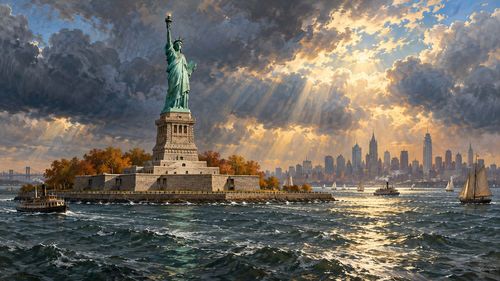
Liberty Enlightening the World
On October 28, 1886, President Grover Cleveland stood on Bedloe's Island in New York Harbor and pulled a cord that released a French tricolor from the face of the Statue of Liberty, unveiling the largest sculpture in the world to a crowd of dignitaries, naval vessels, and the enormous enthusiasm of a city that had been waiting for years. The statue — officially titled Liberty Enlightening the World — had been conceived by French political thinker Édouard de Laboulaye as a gift from the French people to the American, a celebration of the democratic ideals the two nations shared and a pointed contrast with the authoritarian governments that surrounded France. Sculptor Frédéric Auguste Bartholdi designed it. The engineer who built its internal iron skeleton, making the copper skin's impossible scale structurally possible, was Alexandre Gustave Eiffel — who would apply lessons learned here to a tower in Paris three years later. Standing 305 feet from ground to torch tip, Liberty was the tallest structure in New York at the time of her dedication.
The meaning of the statue has never been fixed. Laboulaye and Bartholdi intended it as a symbol of the friendship between France and the United States and of liberal democratic ideals. Emma Lazarus's 1883 sonnet, "The New Colossus" — "Give me your tired, your poor, your huddled masses yearning to breathe free" — recast it as an emblem of immigration and refuge, though the poem was not mounted on the pedestal until 1903. In the century and more since, the statue has been claimed by advocates of immigration, by advocates of restriction, by protesters, by governments, and by advertising campaigns. It has appeared on currencies, stamps, corporate logos, and political posters of every ideological persuasion. The torch that Cleveland unveiled on October 28, 1886 has meant, across its 140 years, whatever the country most needed it to mean — which may be the most honest measure of a great symbol's power.
Liberty Enlightening the World — a monument that has meant whatever America most needed it to mean across 140 years of history, argument, and aspiration.
The Keystone
On October 28, 1965, construction workers in St. Louis, Missouri lowered an eight-foot triangular section of stainless steel into the gap at the top of the Gateway Arch, completing one of the most mathematically demanding structures ever built and one of the most recognizable monuments in the American West. The arch had been designed by Finnish-American architect Eero Saarinen as the centerpiece of the Jefferson National Expansion Memorial, intended to commemorate the westward expansion of the United States and St. Louis's role as the gateway through which much of it passed. Saarinen's design — a catenary curve, the shape that a chain makes when hung between two points — was not an arch in the traditional sense but a precisely calculated parabolic form 630 feet tall at its apex, with legs 630 feet apart at their bases. Every dimension was mathematically exact. Every piece of stainless steel cladding had to be shaped to curve in two directions simultaneously.
The final keystone piece presented the construction team with a problem: the two legs of the arch, each built independently from the ground up, had to meet within a fraction of an inch at the top after rising 630 feet. Temperature variations on the day of completion caused the steel to expand, and fire hoses had to be used to cool the south leg before the gap was small enough to receive the triangular section. Saarinen himself had died of a brain tumor in 1961, four years before the arch was completed, and never saw his design realized. The monument he left behind sits on the western bank of the Mississippi River, and on a clear day it is visible from thirty miles away — a silver curve against the Missouri sky, marking the place where the American continent opened into something that felt, to the people who crossed it, like the possibility of beginning again.
The Gateway Arch on the Mississippi — a monument to westward expansion whose architect died four years before its completion, and whose keystone required fire hoses and exact mathematics to set in place.
❦
Could That BE Any More Missed
On October 28, 2023, Matthew Perry was found dead at his home in Pacific Palisades, Los Angeles. He was fifty-four years old. The Los Angeles County Medical Examiner later determined that he had died from the acute effects of ketamine, with drowning, coronary artery disease, and the effects of buprenorphine listed as contributing factors. Perry had been, for a decade, one of the most recognizable faces on American television — Chandler Bing, the self-deprecating, joke-deflecting, emotionally defended friend on Friends, the NBC sitcom that ran from 1994 to 2004 and became one of the most watched television programs in the world. The character Perry inhabited for ten seasons was, by the actor's own account, closer to him than most fictional characters come to their performers — a man who used humor as both a weapon and a shield, and who was funnier than anyone in the room as a way of never having to be more vulnerable than the room could handle.
Perry had been open about his addiction struggles for years before his death — he had been hospitalized multiple times, spent time in rehabilitation facilities, and had written about his experience with painful candor in his 2022 memoir, Friends, Lovers, and the Big Terrible Thing. He estimated that he had spent approximately nine million dollars on his sobriety attempts. The memoir, published just a year before his death, described a man who understood exactly what his addiction was doing to him and who was fighting it with every resource he had. His death, despite being in some sense foreseeable given what he had lived through, arrived with the particular shock of something that shouldn't have happened to someone who had tried so hard to prevent it. The tributes that followed came from fans who had spent a decade watching him be funny on a couch in a coffee shop in Manhattan — and who had understood, without necessarily having the words for it, that the funniness was also something else.
The kind of warm, lamplit gathering place that a generation of television viewers came to think of as the background of their own friendships — and that Matthew Perry made feel, for ten years, like somewhere worth coming back to.