April 7: Coming Home From the Moon
Yesterday, for the first time in 54 years, human beings looked down on the full disc of the Moon. For seven hours, Commander Reid Wiseman, Pilot Victor Glover, Mission Specialist Christina Koch, and CSA astronaut Jeremy Hansen photographed 30 geological targets on the lunar surface, narrated what they saw to scientists at Mission Control in real time, and went places — around the far side, behind the Moon, out of all contact with Earth — that no one alive had ever been. At 7:02 p.m. EDT, they reached closest approach: 4,067 miles from the surface, the Moon appearing the size of a basketball held at arm's length. At 7:07 p.m., they traveled 252,757 miles from Earth — farther than any human beings in history, breaking a record that had stood since the emergency return of Apollo 13 in 1970. The Moon's gravity caught them and turned them, and now the Orion spacecraft — named Integrity by the crew — is on a free-return trajectory home. Splashdown is scheduled for Friday, April 10, at 8:07 p.m. EDT, in the Pacific Ocean off San Diego.
A Bright Spot on the Moon
Shortly after the crew broke the human distance record, floating farther from Earth than anyone ever had, Canadian astronaut Jeremy Hansen spoke up from inside the spacecraft. His voice was audibly unsteady. He told Mission Control that the crew wanted to propose names for two unnamed craters they had identified during the flyby. The first, he said, they wished to call Integrity — the name of their spacecraft and, in his words, an ode to everyone who has worked on, watched, or supported the mission. The second, he said, was a bright crater, newly formed, catching the light on the far side of the Moon. "It's a bright spot on the moon," Hansen said, "and we would like to call that Carroll." Carroll was the name of Commander Reid Wiseman's wife, who died from cancer in 2020. The four astronauts embraced. Some of them wept. A name passed from Earth to the Moon, written in light on a crater no human eye had ever seen before yesterday — now seen, named, and carried home. The proposals will be formally submitted to the International Astronomical Union, the body that governs the naming of celestial bodies and their features.
The crew also witnessed events that no human had ever experienced from that vantage point. When the spacecraft passed behind the far side of the Moon, communications with Earth were cut for approximately 40 minutes — among the longest communication blackouts in human spaceflight history. In that silence, alone beyond the Moon's horizon, the crew watched a solar eclipse: the Moon passing in front of the Sun, visible from their unique position in deep space. Pilot Victor Glover described the view during the eclipse: "Humans probably have not evolved to see what we're seeing. It is truly hard to describe. It is amazing." Commander Wiseman said simply: "No matter how long we look at this, our brains are not processing this image in front of us. It is absolutely spectacular, surreal." When contact was restored, the crew reported seeing Earthrise — the blue planet rising over the Moon's far horizon, just as the Apollo 8 crew had first photographed it from lunar orbit in December 1968, in the image that changed how humanity understood where it lived.
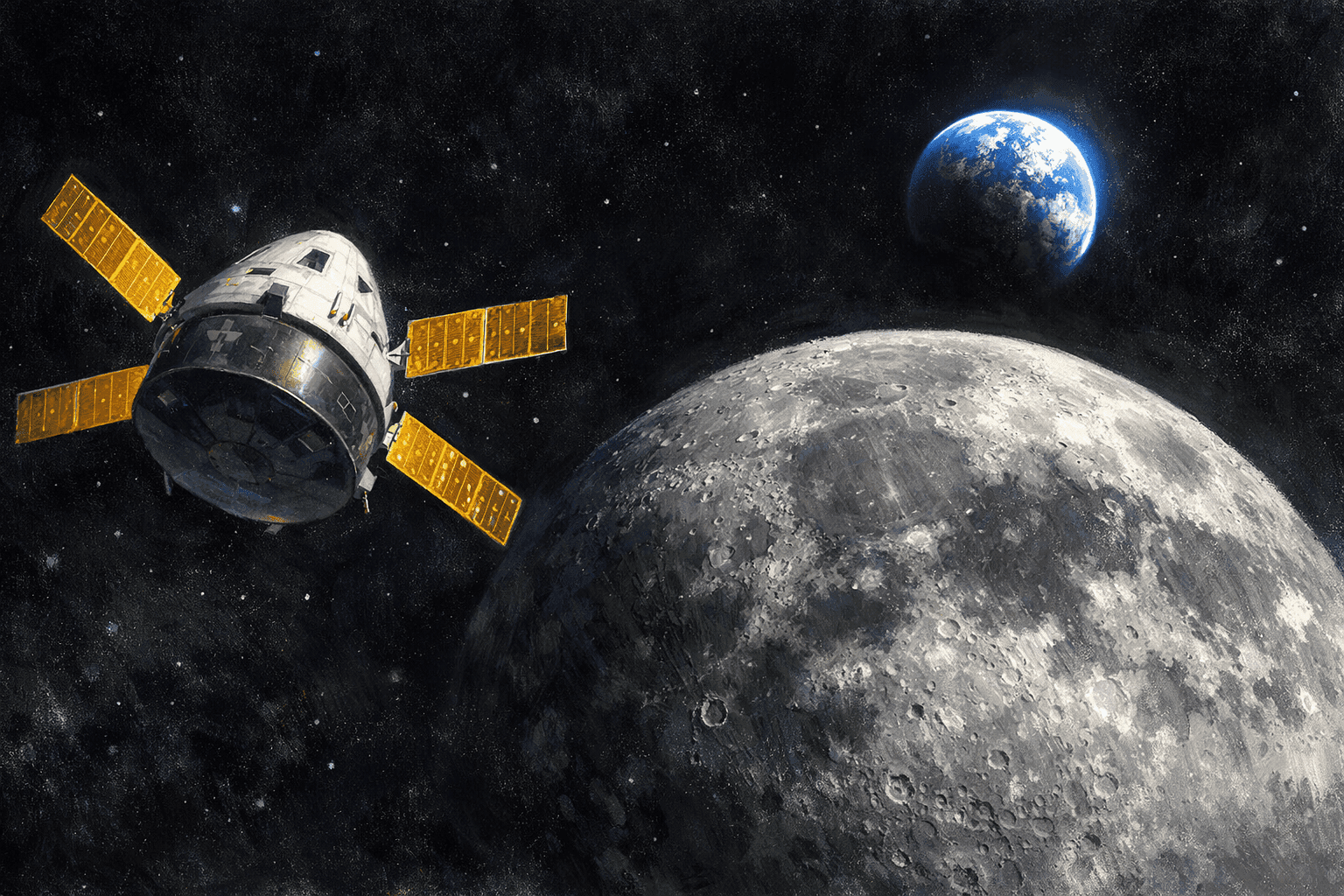
On Good Friday, in the middle of the mission, Pilot Victor Glover shared an Easter message from inside the spacecraft. "This is an opportunity for us to remember where we are, who we are, and that we are the same thing," he said, "and that we've gotta get through this together." The crew of Artemis II launched on April Fools' Day beneath a Full Pink Moon, flew around the far side of the Moon on Easter Monday, and will splash down on Good Friday's echo, April 10 — a final arc home across a week when the whole world had been watching the sky. They will travel a total of 695,081 miles by the time they hit the water off San Diego. They saw things no living human had seen. They broke the record no one had broken in 56 years. They named a bright spot on the Moon for someone they loved. And now, as the Orion spacecraft turns its nose toward the pale blue dot it came from, there are two new names on the lunar surface: Integrity. And Carroll.