April 6: Humans at the Moon
At 12:37 a.m. this morning, the Orion spacecraft crossed into the lunar sphere of influence — the zone where the Moon's gravity exerts a stronger pull on the vehicle than the Earth's. It was a threshold no human being had crossed since December 1972. From that moment forward, the crew of Commander Reid Wiseman, Pilot Victor Glover, Mission Specialist Christina Koch, and CSA astronaut Jeremy Hansen has been, technically, in lunar space. Today's flyby runs from 2:45 p.m. EDT, when Orion's windows will be trained on the Moon, through 9:20 p.m., when the crew swings past and begins the long arc home. The most dramatic moments come in the early evening: at 6:44 p.m., Mission Control will lose all contact with the crew as the spacecraft passes behind the Moon — roughly 40 minutes of silence during which the most historic part of the mission takes place entirely beyond the reach of Earth. At 7:02 p.m., still out of contact, the crew will reach closest approach. At 7:05, they will travel farther from Earth than any human beings in history. Then the Moon's gravity will throw them home, and the signal will return.
What They Are Seeing That No One Has Seen Before
The nine Apollo missions that flew to the Moon were designed around landing — their trajectories prioritized the illuminated near side where the astronauts would touch down. The far side was largely in darkness during those missions. Artemis II flies a different path entirely: a trajectory that gives the crew a view of the entire lunar disc at once, including the poles and parts of the far side that no human eye has ever observed. From 4,070 miles — "the size of a basketball held at arm's length," in NASA's description — the crew will look down on 3.8-billion-year-old impact craters, ancient lava flows, and surface features that have been waiting since the formation of the Solar System for someone to describe them. NASA scientists identified 35 specific geological targets for the crew to photograph and narrate in real time to Mission Control, including the vast Orientale Basin — a nearly 600-mile-wide crater straddling the near and far sides — and the Hertzsprung Basin, a 400-mile crater on the far side that has never been observed by humans at this resolution. "That period of our planet's history that we can no longer get here, even if we go to the deepest parts of the ocean," said NASA's Artemis II Lunar Science lead Kelsey Young, "is there on the Moon." Christina Koch, already seeing the far side for the first time earlier in the approach, said simply: "It is absolutely phenomenal."
As the crew prepared for today's flyby, they received a recorded message from Apollo 16 astronaut Charlie Duke — one of only twelve people in history to have walked on the Moon, a man who last stood on the lunar surface 54 years ago. The gesture connected the two eras of lunar exploration across half a century in the most personal way imaginable: someone who has been there, speaking to the people who are going back. The crew has also experienced what Mission Control described as "moon joy" in the days since launch — that particular euphoria that comes from seeing the Moon grow from a distant disc into something real, close, and fully dimensional. Pilot Victor Glover, watching the approach, described it: "That we can do this right now means we could do so much more."
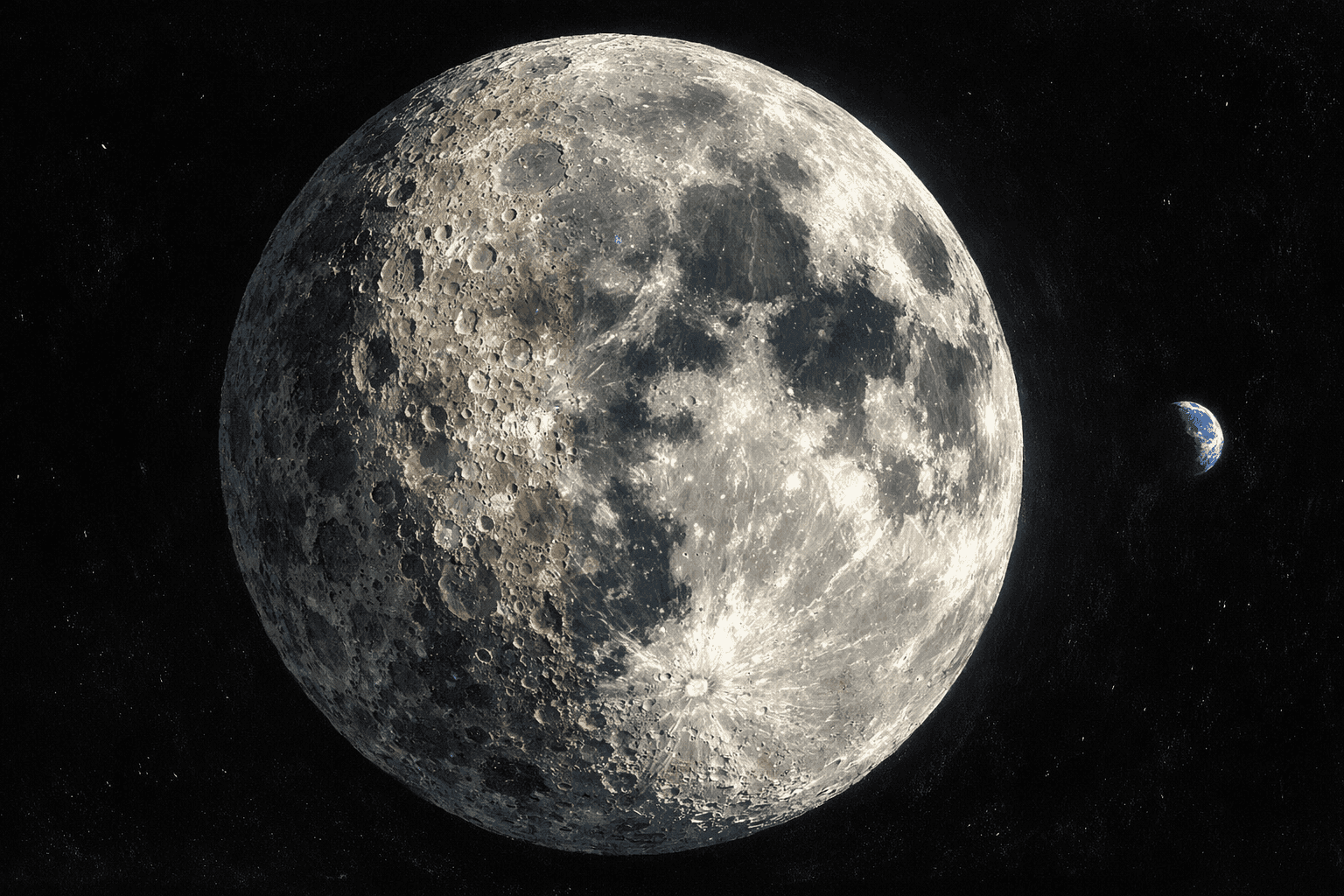
Somewhere on the Moon's surface tonight, in the Taurus-Littrow Valley, Gene Cernan's daughter's initials are still in the dust. T D C. Untouched. The crew of Artemis II will not land — this is a test flight, not a landing mission — but they will see the Moon as no one alive has seen it, and what they photograph today will help determine where humans land in 2028. At 7:25 p.m., as the spacecraft emerges from behind the Moon's far side and communications are restored, the crew will see something that has no formal name but a very famous history: Earthrise. The blue planet will come back into view over the horizon of the Moon — a sight that, when the Apollo 8 crew first photographed it in December 1968, changed how humanity understood its place in the universe. Today it rises again, for four new witnesses, 252,757 miles from home.