April 5: The Sunday That Changes Everything
This morning, before dawn, churches across the world held vigil services in the dark — and then, at the first light, turned on every candle and every light they had. The sunrise service is one of the oldest traditions in Christian observance, rooted in the Gospel accounts of women arriving at Jesus's tomb in the early morning and finding it empty. Today, from midnight masses in the Philippines to sunrise gatherings on the beaches of California to high-noon celebrations in West African churches, more than two billion Christians mark the same belief: that on this day, three days after his crucifixion on Good Friday, Jesus Christ rose from the dead. It is the foundational claim of Christianity, and Easter Sunday is the day the tradition turns on. Everything else — Lent, Palm Sunday, Good Friday, Holy Saturday — points here.
Eostre, Eggs, and a Monk Who Changed History
The word "Easter" has a surprisingly mysterious origin. In most of the world's languages, the holiday carries a name derived from Passover: Pâques in French, Pasqua in Italian, Pascua in Spanish, Pascha in Greek and Latin — all tracing to the Hebrew Pesach, the feast of liberation, because Jesus was crucified during Passover week. But in English and German — Easter and Ostern — the name points somewhere older and stranger. In the 8th century, an Anglo-Saxon monk named Bede — the most learned man in England, and the author of the first history of the English people — wrote a single paragraph that has puzzled scholars ever since. He explained that the month of April had once been called Ēosturmōnaþ in Old English — Eostre's Month — named for an Anglo-Saxon goddess of spring and dawn called Eostre, in whose honor feasts were celebrated. When Christianity came to England, he wrote, the new spring celebration simply inherited her name. That one paragraph, written around 725 CE, is essentially everything we know about Eostre from primary sources.
Whether Bede invented her or recorded a genuine tradition remains debated — though in 1958, archaeologists discovered more than 150 Romano-Germanic votive inscriptions to a triad of goddesses called the matronae Austriahenae in Germany, datable to around 150–250 CE, lending support to the idea that some form of spring goddess worship in the region was real. What is not debated is the origin of the eggs and the bunny. Eggs have symbolized new life, rebirth, and fertility across cultures since long before Christianity — they appear in creation myths around the world and were established symbols of spring in pre-Christian pagan traditions. Early Christians adopted them as symbols of the resurrection: as one ancient stone rolled away from a tomb, so an egg is opened from within. The hare — which became the Easter bunny over centuries of folklore — was associated with fertility, spring, and the moon across many ancient cultures. Pope Gregory I, writing to missionaries in England in 601 CE, explicitly advised them to adapt existing pagan festivals to Christian purposes rather than abolish them: let the celebrations continue, he said; change what they celebrate. Easter, in both its name and its traditions, is the clearest example of that strategy working across fifteen centuries.
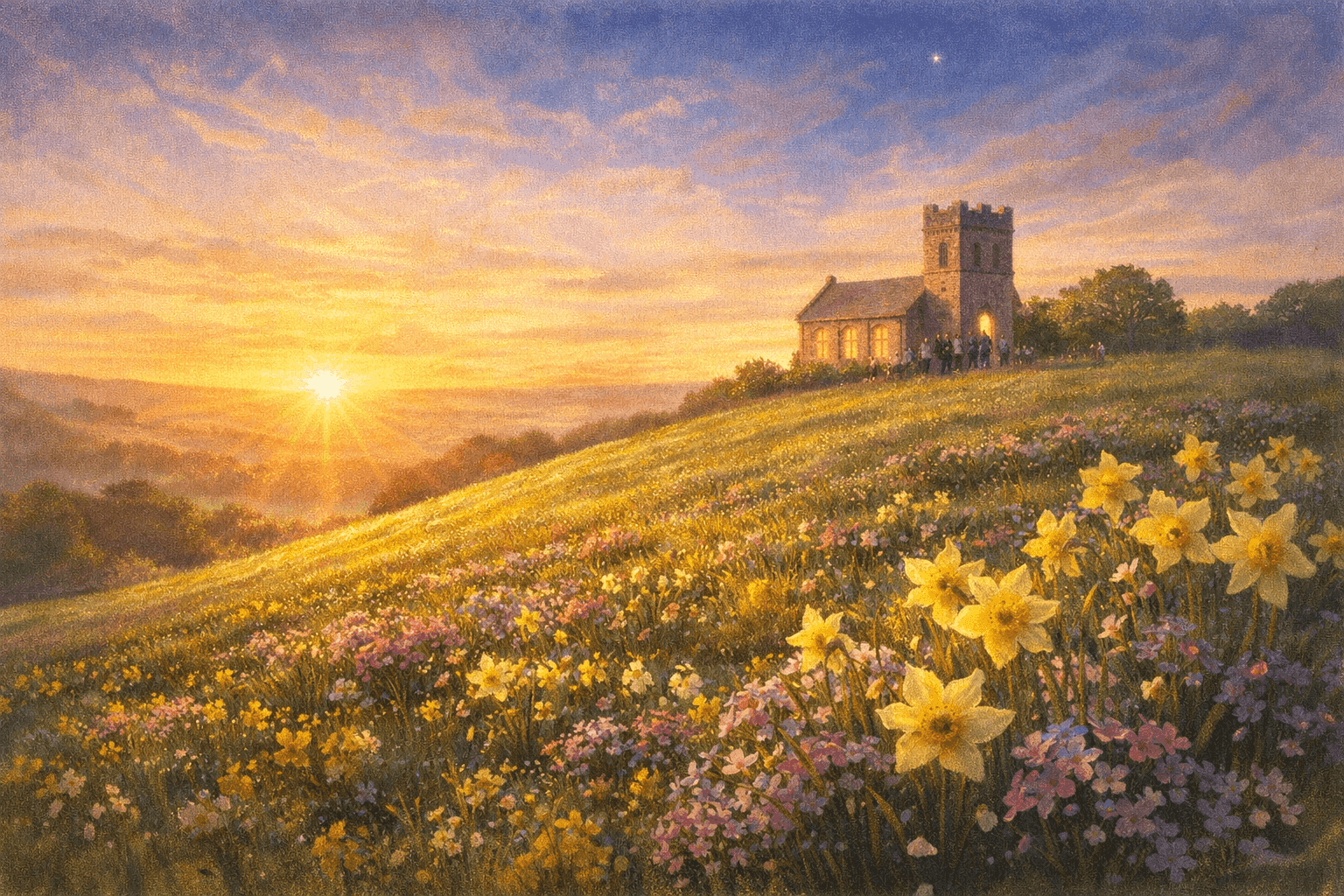
Easter's date is itself one of the more elegant pieces of calendar mathematics in human history. It falls on the first Sunday after the first full moon following the spring equinox — a calculation established by the Council of Nicaea in 325 CE, designed to tie Christianity to the same lunar rhythms that governed Passover and, before that, the ancient agricultural calendar of the Near East. This means Easter can fall as early as March 22 or as late as April 25, depending on the Moon's phase and position. This year it falls on April 5 — two days after Good Friday, one week after Palm Sunday, five days after the Full Pink Moon that rose on April Fools' Day over the Kennedy Space Center launch pad. This particular Easter arrives with the crew of Artemis II somewhere between the Earth and the Moon, en route to the first human lunar flyby in 54 years, scheduled for Monday. There has never been an Easter quite like this one — with the old spring light pouring over everything, the egg and the bunny and the empty tomb and the hare that was once a bird and the goddess Bede remembered, and four human beings arcing through the dark toward the same Moon that lit every Easter that came before. Happy Easter.