April 30: The Atom Breaks Open, Tomorrow on Display, The Bunker at the End of History
April 30 spans the full arc of what the twentieth century believed about itself — its science, its optimism, and its capacity for catastrophe. A British physicist peered inside the atom and found it was not what anyone had thought. An American World's Fair opened its gates to offer a world on the verge of war the consolation of a future it might yet live to see. And in a concrete bunker beneath the ruins of Berlin, the man who had done more than anyone to ensure that the future would be as terrible as it was eventually became its last casualty. Three stories, forty-eight years, and the permanent reminder that human knowledge and human darkness advance together, at roughly the same pace.
Smaller Than Anyone Had Imagined
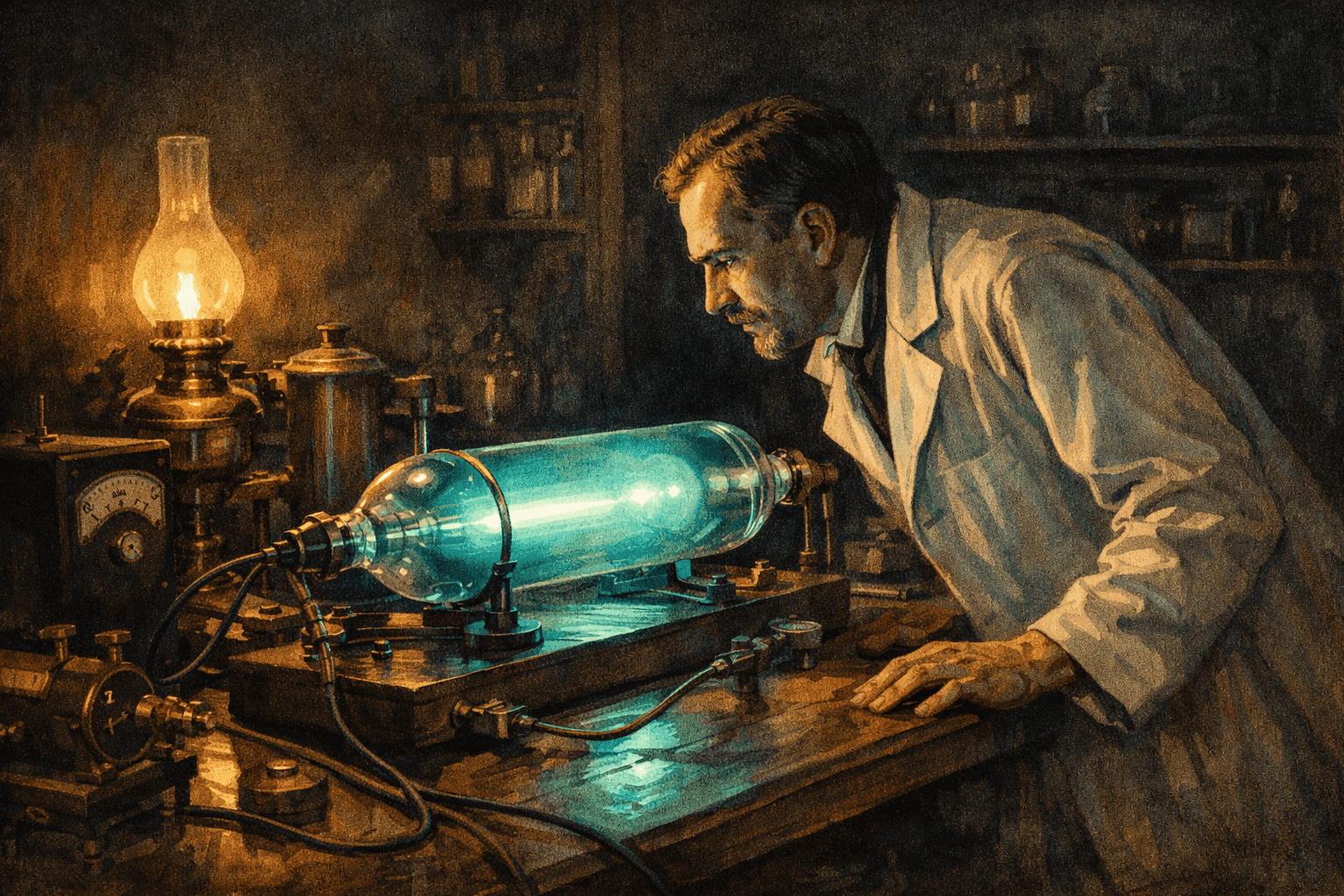
On April 30, 1897, J.J. Thomson stood before the Royal Institution in London and presented the findings from his experiments at the Cavendish Laboratory in Cambridge — announcing, with characteristic understatement, that he had discovered a particle smaller than the atom. Working with cathode ray tubes, Thomson had demonstrated that the rays produced within them consisted of negatively charged particles with a mass roughly 1,800 times smaller than a hydrogen atom — the same regardless of what material the cathode was made from or what gas was used in the tube. This uniformity was the key insight: these were not artifacts of the experimental setup but fundamental constituents of matter itself. Thomson called them "corpuscles"; the world would come to know them as electrons. The atom, which science since Democritus had considered the irreducible unit of matter — the Greek word itself means "uncuttable" — turned out to contain something smaller still.
The consequences of Thomson's discovery unfolded across the following decades with the force of a controlled detonation. His student Ernest Rutherford would probe the atom further and discover the nucleus in 1911. Niels Bohr would model the electron's orbital behavior in 1913. The quantum mechanical revolution of the 1920s — Heisenberg, Schrödinger, Dirac — would describe the behavior of electrons in ways that defied classical intuition entirely and produced the most precisely verified theory in the history of science. Every transistor in every computer, every LED in every screen, every laser in every fiber-optic cable operates on principles that trace directly back to Thomson's cathode ray experiments. He won the Nobel Prize in Physics in 1906. His son George Paget Thomson won the Nobel Prize in Physics in 1937 for demonstrating that electrons exhibit wave properties — proving, in the most familial possible way, that the particle his father had discovered was stranger than either of them had supposed.
The World of Tomorrow
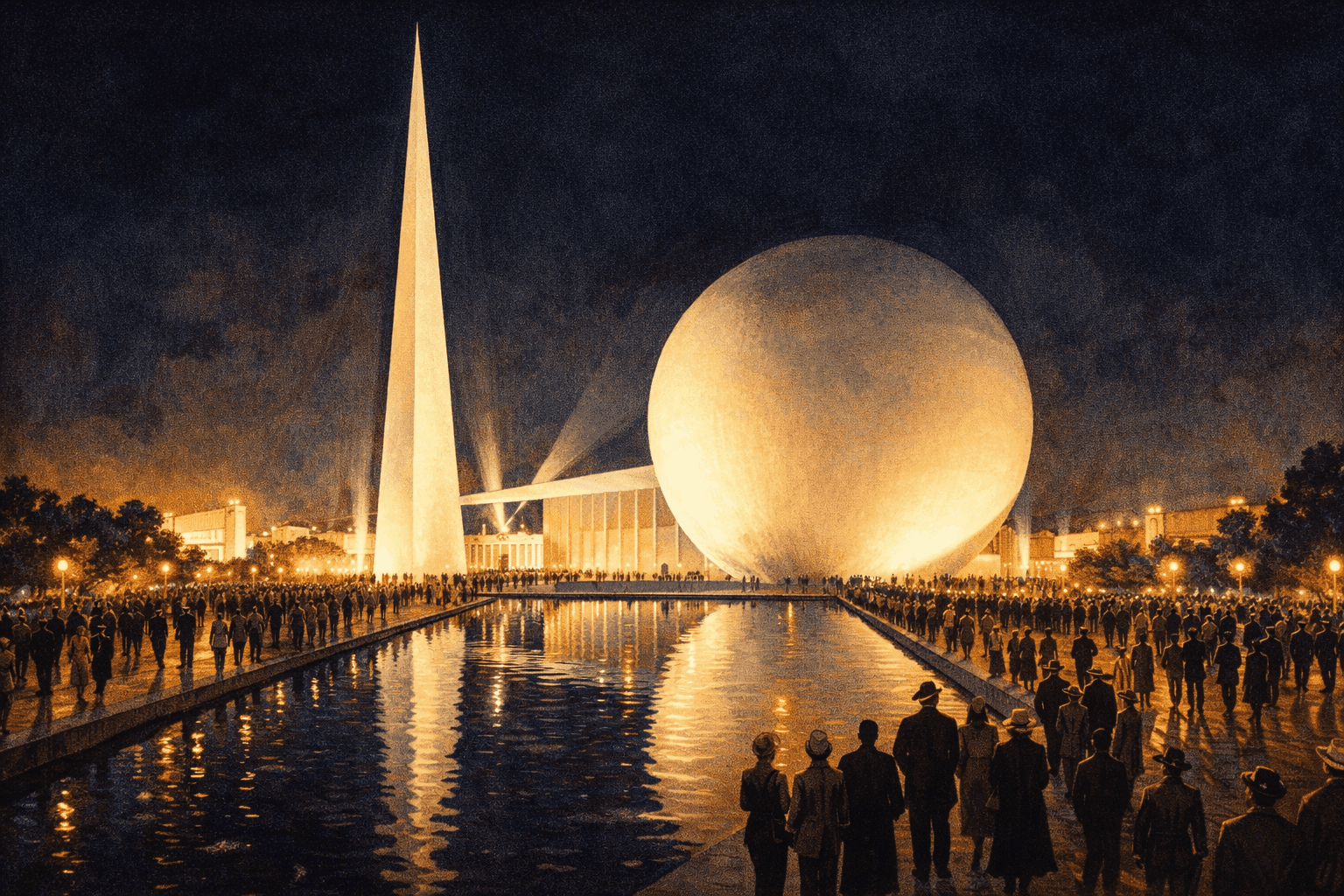
On April 30, 1939 — the 150th anniversary of George Washington's inauguration, chosen deliberately — the New York World's Fair opened in Flushing Meadows–Corona Park in Queens, promising its visitors "The World of Tomorrow" at a moment when the world of today was darkening rapidly. Adolf Hitler had already annexed Austria and Czechoslovakia; in four months he would invade Poland and begin the war that the fair's optimistic tagline seemed designed to hold at bay. Forty-four million people would visit over the fair's two-season run, passing beneath the Trylon — a 610-foot spike — and the Perisphere, a globe 180 feet in diameter that housed a diorama of an imagined American city of the future called "Democracity." General Motors' Futurama exhibit, which transported visitors on moving chairs above a scale model of America in 1960, drew the longest lines of any attraction in the fair's history.
What the fair imagined was, by and large, the world that eventually arrived — if not exactly on the schedule or in the form its designers predicted. The interstate highway system that Futurama depicted became reality in the 1950s. Television, demonstrated publicly at the fair by RCA and President Franklin Roosevelt — who became the first sitting president to appear on TV — became the dominant medium of American life within a decade. Nylon, introduced at the fair by DuPont, replaced silk in a thousand applications. The optimism that the fair embodied was not naive, exactly; the designers and exhibitors knew what was happening in Europe. It was something more deliberate than naivety — a conscious act of imagination, a decision to describe a future worth surviving toward, in the hope that the description might help make it real. The fair closed in October 1940. By then, the war the Perisphere had tried to look past had been underway for more than a year. The world of tomorrow would take longer to arrive than anyone had hoped, and it would require passing through something terrible to get there.
The Reich's Last Day
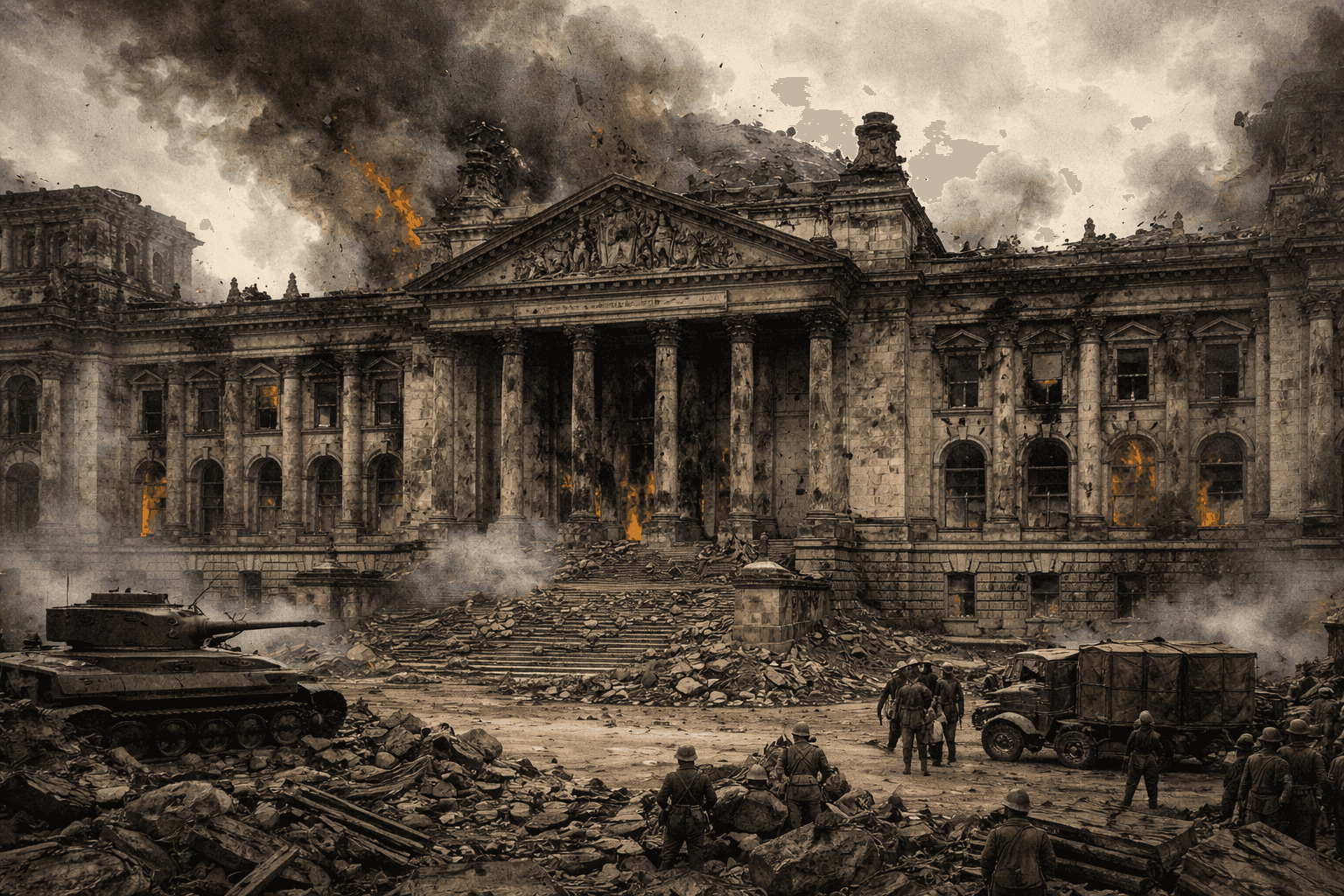
On April 30, 1945, Adolf Hitler died by suicide in the Führerbunker beneath the Reich Chancellery in Berlin, as Soviet forces fought street by street through the city above him. He had been in the bunker since mid-January, presiding over the final disintegration of the state he had built — issuing orders to armies that no longer existed, refusing the counsel of commanders who told him the war was lost, and watching through the bunker's walls the spreading fires and the rumble of artillery that marked the Red Army's advance. Eva Braun, whom he had married the previous day, died alongside him. Their bodies were carried to the Reich Chancellery garden, burned in accordance with Hitler's instructions, and buried in a shell crater — a deliberately anonymous end for a man who had spent twelve years constructing one of the most elaborate personality cults in modern history.
Germany's unconditional surrender followed on May 8, 1945 — V-E Day, Victory in Europe — eight days after the bunker. What Hitler had started on September 1, 1939, with the invasion of Poland had by then consumed an estimated 70 to 85 million lives, the majority of them civilians, in the deadliest conflict in human history. The Holocaust — the systematic murder of six million Jews and millions of others, including Roma, disabled people, political prisoners, and Soviet POWs — was among the most deliberate and thoroughly documented acts of genocide in recorded history. April 30, 1945, did not end the grief or the reckoning; it merely removed the man at the center of it from the world he had damaged beyond any single generation's capacity to fully repair. What it did end, concretely and permanently, was the Third Reich — which had been promised to last a thousand years and survived, in the end, for twelve.