April 3: Why They Call It Good
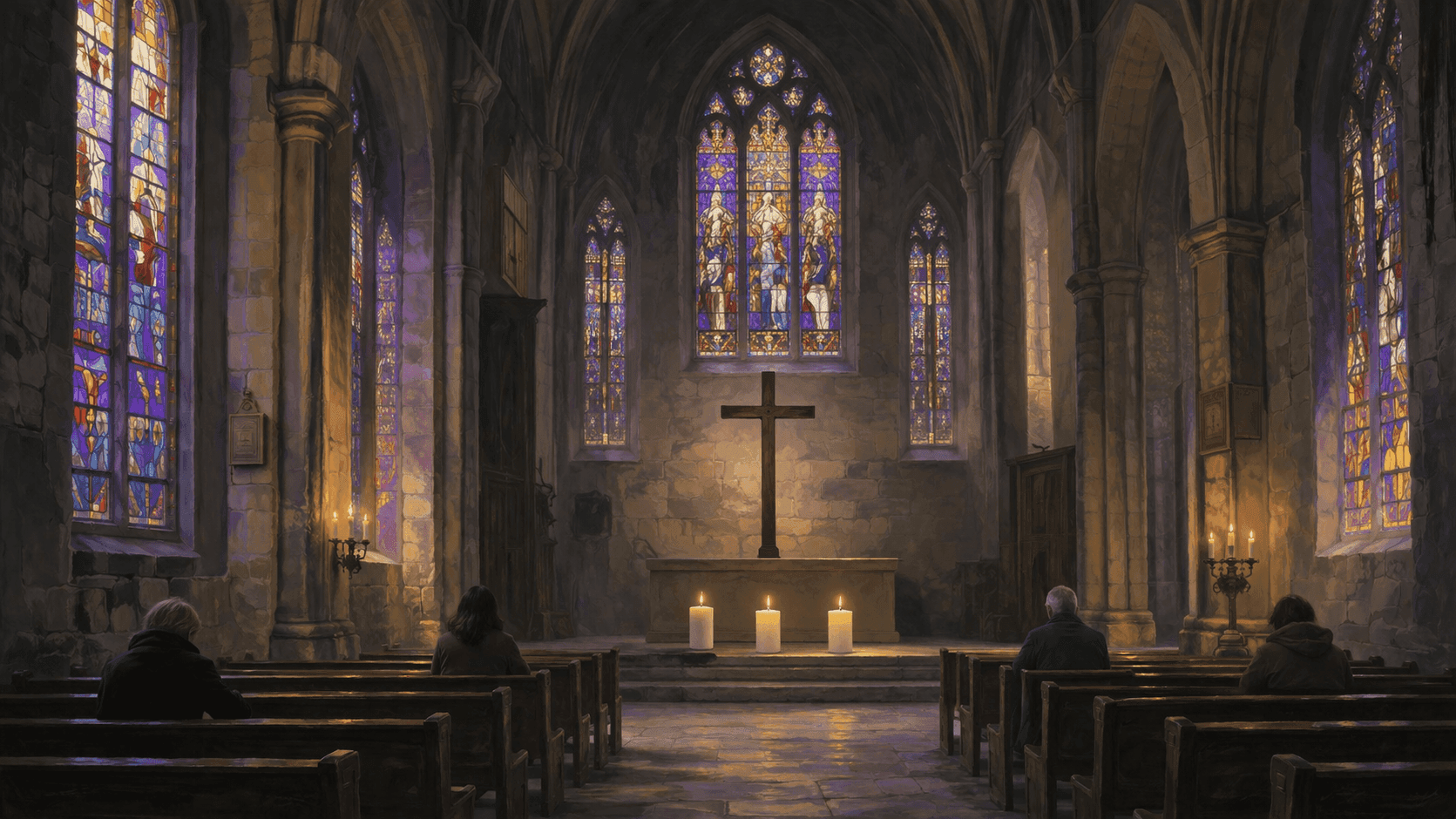
Today, in cities across every inhabited continent, Christians observe what many consider the most theologically weighty day of the year. Streets in Kolkata, Nairobi, Jakarta, Manila, Rome, and Mexico City fall quiet. Churches dim their lights, strip their altars, and read aloud the Passion narrative — the account of Jesus's arrest, trial, and execution that appears in all four Gospels. Bells fall silent. Choirs set aside their music. In Jerusalem, pilgrims walk the Via Dolorosa, the traditional route Jesus traveled to the crucifixion. In the Philippines, some devout believers carry wooden crosses through the streets. Across the world, the tone is the same: this is not a day for celebration. It is a day for keeping still, and for sitting with something difficult. That it is called "Good" Friday is, at first glance, one of the stranger names in the history of religion.
The Long Friday and the Holy Book
The name "Good Friday" has puzzled people for as long as it has existed, and linguists and theologians have offered competing explanations for centuries. The most widely accepted is that in medieval English, the word "good" carried a meaning closer to "holy" or "sacred" — the same root that gives us "the Good Book" as a name for the Bible. References to "Good Friday" in texts as far back as the 1200s suggest that "good" here meant "pious" or "solemn," not joyful. In Old English, the day was known as langa frigedæg — the "Long Friday" — a name that survives in Scandinavian languages and Finnish to this day, referring to the lengthy fasting and religious observances that filled the day. In German it is Karfreitag, the "Sorrowful Friday" or "Mourning Friday." In French, Vendredi Saint — "Holy Friday." In Spanish, Viernes Santo — the same. Only in English does the word "good" appear, carrying with it that old, larger meaning. Some scholars have also proposed it may derive from "God's Friday" — a theory harder to trace etymologically but intuitively appealing.
Within Christian theology, there is a second kind of answer to the question. The crucifixion, in Christian belief, is not simply a tragedy — it is the event upon which the entire structure of salvation depends. Jesus's death, in this reading, was the necessary act that made Easter possible; the suffering of Good Friday is what gives Easter Sunday its meaning. "Good" in this sense points not to the event itself but to what it accomplished and what it opened. The Easter Triduum — the three days of Maundy Thursday, Good Friday, and Holy Saturday — is understood in most Christian traditions as a single continuous liturgical act, not three separate observances. Good Friday is the long breath in the middle. It is the long Friday between the Last Supper and the empty tomb. The waiting is the point.
Good Friday falls today, April 3 — two days before Easter Sunday, April 5. The date, as with all of Holy Week, is determined by the lunar calendar: Easter falls on the first Sunday after the first full moon following the spring equinox, a calculation that traces its roots to the Council of Nicaea in 325 CE and ties Christianity to the same astronomical rhythms that once governed Passover, Nowruz, and the planting of spring crops. This week has been an extraordinary convergence of the calendar's deepest resonances — Palm Sunday opened Holy Week on March 29, the Full Pink Moon and the Paschal Moon rose on April 1 alongside the Artemis II launch, and now the most solemn Friday of the year arrives with Easter just beyond the threshold. Whatever one's tradition or belief, there is something in the structure of this week — its arc from triumphal entry through suffering to renewal — that speaks to something older than any single religion. The long Friday has always preceded the Sunday. The waiting has always been part of the story.