April 27: When Kepler Counted Back to the Beginning, A General Who Would Save the Union, The Last GTO
Some questions are so large that the audacity required to attempt an answer is, in itself, the story. April 27 belongs to three figures who looked at something immense — the age of the universe, the fate of a divided nation, the end of an automotive era — and refused to look away. A German astronomer in the seventeenth century did the math as best his tools and theology would allow and arrived, confidently, at a creation date for all of existence. A tanner's son from Ohio would grow up to command an army, end a war, and govern a nation through one of the most turbulent periods in its history. And an automaker let go of a name that had, for half a century, been synonymous with a particular American dream about the open road and the rumble of a powerful engine. Each story is, at its core, about the courage to reckon with something larger than yourself.
The Day Before Everything
Johannes Kepler, the German mathematician and astronomer who had already transformed humanity's understanding of planetary motion by describing the elliptical orbits of the planets around the sun, was also a man of his time in his conviction that the universe had a specific, calculable origin date. Working within the biblical chronological tradition established by earlier scholars, and applying the astronomical tools and planetary tables available to him in the early seventeenth century, Kepler calculated that the universe had been created on April 27, 4977 B.C. — arriving at this figure with the precision and confidence of a man who had, after all, successfully described the mathematics of celestial mechanics. The calculation was not casual; it was a serious attempt, by one of the sharpest scientific minds in Europe, to answer the largest possible question using the best available methods.
Modern cosmology, of course, places the age of the universe at approximately 13.8 billion years — a number that Kepler's tools and theological framework could not have produced and that would have strained even his considerable imagination. What makes Kepler's calculation worth remembering is not its accuracy but what it represents: the moment when the scientific mind, still working within a religious cosmology, nevertheless insisted on applying rigorous quantitative methods to a question that had previously been answered only by faith. Kepler was, in this as in his planetary work, a transitional figure — standing with one foot in a medieval worldview and the other in the scientific revolution he was helping to create. His universe-creation date was wrong by almost five billion times. His insistence that the question deserved a precise, evidence-based answer was entirely correct, and it is an insistence that every cosmologist working today inherits from him.

The Tanner's Son from Ohio
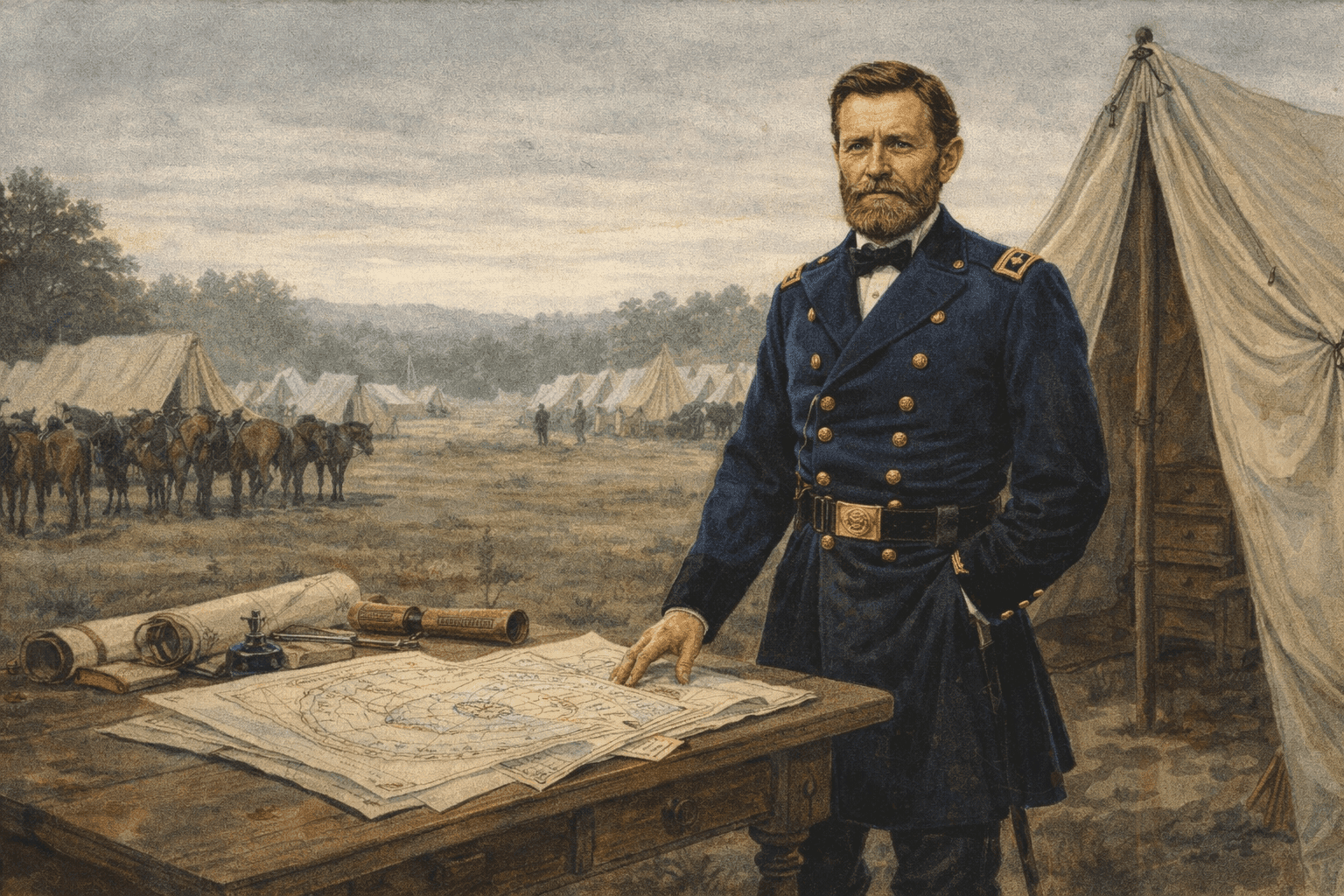
On April 27, 1822, Hiram Ulysses Grant was born in Point Pleasant, Ohio, the son of a tanner who recognized his boy's aptitude early enough to secure him an appointment to West Point. There, through a clerical mix-up that gave him a new middle name, he became Ulysses S. Grant — initials that would eventually suggest the nickname "Unconditional Surrender" Grant, a play on the terms he had offered the Confederate garrison at Fort Donelson in February 1862. The path between the Ohio tannery and that victory was not straight. Grant had graduated from West Point in the middle of his class, served capably in the Mexican-American War, and then, in the early 1850s, resigned from the army under circumstances that have always suggested a struggle with alcohol, returning to civilian life in a series of failed business ventures that left him working in his father's leather goods store in Galena, Illinois, when the Civil War began in 1861.
What happened next was one of the more remarkable reversals in American military history. Grant volunteered, was given command of an Illinois regiment, and proved himself so quickly that within a year he was a major general, and within two had won the victories at Shiloh, Vicksburg, and Chattanooga that made him the Union's most successful commander. Abraham Lincoln, whose previous generals had consistently found reasons not to fight, made him general-in-chief of all Union armies in March 1864 with a directness that amounted to an instruction: end it. Grant did — through a brutal strategy of sustained pressure on multiple fronts that finally exhausted the Confederacy's capacity to resist. He accepted Lee's surrender at Appomattox in April 1865 with the generosity that Lincoln had asked of him. As president from 1869 to 1877, he pursued the aggressive enforcement of Black civil rights through the very Ku Klux Klan Act we covered on April 20, and his administration's commitment to Reconstruction, imperfect and ultimately unsuccessful as it proved, represented one of the federal government's most serious attempts to deliver on the promise of the Civil War. He died in 1885, four days after completing his celebrated memoirs, which he had written in a race against throat cancer and which remain among the finest military autobiographies in American literature.
Wide-Track to Nowhere
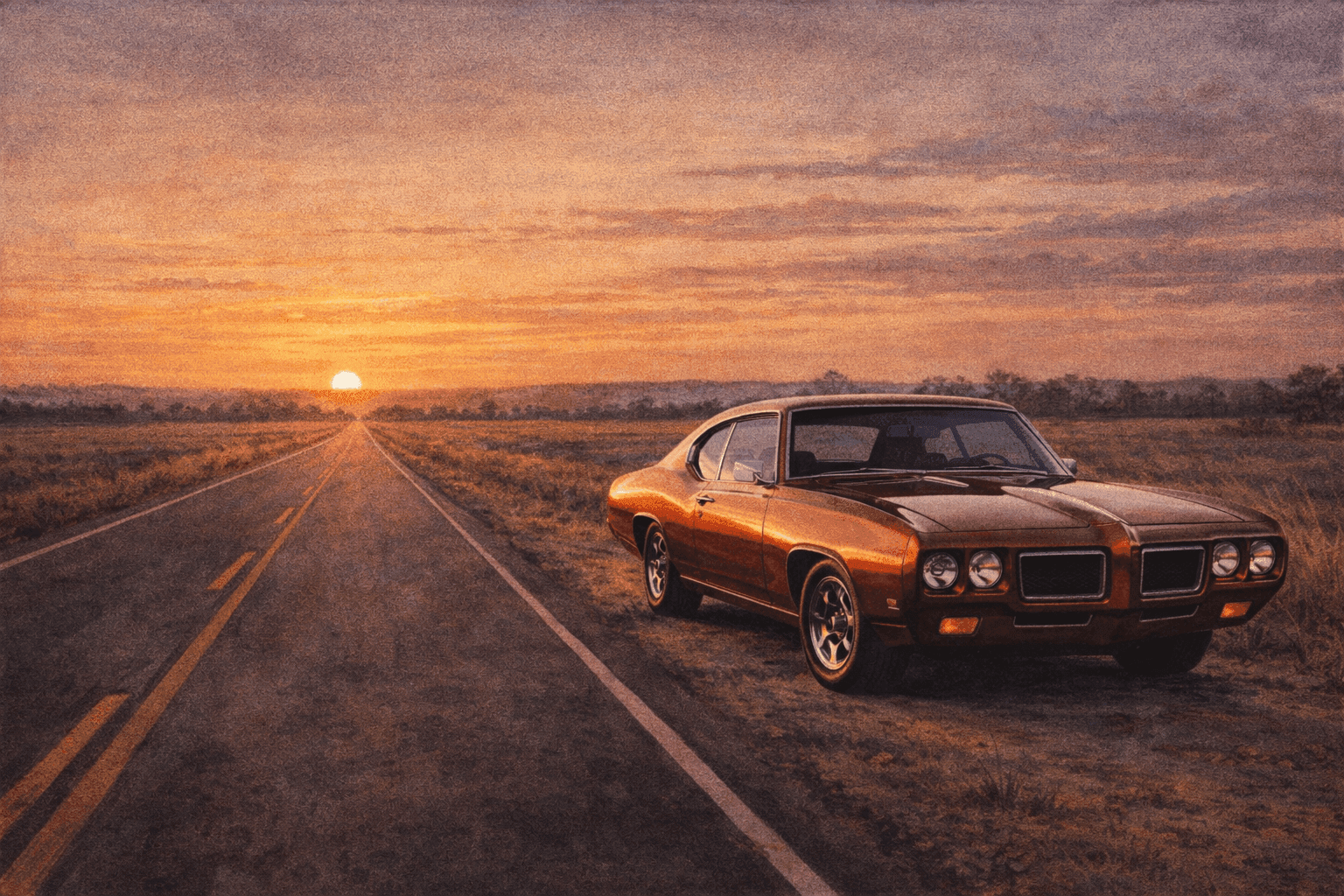
On April 27, 2009, General Motors announced that it would discontinue the Pontiac brand as part of its restructuring ahead of a federal bankruptcy filing, ending a marque that had been part of the American automotive landscape since 1926. The announcement came in the depths of the financial crisis, as GM scrambled to shed divisions and reduce costs in exchange for government bailout funding, and it closed a chapter that enthusiasts had been dreading since Pontiac's product lineup had been gradually diluted through the 2000s into something bearing little resemblance to the brand that had defined American performance driving for decades. Pontiac had been the division that, in 1964, introduced the GTO — widely considered the first true American muscle car — by stuffing a large-displacement V8 engine into a mid-size body and pricing the result within reach of anyone with a job and a need for speed. The formula was immediately and massively successful, and it launched an era of American automotive culture that the GTO, the Firebird, and the Trans Am came to define.
The Pontiac brand's identity had always rested on a particular promise — that excitement and performance did not have to be reserved for the wealthy, that the thrill of a powerful car was a democratic entitlement — and for a period in the 1960s and early 1970s it had delivered on that promise with remarkable consistency. The oil crisis of the 1970s, increasingly stringent emissions regulations, and the gradual corporatization of GM's product development process had steadily eroded what made Pontiac distinctive, and by the time the end came in 2009, the brand had been coasting on its heritage for years. The final Pontiac rolled off the assembly line in Oshawa, Ontario, in October 2010. Car enthusiasts mourned the name; historians of the American automobile mourned the idea it had represented — the notion that a car could be a statement of identity, a declaration of what kind of American you wanted to be, available at a price that made the declaration accessible to nearly everyone. The wide-track wagons and the screaming chickens and the Judge are museum pieces now. The open road, at least, is still there.