April 26: A Fugitive's Final Hour, The Shot That Saved a Generation, Let the Night Begin
April 26 deals in thresholds. It is the date on which the man who killed Abraham Lincoln ran out of road, dying in a burning Virginia barn twelve days after the crime that had convulsed the nation. It is the date on which a country that had spent decades fearing the summer — fearing what the polio virus did to its children — lined up to receive the first mass trials of a vaccine that would eventually erase that fear. And it is the date on which a converted television studio on West 54th Street opened its doors, turned up the music, and became, almost instantly, the most famous nightclub in the world. Three very different thresholds, on three very different kinds of April days, each one marking the moment a long story changed.
The Barn at Garrett Farm
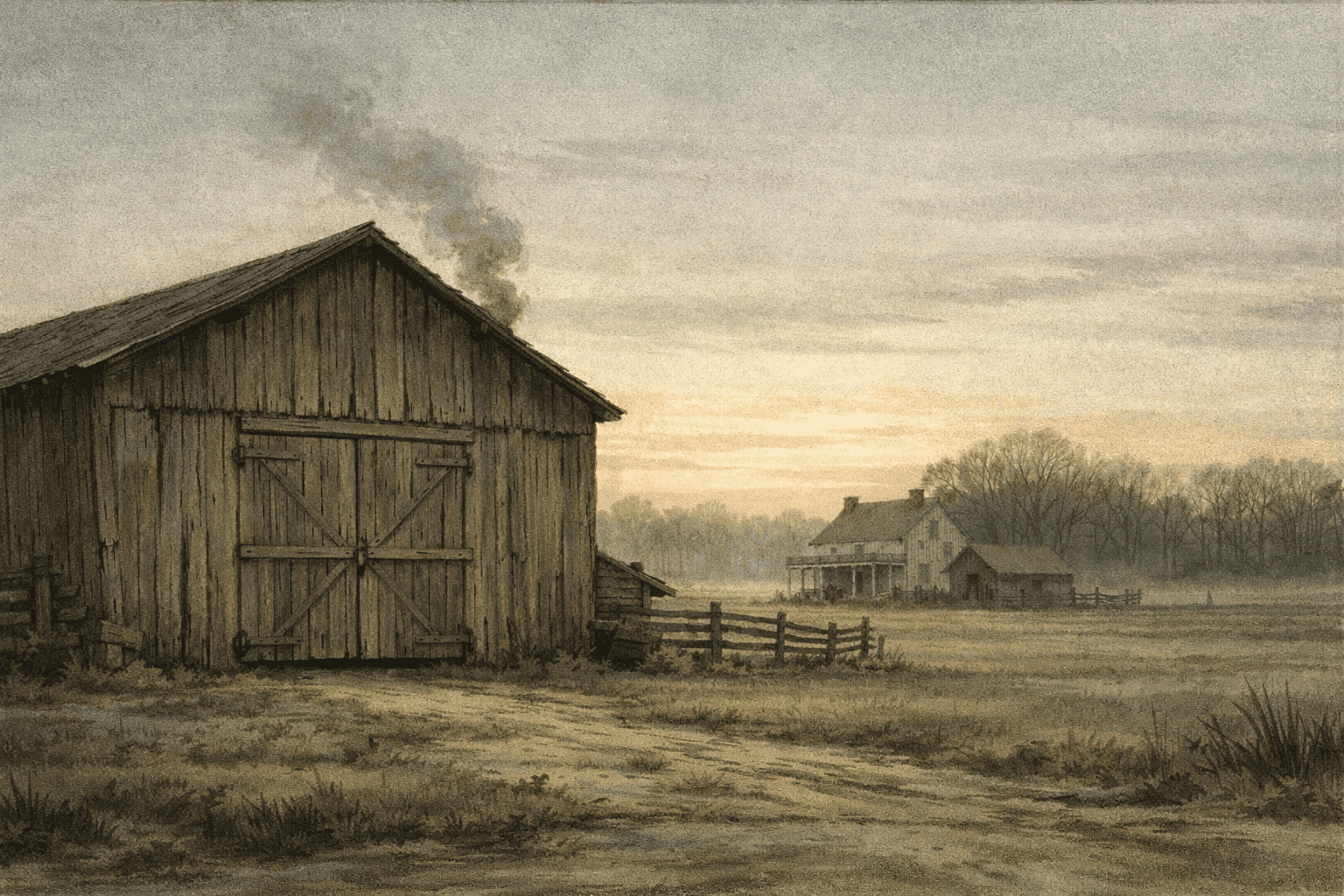
On April 26, 1865, twelve days after shooting Abraham Lincoln at Ford's Theatre and six days after the president's death, John Wilkes Booth was cornered in a tobacco barn on the Garrett family farm near Port Royal, Virginia, by a detachment of the 16th New York Cavalry. Booth had fled Washington the night of the assassination with co-conspirator David Herold, crossing the Anacostia River into Maryland, stopping at the home of Dr. Samuel Mudd to have his broken leg set, and making his way south through Confederate-sympathizing territory in the desperate hope of reaching the Deep South. His flight had been impeded by his injured leg, by the rapid collapse of Confederate resistance — Lee's surrender at Appomattox had come just over two weeks earlier — and by the fact that the federal government had deployed thousands of soldiers and detectives in the largest manhunt in American history to that point. The soldiers surrounded the barn at 2:00 a.m. and demanded surrender. Herold came out. Booth refused.
The barn was set on fire. As the flames rose, Sergeant Boston Corbett — acting without orders — fired through a gap in the barn's slats and struck Booth in the neck, paralyzing him. Booth was dragged from the burning structure and died on the Garrett farmhouse porch approximately two hours later, unable to move but apparently conscious, asking that his hands be raised so he could see them. His reported last words — "useless, useless" — have been debated by historians, but the scene itself is not disputed: the man who had killed the president died at dawn on a Virginia farm, watching his hands in the light of a burning barn. His death closed the immediate crisis of the assassination but did nothing to resolve what Lincoln's murder had set in motion — the transfer of power to Andrew Johnson, the unraveling of the Reconstruction Lincoln had envisioned, and the long, painful divergence between the America that had won the Civil War and the America it chose, in the decades that followed, to build.
Roll Up Your Sleeve
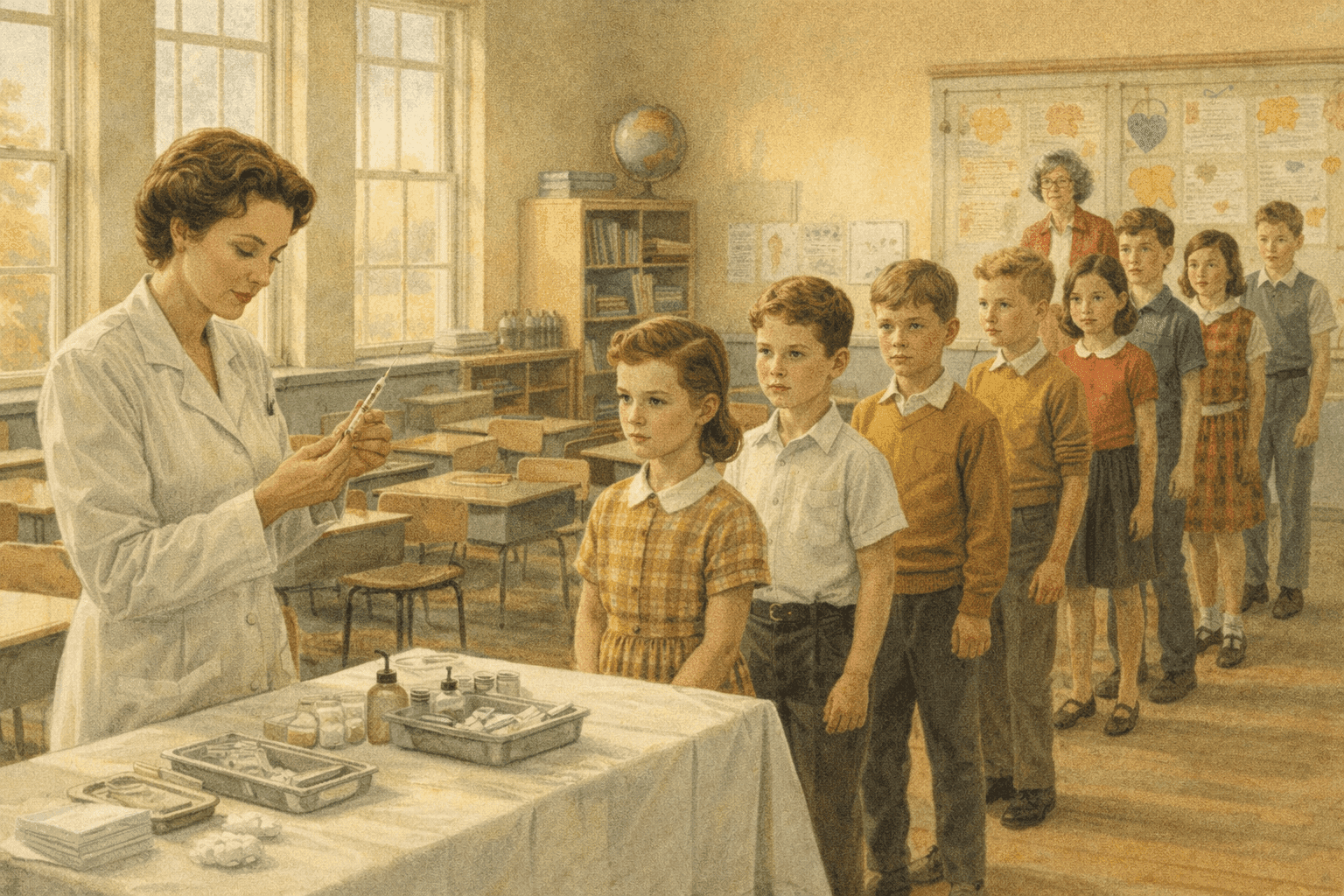
On April 26, 1954, nearly two million American schoolchildren in 44 states began receiving injections of Jonas Salk's experimental polio vaccine in the largest medical field trial in history. The trial — organized by the National Foundation for Infantile Paralysis and supported by the March of Dimes, whose fundraising had helped finance Salk's research — enrolled children who came to be known as "Polio Pioneers," first and second graders who received either the vaccine or a placebo in a double-blind study designed to determine whether Salk's inactivated virus preparation could provide protection against a disease that had been terrorizing American families for decades. Polio had reached epidemic proportions in the United States in the postwar years: the 1952 outbreak alone had infected nearly 58,000 people, left more than 21,000 with some degree of paralysis, and killed over 3,000. Every summer brought fresh dread — parents kept children away from public pools, crowded theaters, and anywhere the virus might spread.
The results of the 1954 trial were announced on April 12, 1955 — the tenth anniversary of Franklin Roosevelt's death, a choice of date that was not accidental, as Roosevelt's struggle with polio had made him the disease's most prominent symbol — and they were unambiguous: the Salk vaccine was safe, potent, and effective. The announcement prompted celebrations across the country that witnesses described as resembling the end of a war. Church bells rang. Strangers wept in the streets. Within two years, polio cases in the United States had dropped by nearly ninety percent. The disease that had paralyzed a president, that had emptied swimming pools and shuttered schools every summer, that had placed iron lungs in hospital wards across the country, was in full retreat. Salk, who had refused to patent the vaccine — when asked who owned it, he replied "the people" — became one of the most celebrated scientists of the twentieth century. The children who rolled up their sleeves on April 26, 1954, were the first soldiers in a campaign that would eventually push polio to the edge of global eradication.
54
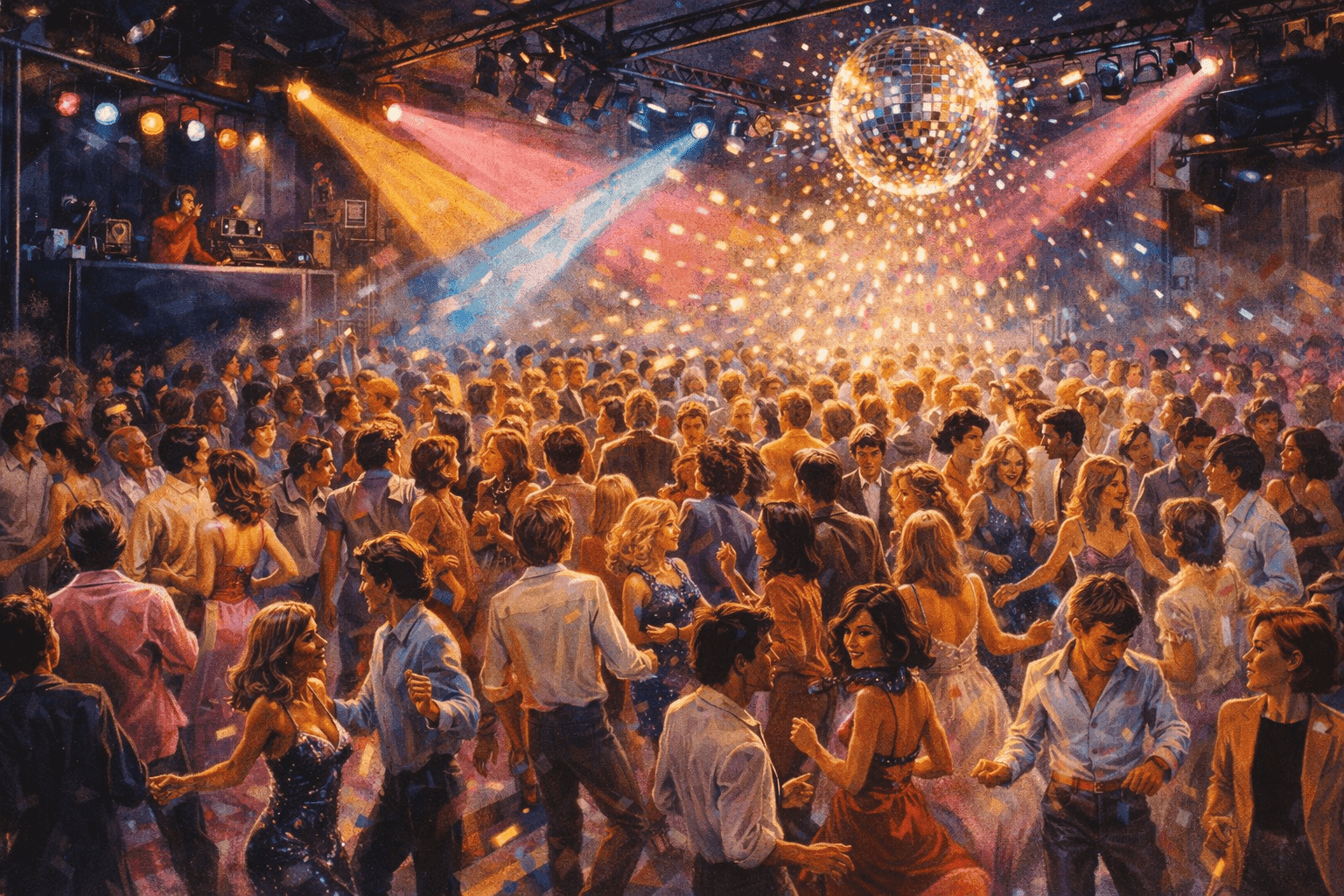
On April 26, 1977, Ian Schrager and Steve Rubell opened Studio 54 in a former CBS television studio on West 54th Street in Manhattan, and within weeks had created something that had not previously existed: a nightclub as cultural institution, as nightly performance, as the most exclusive and most discussed room in America. The genius of Studio 54 was curatorial. Rubell, who worked the door himself, understood that the experience inside depended entirely on who was inside, and he managed the velvet rope with a showman's instinct — turning away the merely wealthy and conventionally attractive in favor of the interesting, the beautiful, the famous, the outrageous, and the genuinely surprising. On any given night, the dance floor might hold Andy Warhol and Liza Minnelli and Mick Jagger and the drag queens and the club kids and the delivery drivers who had caught Rubell's eye from the street. The mix was the point.
The club's run was brief and spectacular. Rubell and Schrager were arrested in December 1978 for tax evasion — Rubell had publicly boasted about the club's profits, which turned out to be a costly mistake — and sentenced to three and a half years in federal prison in 1980. Studio 54 changed hands and limped on for a few years before closing in 1986. In its roughly three-year golden period, it had been the backdrop for some of the era's most celebrated photographs, the soundtrack of the disco movement's peak, and a space in which the social hierarchies of late-1970s New York were temporarily, thrillingly suspended in favor of something more democratic and more anarchic. New York City in 1977 was broke, crime-ridden, and widely considered to be in irreversible decline. Studio 54 proposed, with considerable conviction, that it was also the most exciting place on earth — and for three years, it was very difficult to argue with that proposition.