April 25: The First Lady of Song, A Child's Letter to the Kremlin, When the Mountains Moved
It takes a certain kind of courage to put something fragile into the world — a voice, a question, a community — and trust that it will be received. April 25 is a date populated by exactly that kind of courage: the singular artistic courage of a woman born in Newport News, Virginia, who transformed the jazz vocal tradition through sheer brilliance and discipline; the disarming moral courage of an eleven-year-old girl from Maine who wrote a letter to the most powerful man in the Soviet Union and asked him, plainly, if he wanted peace; and the collective courage of a people who watched their ancient capital reduced to rubble and began, almost immediately, the work of putting it back together. Each story is, in its way, about the reach of the small and the human into the large and the indifferent.
Ella
On April 25, 1917, Ella Jane Fitzgerald was born in Newport News, Virginia, the daughter of a couple who separated when she was young and who died — her mother in a car accident — when Ella was fifteen. She spent a difficult adolescence in a Yonkers reform school, arrived in Harlem with nothing, entered an Apollo Theater amateur contest in 1934 on a dare, and won. Within two years she was singing with the Chick Webb Orchestra at the Savoy Ballroom; by 1938 she had her first number-one hit, a swinging novelty version of a nursery rhyme called "A-Tisket, A-Tasket," that would have been perfectly sufficient as a career highlight for most artists. For Fitzgerald it was barely a beginning. The decades of work that followed — the Decca years, the celebrated Songbook series on Verve in which she recorded definitive interpretations of the Great American Songbook's foundational composers, the collaborations with Louis Armstrong and Duke Ellington — constitute one of the most comprehensive and consistently excellent bodies of recorded music any vocalist has produced.
What set Fitzgerald apart from her peers was not merely the quality of her voice — though the three-octave range, the purity of tone, and the intonation that almost never wavered were remarkable gifts — but the intelligence with which she deployed it. Her scat singing, in which she improvised extended wordless passages with the rhythmic and harmonic inventiveness of a bebop horn player, set a standard that subsequent vocalists are still measured against. Her phrasing was so naturally musical that jazz musicians who played with her described the experience as playing with another instrumentalist — someone who understood the structure of a song well enough to take it apart and rebuild it in real time without ever losing the thread. She won thirteen Grammy Awards, was awarded the Presidential Medal of Freedom, and performed for six decades despite the diabetes that eventually cost her both legs. She died in 1996, at seventy-nine, having recorded more than two hundred albums. The voice she put into the world in a Harlem amateur contest when she was seventeen years old is still in it.

Dear Mr. Andropov
On April 25, 1983, Soviet General Secretary Yuri Andropov sent a letter to Samantha Smith, an eleven-year-old girl from Manchester, Maine, who had written to him the previous autumn asking whether the Soviet Union truly intended to start a nuclear war with the United States. Samantha had written the letter after reading a Time magazine article about Soviet-American tensions — tensions that, in late 1982, were at their most acute since the Cuban Missile Crisis — and her question was as simple and as devastating as only a child's question can be: did the USSR want war? Andropov's response, which he had apparently written personally rather than delegating to Soviet foreign ministry staff, answered her directly: the Soviet Union, he wrote, did not want war. He invited her to visit the country and see for herself. Samantha Smith accepted.
The visit she made to the Soviet Union in July 1983 — two weeks spent touring Leningrad, Moscow, and a children's camp in the Crimea — was covered by international media and watched by millions of people in both countries who found in the image of an American girl and Soviet children swimming and laughing together something that no diplomatic communiqué had been able to provide: evidence that the people on the other side of the Iron Curtain were, at some essential level, people. Samantha became an international celebrity and a symbol of what has since been called "citizen diplomacy" — the capacity of ordinary individuals, operating outside official channels, to change the temperature of international relations. She died in a plane crash in August 1985, at thirteen years old, and her death provoked an outpouring of grief in the Soviet Union that surprised many Americans. Andropov had died earlier that year; he never saw what his letter had started. The Soviet Union erected a monument to Samantha Smith. The state of Maine named a mountain after her. Her question — simple, direct, and unanswerable by the language of geopolitics — still stands.

The Earth Shifts, Nepal Endures
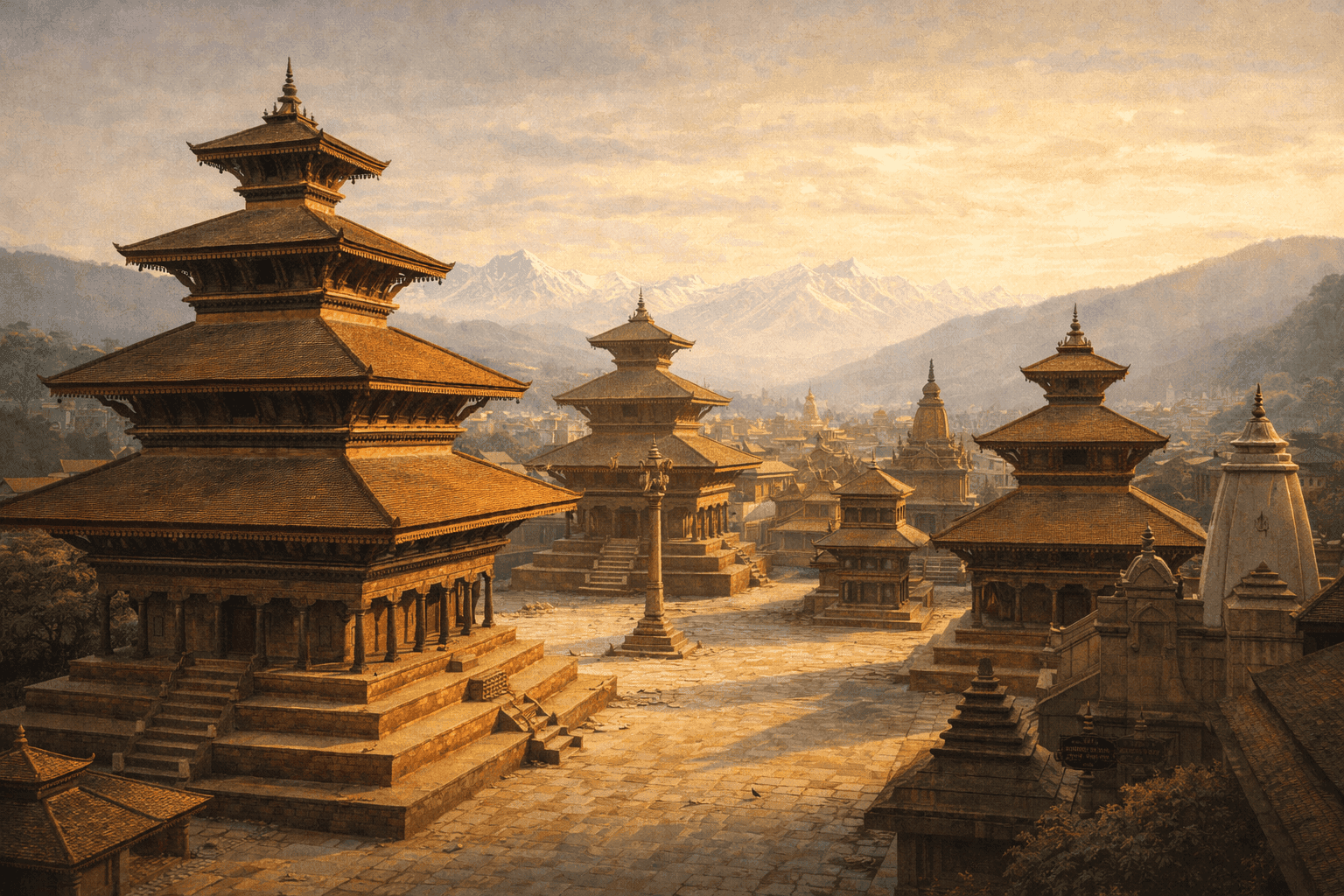
At 11:56 a.m. local time on April 25, 2015, a magnitude 7.8 earthquake struck approximately 48 miles northwest of Kathmandu, Nepal, sending seismic waves through one of the most densely populated and historically rich regions of South Asia. Nearly 9,000 people were killed, more than 22,000 were injured, and hundreds of thousands of homes were destroyed or made uninhabitable across a country whose ancient building stock — mud brick, stone, and timber structures in many cases centuries old — was catastrophically vulnerable to lateral ground motion. In Kathmandu's Durbar Square, temples that had stood since the medieval period — the Kasthamandap, from which the city takes its name; the Vatsala Durga temple; structures that had survived invasions, political upheavals, and previous tremors — collapsed in seconds. Mount Everest base camp was struck by avalanches triggered by the quake; nineteen climbers and camp workers were killed. The scale of the destruction, broadcast in photographs around the world within hours, prompted an international humanitarian response that brought rescue teams, medical personnel, and aid from dozens of countries.
What followed the initial emergency was the longer, harder, and less photographed work of recovery. Nepal — one of the world's poorest countries, with a per capita GDP that made the reconstruction costs staggering relative to its resources — embarked on a rebuilding process that has been marked by both remarkable community resilience and significant frustration with the pace of governmental and international assistance. Several of the historic temples in Kathmandu's Durbar Square have been painstakingly reconstructed using traditional techniques and original materials recovered from the rubble. Others remain in various states of repair or ruin. The earthquake of April 25, 2015 sits in the long history of a region that sits atop one of the world's most geologically active fault systems — the collision zone between the Indian and Eurasian tectonic plates that also built the Himalayas — and the knowledge that another major earthquake will come, eventually, shapes every rebuilding decision. Nepal's response to the disaster was not defined by the magnitude of the destruction, but by the quiet, persistent determination of its people to reclaim what was theirs.