April 23: A King Falls at the Moment of Victory, The Bard Is Born, Justice for a Nation's Grief
History has a taste for cruel timing — the victory that costs the victor everything, the genius born into a world not yet equipped to measure what he would become, the verdict that arrives years after the wound it was meant to address. April 23 is a date acquainted with that irony across ten centuries: an Irish king who unified a fractured island died on the morning of his greatest triumph; a child born in a Warwickshire market town would grow into the writer by whose standard all subsequent literature in the English language is measured; and a courtroom in Los Angeles delivered its sentence on a crime that had, five years before, shattered whatever remained of a decade's political hope. Greatness, genius, and grief — and the insistence of each on being held alongside the others.
The High King's Last Morning
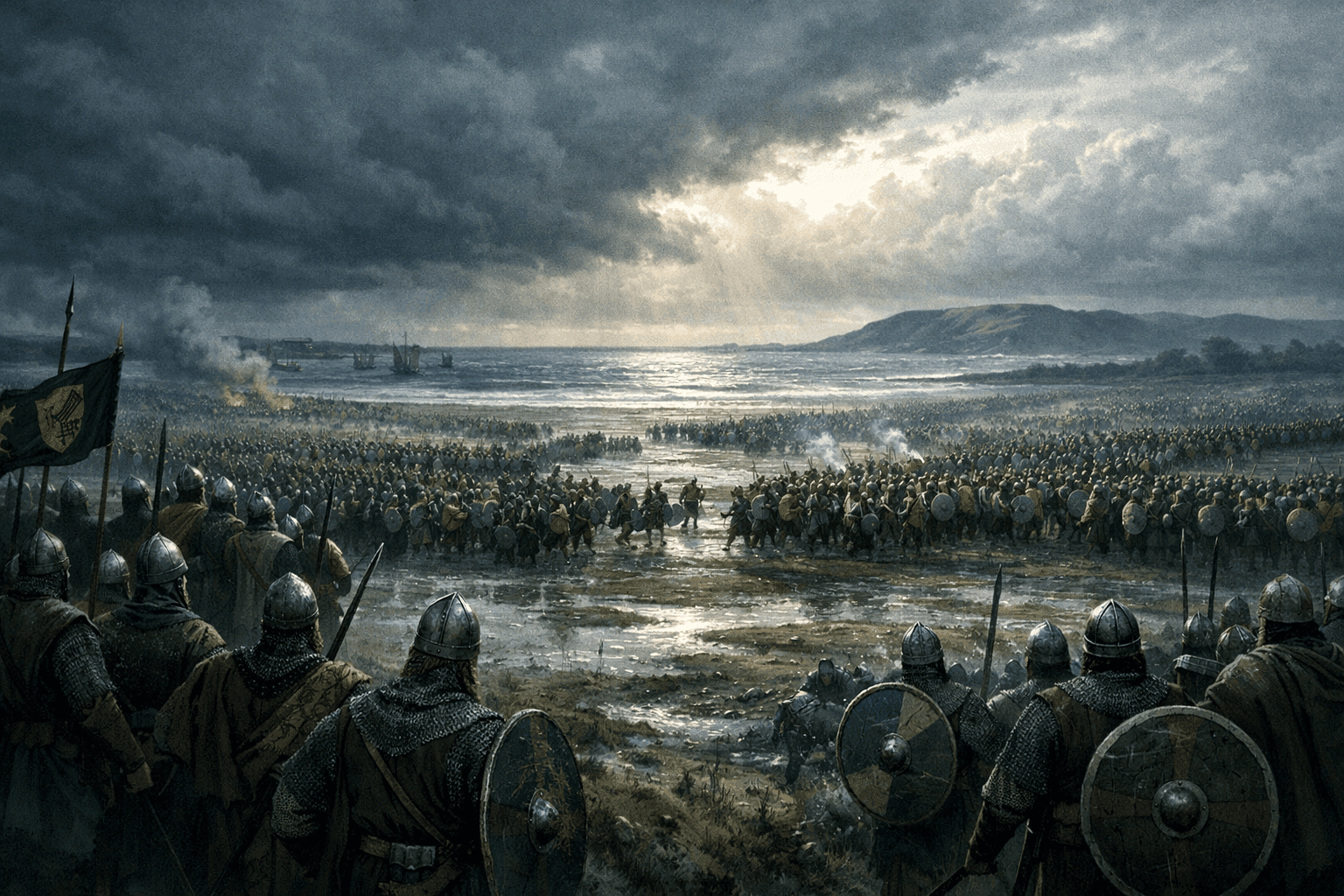
On April 23, 1014 — Good Friday — Brian Boru, High King of Ireland, knelt in prayer in his tent on the shores of Dublin Bay as the Battle of Clontarf raged to its conclusion on the field outside. His forces had spent the day routing a coalition of Norse Vikings and rebellious Irish chieftains who had challenged his authority over the island, and by the day's end the battle was won — a decisive Irish victory that effectively ended the era of major Viking military power in Ireland. Brian had not fought personally; at seventy-three, he had remained in his tent in prayer and left the command to his sons. It was this choice that killed him. A small group of retreating Viking warriors, led by a Norse chieftain named Brodir, stumbled upon the royal tent and cut him down. He died on the morning of his greatest triumph, the battle already won, the enemy already in retreat.
Brian Boru had spent decades earning the title of High King through a combination of military brilliance, shrewd political alliance-building, and the sheer persistence of a man who refused to accept that Ireland's chronic fragmentation among competing provincial kings was an unchangeable fact. He was the first ruler in the island's history to exercise anything approaching centralized authority over its disparate kingdoms, and his achievement — however incomplete and however contested — established a template for Irish nationhood that would inform the island's self-understanding for centuries. His death at Clontarf transformed him instantly from a king into a legend: the great unifier, martyred at the moment of his people's deliverance, whose sacrifice gave the victory its bittersweet perfection. Irish storytellers understood, almost immediately, that this was the kind of story that lasts. They were right. A thousand years later, Brian Boru remains the most celebrated figure in Irish historical memory — the king who won everything and paid for it with everything.
The Man Who Invented the Human
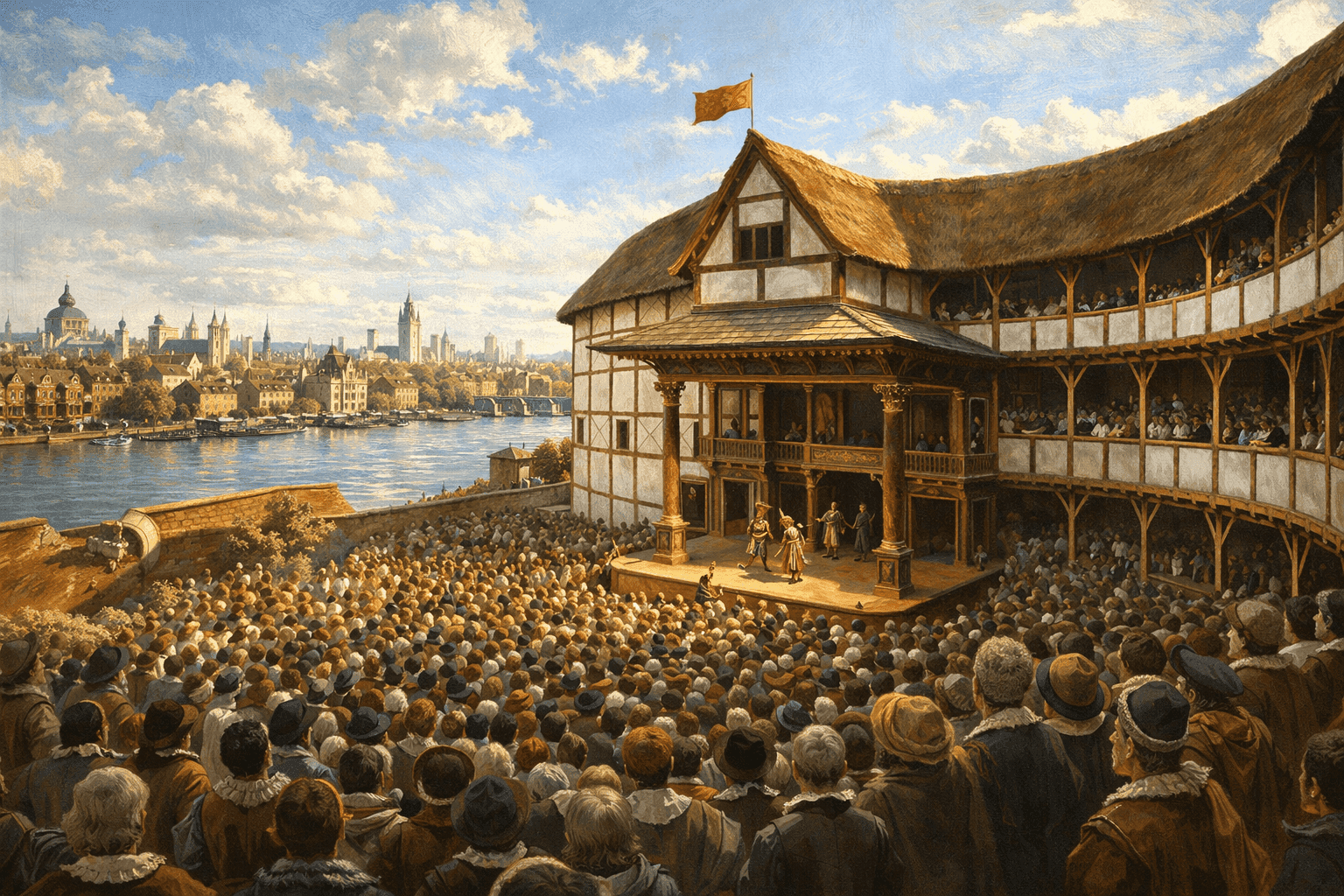
On April 23, 1564, William Shakespeare was born in Stratford-upon-Avon, Warwickshire — the son of a glove-maker and alderman, in a market town of about 1,500 people, in a country whose greatest literary achievements were then still largely confined to verse and the Church. He would go on to write 37 plays, 154 sonnets, and several longer poems; to help found and part-own the Globe Theatre on the south bank of the Thames; and to create a body of work so comprehensive in its rendering of human psychology, so inventive in its language, and so durable in its theatrical power that the critic Harold Bloom argued, with some justice, that Shakespeare had essentially invented the concept of the fully realized human individual in literature — that Hamlet, Lear, Falstaff, Cleopatra, and Iago were the first characters in Western writing who seemed to contain within themselves the full contradictory complexity of an actual person. The claim is debatable, as Bloom intended it to be. The magnitude it gestures toward is not.
Shakespeare's influence on the English language alone is almost impossible to overstate. Scholars have identified more than 1,700 words that appear for the first time in his plays — "bedroom," "lonely," "generous," "obscene," "swagger," "lackluster" — along with dozens of phrases so thoroughly absorbed into common speech that speakers who use them have no idea of their origin. His plays have been translated into every major language on earth and are performed somewhere in the world every day. They have been adapted into films, operas, novels, musicals, and graphic novels; set in feudal Japan and apartheid South Africa and outer space; quoted by presidents and revolutionaries and comedians and grief counselors. He died on April 23, 1616 — his birthday, as tradition holds, though the precise date of his death is documented while his birth date is inferred — at the age of fifty-two, leaving behind a will that famously bequeathed his wife his "second best bed" and an estate to his children, and a body of work that has required no executor. It has taken care of itself.
The Sentence and the Sorrow
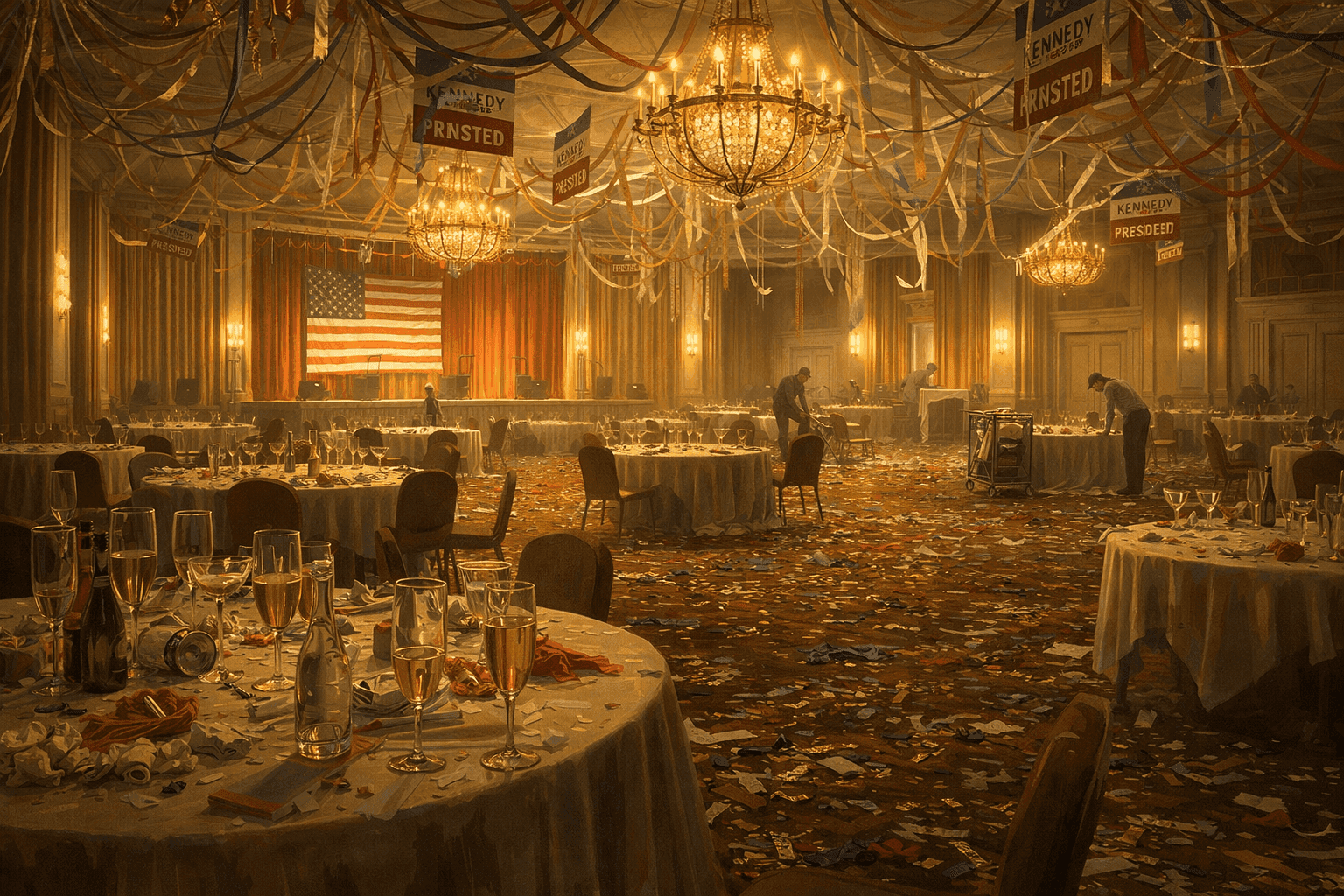
On April 23, 1969, Sirhan Bishara Sirhan was sentenced to death in a Los Angeles courtroom for the assassination of Senator Robert F. Kennedy, who had been shot on June 5, 1968, in the kitchen of the Ambassador Hotel moments after delivering his victory speech following the California Democratic presidential primary. Kennedy had been forty-two years old, the leading candidate for the Democratic nomination, and, to millions of Americans, the last credible vessel for the political hope that the decade had been systematically destroying: his brother John had been killed in Dallas in 1963, Martin Luther King Jr. had been shot in Memphis only two months before, and the country was convulsed by Vietnam, urban unrest, and the fracturing of the New Deal coalition. Robert Kennedy's death, coming when it did and where it did — in the moment of a victory speech, in a hotel kitchen — felt to many like the final, definitive cancellation of something the 1960s had promised and not delivered.
Sirhan's death sentence was commuted to life imprisonment in 1972, when the California Supreme Court ruled the state's death penalty unconstitutional. He has remained in prison, denied parole repeatedly over more than fifty years. The case itself — the questions about the number of shots fired, the trajectory of the bullets, the possibility of a second gunman — has never fully escaped the shadow of conspiracy theory, though no alternative account has established itself with sufficient evidence to displace the official finding. What remains clearest is the magnitude of what was lost: a political figure of genuine charisma and evolving moral seriousness, killed at the apex of his moment, whose absence from the subsequent decades of American political life has always been felt as a kind of negative space — a question about what might have been that the historical record is constitutionally unable to answer.