The Ceasefire That Would Not Die
On Tuesday, as the original two-week ceasefire between the United States and Iran ticked toward expiration, President Trump announced on Truth Social that he was extending it — indefinitely, he said, until Iran's government submits a "unified proposal" and negotiations conclude "one way or the other." The U.S. naval blockade of Iranian ports remains in force. Iran's Foreign Minister called the blockade an act of war and a violation of the ceasefire itself. Talks in Islamabad remain in limbo, with Iran yet to confirm its delegation. By any measure, this is a ceasefire under severe strain. And yet — it holds. The guns have not resumed. That, for now, is what matters most, and history has a great deal to say about why.
158 Meetings, Two Years, One Armistice
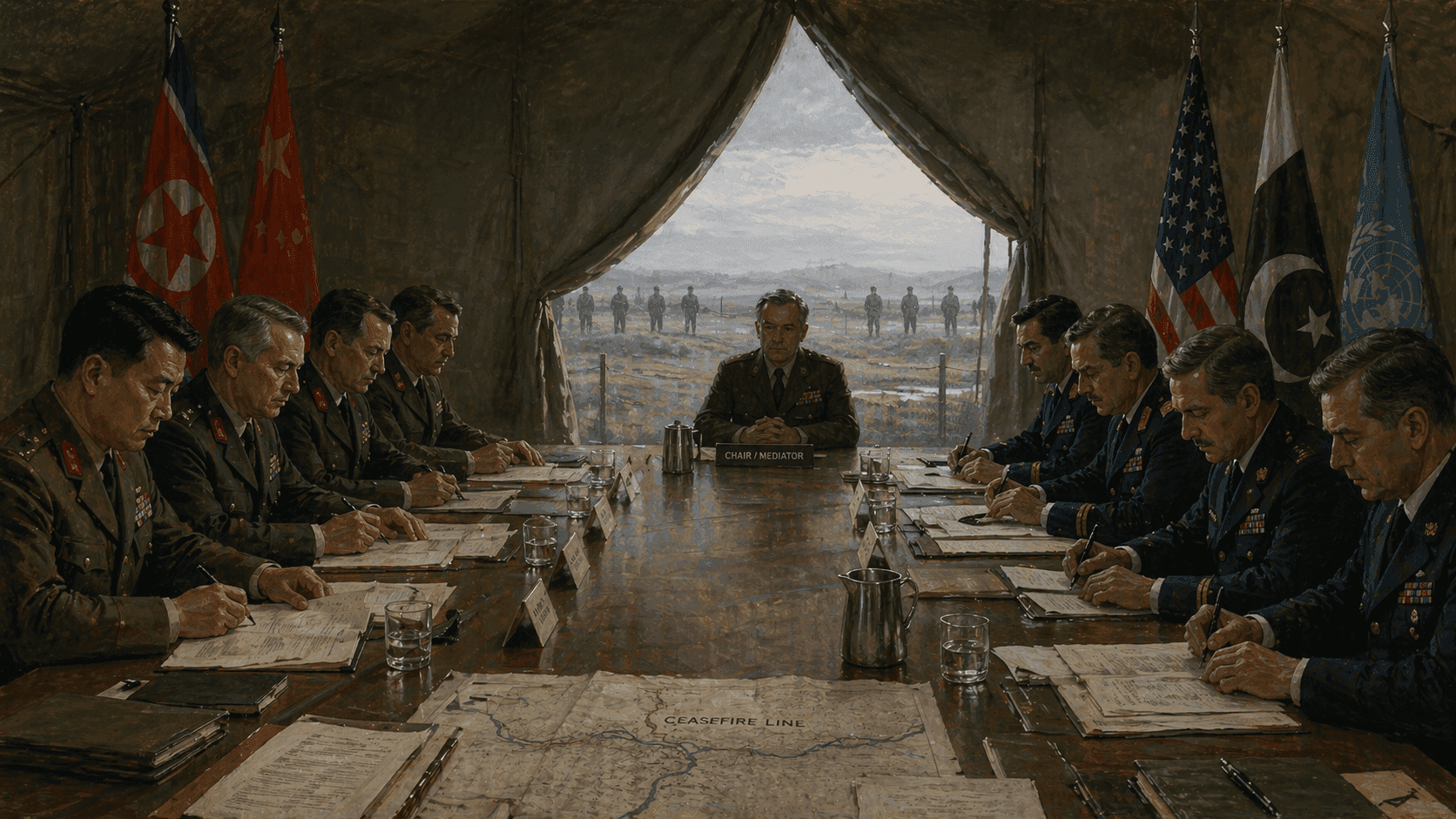
The template for what is happening right now — a ceasefire that stops the killing without resolving the conflict, contested by both sides, maintained through gritted teeth while negotiations drag on — has one great precedent in modern history. On July 10, 1951, military representatives of the United Nations Command and the Korean People's Army sat down in the city of Kaesŏng to begin armistice talks. Both sides expected the negotiations to be swift. They were not. The talks broke off. They resumed. They broke off again. Fighting continued the entire time — fierce, costly, unrelenting — even as negotiators met again and again in a tent at Panmunjom, a village on the 38th parallel that became the most important room in the world. In the end, it took 158 meetings spread over two years and seventeen days to produce the armistice that halted the Korean War on July 27, 1953. The fighting stopped not because either side had won, and not because the underlying disagreements had been resolved — they hadn't — but because the talks, however agonizing, eventually produced a line both sides could live with.
The lesson of Korea — and of other contested, imperfect ceasefires across the arc of history — is that durability rarely arrives cleanly. The Cuban Missile Crisis of 1962 resolved in thirteen days, but only because of secret back-channel concessions that neither side disclosed for decades. The Egypt-Israel ceasefire of 1973, which ended the Yom Kippur War, held despite being repeatedly violated in its first hours. Peace agreements, historians have long observed, seldom look like peace in the moments they are being made. They look like what today looks like: accusations traded across the table, each side claiming the other has already broken the terms, negotiations stalled in a neutral capital, and yet — no resumption of fire. Iran's UN envoy said Tuesday that talks will happen in Islamabad as soon as the naval blockade ends. That is a condition, not a refusal. The door, however narrow, has not been closed.
The U.S.-Iran ceasefire is now in its third week — extended without a fixed endpoint, maintained under conditions that both sides dispute, held together by the kind of fragile diplomatic inertia that historians later identify as the beginning of something rather than the end of nothing. It is not peace. It may not become peace. Tonight is when the original deadline falls, and the hours ahead are uncertain. But the decision to extend rather than escalate — however contested, however qualified — is itself a choice that history recognizes. As the longest armistice negotiation in history ultimately taught the world: peace is rarely announced. Most of the time, it simply keeps not breaking down, one difficult day at a time, until one morning the world wakes up and realizes, with quiet astonishment, that it has held.