November 1: The Ceiling, the Earthquake, the First Tip-Off
November 1: The Ceiling, the Earthquake, the First Tip-Off
Three November 1sts defined by what happens when human ambition meets its moment — a ceiling that redefined painting, a disaster that redefined how the Enlightenment understood God, and a league that started with a gimmick about a tall man and became the world's premier basketball organization
November 1 holds an extraordinary range of human experience — from the sublime to the catastrophic to the simply scrappy and hopeful. On this date across five centuries, a pope pulled back a curtain and showed the world what one man had spent four years painting on his back sixty feet above the floor. A city that had been filled with worshippers on All Saints' Day was consumed by earthquake, tsunami, and fire within hours, producing a disaster so total that it shook the philosophical assumptions of the Enlightenment. And in a hockey arena in Toronto, two basketball teams played a close, physical, relatively low-scoring game before seven thousand fans and a promotional offer involving free tickets for tall people — and the NBA, though it was not yet called that, began. Three November 1sts. Three kinds of human striving.
Look Up
On November 1, 1512, Pope Julius II opened the Sistine Chapel to public viewing and revealed Michelangelo's completed ceiling — 5,000 square feet of fresco depicting nine scenes from Genesis, surrounded by prophets, sibyls, ancestors of Christ, and the celebrated ignudi, the idealized nude figures that frame the central panels. Michelangelo had spent four years painting it — largely alone, on a scaffold of his own design, working in the cramped and physically punishing position of a man painting above his head for hours at a stretch. He had begun the commission reluctantly, considering himself a sculptor rather than a painter, and had argued with Julius repeatedly over delays and funding. What he produced on that ceiling is generally regarded as the supreme achievement of the High Renaissance and one of the greatest single artistic undertakings in human history.
The ceiling's central image — God reaching toward Adam, their fingers nearly touching in the gap between them — has become the most reproduced image in Western art, a composition so simple in concept and so extraordinary in execution that it has been referenced, parodied, and quoted by every subsequent generation. What Michelangelo had done was more than paint a ceiling: he had combined the theological ambitions of Renaissance humanism with the physical realities of human anatomy, rendering the figures with a muscularity and psychological depth that made the biblical narrative feel simultaneously ancient and immediate. Vasari, the first art historian, wrote that the ceiling "made a dumbfounded and stupefied world." It was unveiled on All Saints' Day, which Michelangelo either chose or accepted with characteristic irony — a man who had spent four years arguing with his patron and his own body, offering the result to a holiday dedicated to the perfected.
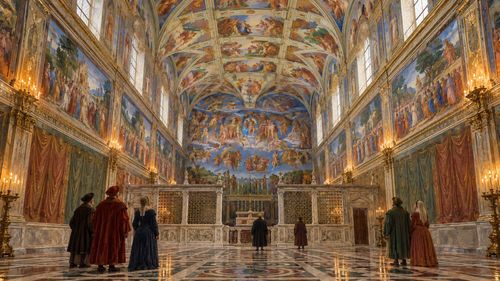
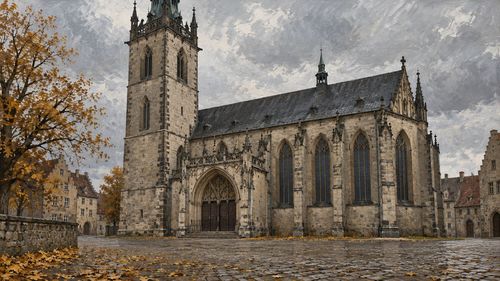
The Sistine Chapel — where on November 1, 1512, the public first looked up and saw what Michelangelo had spent four years creating sixty feet above the floor.
All Saints' Day, 1755
On November 1, 1755, at approximately 9:40 in the morning, an earthquake estimated at magnitude 8.5 to 9.0 struck Lisbon, Portugal — at the moment when most of the devoutly Catholic city's population was in church attending All Saints' Day Mass. The shaking lasted between three and six minutes. Churches collapsed onto their congregations. The royal palace crumbled. The great libraries and archives that had survived centuries of history were crushed in minutes. Those who survived the initial collapse fled to the harbor and the open squares for safety — where they were met by a series of massive tsunamis that swept inland from the Atlantic, some reaching heights of twenty feet, within forty minutes of the first tremor. The fires that followed, ignited by overturned candles and cooking hearths throughout the city, burned for nearly a week. Between 30,000 and 60,000 people died. Approximately 85 percent of Lisbon's buildings were destroyed.
The Lisbon earthquake arrived at precisely the wrong moment for European theodicy — the philosophical project of explaining how a benevolent God could permit natural evil. The disaster struck on a religious holiday, during Mass, in one of the most devoutly Catholic capitals in Europe. Voltaire, who had been working on Candide — his savage satire of the Leibnizian optimism that insisted this was "the best of all possible worlds" — wrote a poem in response to Lisbon that became one of the Enlightenment's most direct challenges to providential thinking. The earthquake did not end religious belief in Europe, but it profoundly complicated the intellectual framework through which educated Europeans understood the relationship between God and human suffering. The Portuguese chief minister, the Marquis of Pombal, responded with what was essentially the world's first modern disaster management program — systematic assessment, organized rebuilding, and the construction of the Pombaline Lower Town on anti-seismic principles that remain visible in Lisbon today.
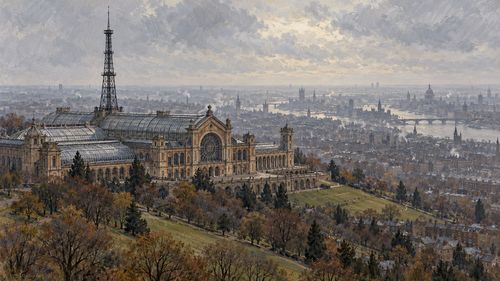
Lisbon as it stood before November 1, 1755 — a magnificent harbor city whose destruction in earthquake, tsunami, and fire that morning challenged the Enlightenment's most comfortable assumptions about the world.
❦
Maple Leaf Gardens, 1946
On November 1, 1946, the New York Knickerbockers defeated the Toronto Huskies 68-66 at Maple Leaf Gardens in Toronto, in the first game in the history of the Basketball Association of America — the league that would, three years later, merge with the National Basketball League to become the NBA. The game was played in a hockey arena, before a crowd of approximately 7,090 fans who had been encouraged to attend in part by a promotional offer that now sounds apocryphal but was entirely real: any fan taller than Toronto center George Nostrand, who stood six feet eight inches, received free admission. The Huskies' management was so uncertain of the league's appeal that they needed height-based gimmicks to fill seats. The game itself was close, physical, and played at a pace that modern fans would find almost unrecognizable — but it was basketball, and it was the beginning.
The Toronto Huskies lasted exactly one season before folding — one of several franchises that did not survive the BAA's early years. The New York Knickerbockers, by contrast, have played continuously from that November evening to the present, making them one of the NBA's oldest franchises. The league they helped inaugurate in 1946 has grown into an organization with thirty teams, a global television presence, and players from more than forty countries. The game in Toronto drew seven thousand fans and offered free admission to tall strangers. The 2023 NBA Finals drew an average of eleven million viewers per game. The distance between those two numbers is a measure of what a sport can become when it finds the players and the audience it was built for — starting, on November 1, 1946, with a 68-66 game in a hockey rink and a promotional gimmick that would not survive the week.
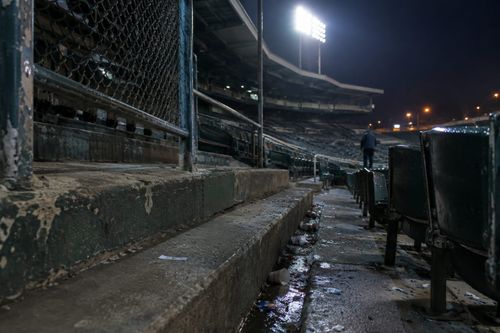
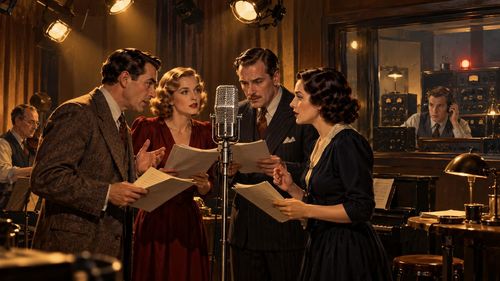
A 1940s arena converted for basketball — the scrappy, intimate setting where the league that became the NBA played its first game before seven thousand fans and a promotional offer involving free tickets for tall people.